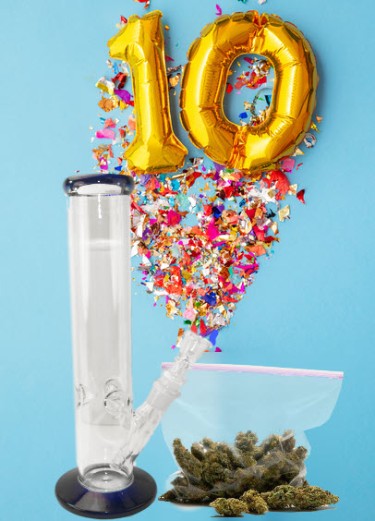
Let’s play a game. I’m going to list a few predictions made by prohibitionists over the past decade, and you tell me which ones came true.
Legal weed will flood emergency rooms with stoned drivers. Legal weed will spike violent crime. Legal weed will hook a new generation of teenagers. Legal weed will turn state highways into a graveyard.
If you’ve been paying attention to actual data instead of press releases from groups like Smart Approaches to Marijuana, you already know the answer. None of it happened. Not the way they said it would, not at the scale they claimed, and in several cases, not at all.
I don’t say this as a cheerleader. I’ve written plenty in this space about cannabis overpromising too, about the industry’s own hype merchants claiming weed cures everything from anxiety to inflammation to your uncle’s bad attitude at Thanksgiving. Advocates oversold the miracle. But statistician Aaron Brown at Reason just published a deep dissection of the specific studies prohibitionists lean on hardest, and walking through it is a useful exercise in figuring out who’s actually been telling the truth for the last ten years.
Last October, the Wall Street Journal ran an editorial titled “More Marijuana Users Are Crash Dummies,” opening with the line: “How much social and public-health damage will Americans suffer before doing a U-turn on marijuana promotion?” Their evidence was a study claiming more than 40 percent of drivers who died in car accidents in one Ohio county over six years tested positive for elevated THC.
Here’s the problem. That study doesn’t exist yet, not as a completed, published paper anyone can actually read. It’s a conference abstract and a press release describing “research in progress.” When Brown’s team tried to reach lead author Akpofure Ekeh at Wright State University to get the underlying data, they couldn’t get him on the phone, and a spokesperson for the American College of Surgeons confirmed there simply isn’t a finished study to review yet.
Even the abstract itself falls apart under basic scrutiny. THC testing after a fatal crash isn’t done randomly, it’s typically ordered when impairment is already suspected, which means the sample is biased from the start. And THC shows up in blood for days after use, so testing positive tells you almost nothing about whether someone was actually impaired at the moment they crashed. There was no control group in the data, so nobody knows if that 40 percent figure is higher or lower than THC prevalence in the general population. None of that stopped the Journal from running a subhead claiming “high-on-pot drivers are contributing to more highway accident deaths” about a study that, as of this writing, still hasn’t been published.
A more legitimate study, from the Insurance Institute for Highway Safety, compared fatal crash rates in five Western states before and after legalization and attributed a 2.3 percent increase to the policy change. That’s a real, peer-reviewed number, and prohibitionists have run with it as proof of catastrophe.
But look at how the data was actually presented. The three-year average traffic death rate rose 9.5 percent in legalization states after the policy change. It also rose 6.5 percent in the control states that never legalized anything. When Brown re-plotted the same data as a continuous time series instead of a before-and-after snapshot, the trend line in legalization states was actually rising more slowly than it had been pre-legalization, while the non-legal states kept climbing. That doesn’t prove legalization reduced traffic deaths. Correlation isn’t causation in either direction. But it does mean the chart prohibitionists point to was constructed in a way that visually exaggerates a modest statistical adjustment into something that looks like a crisis.
This is the one that got the most breathless coverage. A study out of Ontario claimed marijuana-related traffic accidents requiring emergency room treatment rose 475 percent after legalization, and CNN ran with that number in a widely shared 2023 piece.
Here’s what got left out of nearly every headline. During the period studied, 120,569 people showed up in Ontario emergency rooms after traffic accidents. Just 125 of them, one-tenth of one percent, had documented cannabis involvement according to the treating medical team’s own clinical judgment. For every one of those cannabis-involved patients, there were 18 involving alcohol. Of the 125 cannabis cases, 42 percent also involved alcohol.
The raw numbers alone don’t get you to 475 percent. Before legalization, roughly two people a month showed up with documented cannabis involvement. After, it was about six a month. That’s a 200 percent increase on a tiny base, itself worth scrutinizing, but nowhere near 475. The researchers got to that inflated figure by adjusting for pandemic lockdown driving patterns, assuming that if people had been driving as much as usual during COVID, cannabis-related accidents would have been proportionally higher. That’s a statistical assumption stacked on a small sample stacked on a subjective clinical judgment call about who counts as “cannabis involved,” including passengers who weren’t driving at all.
None of this means legalization is risk-free or that heavy use carries zero consequences, especially for developing brains. I’m not interested in swinging the pendulum to the opposite fantasy. What the data consistently shows, across a decade and two dozen states, is an absence of the specific catastrophes prohibitionists promised. Homicide rates in Colorado, Washington, and Oregon stayed below the national average after legalization, and a Reason Foundation analysis covering 1999 through 2022 found both medical and recreational legalization associated with a decrease in homicide rates, not an increase. A 2013 RAND Drug Policy Research Center report found little support for any causal link between marijuana use and violent or property crime.
Teen use, the fear that launched a thousand D.A.R.E. assemblies, has actually declined. The University of Michigan’s Monitoring the Future survey, the gold-standard federally funded study on adolescent substance use, found teen marijuana, alcohol, and nicotine use holding at historic lows for the fifth consecutive year in 2025, with 91 percent of 8th graders, 82 percent of 10th graders, and 66 percent of 12th graders reporting no use of any of the three in the past month. Researchers expected use to rebound after pandemic restrictions lifted. It never did.
This is worth sitting with, because it’s the pattern that keeps repeating across every prohibitionist claim: the alarm gets raised loudest right when the underlying trend is moving in the opposite direction.
Harry Anslinger, who ran the Federal Bureau of Narcotics from 1930 to 1962, wrote that marijuana caused an uncountable number of “murders, suicides, robberies, criminal assaults, holdups, burglaries, and deeds of maniacal insanity.” He needed apocalyptic claims to justify the scale of the drug war he was building. Modern prohibitionist groups need the same thing, just calibrated to a modern audience that won’t buy “reefer madness” anymore. So the claims got more technical: crash rate percentages, emergency room statistics, conference abstracts dressed up as settled science. The rhetorical function is identical. Manufacture a crisis large enough to justify rolling back a policy that a supermajority of the country now supports.
And that supermajority is real and growing. Gallup found 64 percent of Americans believed marijuana should be legal for both medical and recreational use in 2025, up from just 31 percent in 2000. That’s not a country getting fooled by industry marketing. That’s a country that watched the promised catastrophe fail to arrive and adjusted its views accordingly.
Cannabis advocates should take the lesson here too. The industry doesn’t need to inflate its own case any more than prohibitionists need to inflate theirs. The honest version of the story, that legalization didn’t unleash chaos and also didn’t cure society’s ills, is compelling enough on its own. It’s also, as far as I can tell, the actual truth.
Sources: Aaron Brown for Reason, “No, Marijuana Legalization Didn’t Fill Emergency Rooms With Stoned Drivers” (Aug. 28, 2026); Reason Foundation homicide rate analysis, 1999-2022; RAND Drug Policy Research Center (2013); Monitoring the Future survey, University of Michigan Institute for Social Research (2025 results); Gallup polling on marijuana legalization support (2025).
10 YEARS OF LEGAL WEED IN COLORADO, READ THIS…