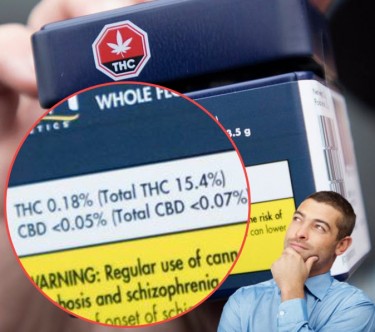
The THC Number Is Lying to You (Sort Of)
I have watched a grown man stand at a dispensary counter, squinting at two jars of flower like he was choosing between vintages of Bordeaux, before picking the one labeled 27% THC because, and I quote, “the number’s bigger.” Reader, I have been that man. Most of us have.
The legal cannabis market has trained an entire generation of shoppers to judge a product by one figure on a sticker. That figure has quietly become shorthand for strength, quality and value all at once. Higher number, better weed, bigger high. Simple.
Except the science keeps saying it isn’t simple at all. The THC percentage is a real measurement of something, but it is a surprisingly poor predictor of the thing you actually care about: how you are going to feel forty minutes from now.
Twice the THC, not twice the high
The latest nudge comes from a meta-analysis by Isabella Goodwin of Australian Catholic University and Amir Englund of King’s College London, published in Neuroscience and Biobehavioral Reviews and republished as an op-ed on Marijuana Moment via The Conversation. They pooled 41 studies covering 1,020 participants who used cannabis less than once a week. Everyone received a known dose of THC, and their reports were compared against a placebo, because simply believing you have taken THC produces a mild high on its own.
The researchers anchored their analysis on a proposed “Standard THC Unit” of 5 mg, the cannabis equivalent of a standard drink. Inhaling one unit raised self-rated “high” by 34 points on a 100-point scale over placebo. Doubling the dose to 10 mg pushed that figure to just 39 points. That is roughly 15% more effect for 100% more drug.
Anxiety, tiredness and alertness did not budge at all between 5 mg and 10 mg. In pharmacology, this is a familiar shape: a steep climb at low doses, then a curve that flattens as each additional milligram buys you less. The authors’ practical takeaway is the old harm-reduction mantra, “start low, go slow,” because the pleasant effects plateau early while the unpleasant ones can keep coming.
Now, intellectual honesty requires me to flag a gap in my own argument. This meta-analysis measured dose, meaning milligrams that actually entered the body. The number on your jar is concentration, meaning the percentage of the flower’s dry weight that is THC. Those are not the same thing. A joint of 25% flower and a joint of 15% flower can deliver an identical dose if you take fewer or shallower puffs of the stronger one. And people do exactly that, often without noticing.
So what happens when you test the percentage itself?
The Colorado experiment
The cleanest real-world answer comes from the University of Colorado Boulder. In a 2020 study in JAMA Psychiatry, Cinnamon Bidwell and colleagues followed 121 regular cannabis users who bought legal products and were randomly assigned to one of four groups: 16% THC flower, 24% THC flower, 70% THC concentrate or 90% THC concentrate. A mobile lab, affectionately nicknamed the “cannavan,” drew blood and tested mood, intoxication, cognition and balance before use, right after, and an hour later.
The concentrate users ended up with dramatically more THC in their blood, more than double the flower users. Yet their self-reported intoxication and their measured impairment were broadly similar. Bidwell summarized it bluntly: potency did not track with intoxication levels. The difference between 16% and 24% flower, the exact kind of difference shoppers pay extra for, did not produce a proportionally bigger high either.
The researchers suspect tolerance and individual biology are doing a lot of the work. These were regular users, and the concentrate crowd likely had built up significant tolerance. That is a limitation of the study, but it is also the point. Who you are matters at least as much as what is in the jar.
The label may not even be true
Here’s where it gets uncomfortable. Before we argue about whether 27% feels stronger than 20%, we should ask whether the 27% is real.
In 2023, Anna Schwabe and Mitchell McGlaughlin of the University of Northern Colorado bought 23 flower samples from 10 dispensaries along Colorado’s Front Range and had them tested by a third-party lab. Their paper in PLOS ONE, aptly titled “Uncomfortably High,” found that about 70% of samples came in more than 15% below their labeled THC. On average, actual THC was about 23% lower than even the lowest figure on the label. Three samples held roughly half of what was advertised.
The incentive behind this is not mysterious. THC percentage drives price, so growers want high numbers and some labs are happy to supply them. Schwabe has said that flower labeled above roughly 28% should be treated with suspicion. A separate analysis cited by NORML found an unusual spike of products in Nevada and Washington reporting just above 20% THC, the kind of statistical bump that suggests numbers are being nudged toward a marketing threshold.
So that 27% jar might be a 19% jar wearing a nicer outfit. You may have spent years calibrating your expectations against a number that was partly fiction.
THC isn’t working alone
Cannabis produces over a hundred cannabinoids and a long list of aromatic compounds called terpenes. The popular theory, nicknamed the “entourage effect,” holds that these compounds shape the experience together rather than THC acting as a solo artist.
I want to be careful here, because the entourage effect is often sold with far more confidence than the evidence supports. Much of it remains unproven in rigorous human trials. But there are real data points.
The strongest one I know of comes from Johns Hopkins. In a 2024 double-blind study in Drug and Alcohol Dependence, Tory Spindle, Ryan Vandrey and colleagues had 20 healthy adults vaporize THC alone, d-limonene alone (a citrus terpene common in cannabis), both together, or a placebo. Adding d-limonene to a 30 mg dose of THC significantly reduced ratings of anxiety and paranoia, and higher limonene doses reduced them further. Crucially, it did not blunt the other effects of THC.
That is a small study, and it does not prove that the terpene profile on a dispensary label will predict your night. What it does show is that identical THC can produce a measurably different experience depending on what rides along with it. Which means two jars printed with the same percentage are not necessarily the same product.
Your endocannabinoid system didn’t read the label
Then there’s you. THC works mainly by activating CB1 receptors, part of the endocannabinoid system that helps regulate mood, stress, sleep, appetite and pain. That system is not identical from one person to the next, and it does not stay constant in the same person over time.
Tolerance is the obvious variable. As Goodwin and Englund explain, repeated THC exposure prompts the brain to temporarily reduce the number of available cannabinoid receptors. You then need more THC for the same effect, which is great news for dispensary revenue and bad news for your wallet.
Genetics plays a role too. The liver enzyme CYP2C9 does most of the work of breaking down THC, and some people carry a less active version. A 2009 study in Clinical Pharmacology & Therapeutics by Sachse-Seeboth and colleagues gave oral THC to 43 volunteers and found that people with two copies of the CYP2C9*3 variant had about three times the THC exposure of people with the common version, along with a trend toward more sedation. Same dose, very different bloodstream.
Add in body composition, recent meals, sleep, mood, setting, expectation and route of use, and the idea that a single percentage can tell you how high you’ll get starts to look a bit like reading a horoscope off a nutrition label.
So what should the number mean?
Right now, there is no standardized measure of cannabis potency in the sense consumers care about, meaning a reliable link between what’s on the package and what happens in your head. Alcohol has standard drinks. Prescription drugs have milligram doses tested in clinical trials. Cannabis flower has a percentage that may be inflated, measures concentration rather than dose, ignores the rest of the plant’s chemistry and says nothing about the person consuming it.
The Standard THC Unit is a promising step, but it only works for products where dose is measurable, like edibles and vapes. For flower, we are still guessing.
My own working rules, for what they are worth:
-
Treat the THC percentage as a rough ceiling, not a promise.
-
Don’t pay a premium for a few extra percentage points. The evidence that 24% feels meaningfully different from 18% is thin.
-
Pay attention to how specific products actually affect you, and write it down if you have to.
-
If you’re new, returning after a break, or trying something unfamiliar, start low and go slow. The research says the good part arrives early, and more mostly buys you trouble.
The bigger truth is that we are still early in understanding how this plant works on the human body. The percentage on the jar is the easiest thing to measure, so it became the thing we market. That doesn’t make it the thing that matters most. Until the science and the regulators catch up, the most accurate potency test available is still the oldest one: your own experience, approached with a little humility.
Sources
Sachse-Seeboth et al., Clin Pharmacol Ther (2009), via DrugBank
DOES HIGHER THC MEAN STRONGER HIGH? READ ON..