Anthropic CEO Dario Amodei warned that artificial intelligence could more than double the unemployment rate within one to five years, during a May 2025 interview.
Now his company, the maker of the chatbot Claude, will sell its shares to the public as soon as around Thanksgiving, according to Fortune. Anthropic officially filed its prospectus, a public S-1 form outlining its business operations and risks for investors on Oct. 26. It plans to list on the Nasdaq under the stock symbol ANT.
It could be one of the largest initial public offerings in global stock market history, with investors valuing the company at $1.5 trillion to $2 trillion, Reuters reported.
As Anthropic’s IPO nears, investors all across the world are deciding whether or not they want to buy the giant company. However, for college students, the question is less about the stock than about the jobs for which they’re training.
“No firing, no hiring”
Marcos Ortega, a professional forecaster for Metaculus, an online forecasting platform, expects the U.S. unemployment rate to reach roughly 8% to 10% within about five years. That’s about double the current 4.2%, according to the Bureau of Labor Statistics.
But he said he doesn’t expect mass layoffs right away. Companies will hold on to experienced employees, he added, because those workers are familiar with workflows and information specific to their business, which AI tools would need time to learn before taking over.
“I think what’s going to happen is there’s going to be a no firing, no hiring type of movement,” Ortega said.
Most of the jobs lost over the next five years will likely come from knowledge work, or jobs done mostly at a computer, he said. Physical robots will improve, Ortega added, but not fast enough to displace many people in physical jobs, like construction and manufacturing.
He said finance and computer science graduates are especially vulnerable to unemployment because their work is easier to validate, and therefore easier to train AI to do. Similarly, Metaculus forecasters expect U.S. employment of financial specialists to fall about 13% between 2025 and 2035.
Most people won’t forecast the exponential growth that AI will have, so the effects will be stronger than they think. He said students should position themselves for a future where a lot of knowledge work is able to be done by AI.
Enjoy what you’re reading? Get content from The Alligator delivered to your inbox
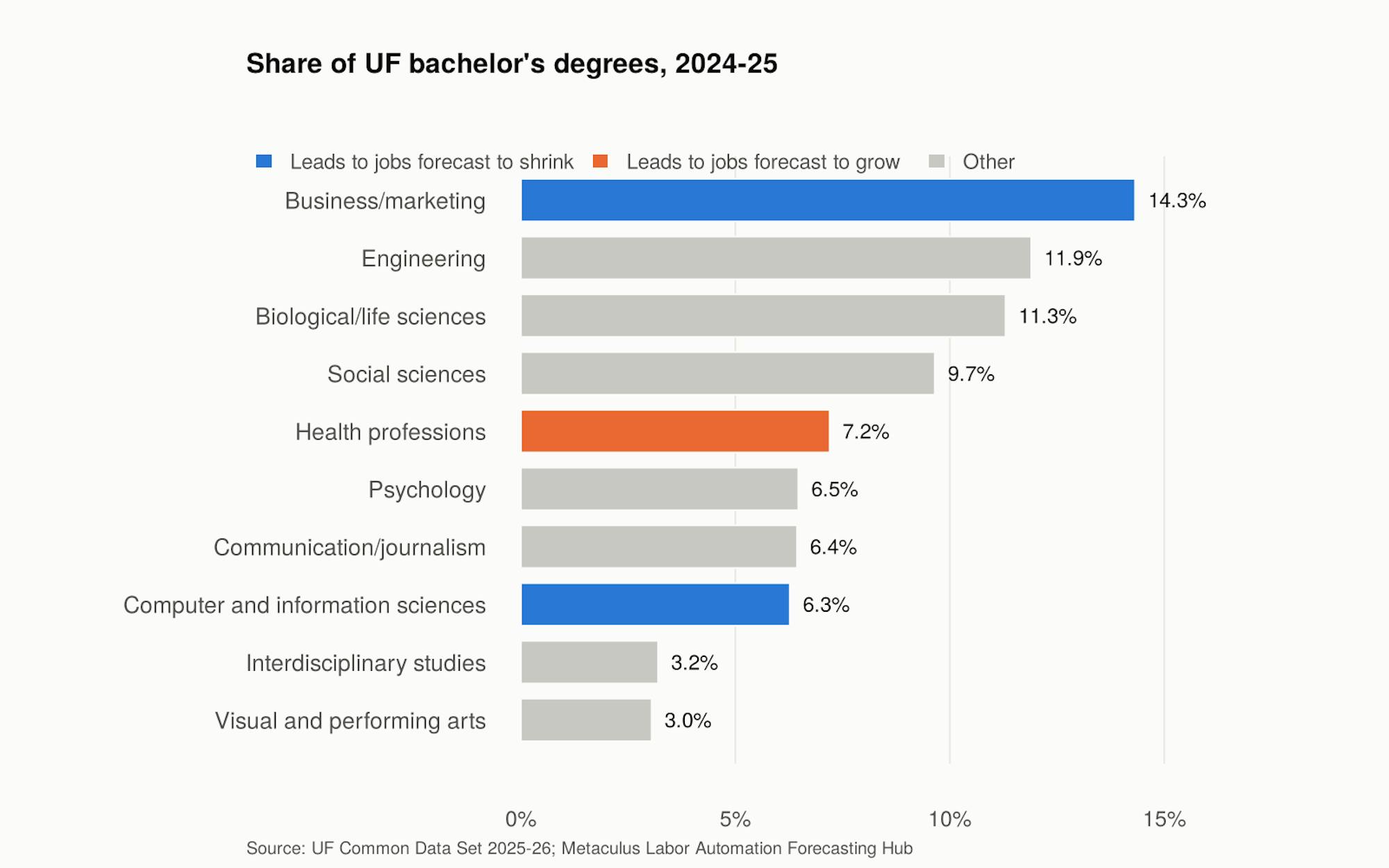
At UF, about 2,100 of the 10,160 bachelor’s degrees awarded in the 2024-25 school year went to business or computer science majors, according to the university’s Common Data Set. Those majors lead to jobs like financial specialist and software developer, which Metaculus forecasters expect to see some of the largest employment declines by 2035. Only about 730 degrees, or 7%, went to health professions majors, which include nursing. Registered nurses are one of the few jobs forecasters expect to grow.
What will always be valued, he said, is quality judgment, intuition and the human side of work, only built through experience from fast-paced jobs, internships and clubs.
Going public won’t speed up Anthropic’s move toward an AI workforce, he said. Instead, it will bring more scrutiny and possible regulations. The bigger question is who will control Anthropic after the public invests in it.
Marco Mari, a research fellow at MIT’s Industrial Performance Center, wrote an Oct. 2 analysis on a Columbia Law School blog addressing this question.
Anthropic’s seven co-founders will hold 50.1% of the votes on major shareholder decisions through a single special share, according to the prospectus, or plan, the company filed. Those rights would begin to phase out only when two or fewer founders remain.
Founder control is common in tech, Mari said, citing that Mark Zuckerberg holds 60.8% of Meta’s voting power.
But at Facebook, Meta’s primary company, the political and social consequences, like the Cambridge Analytica data scandal, came out six years after the company went public, Mari said. With AI, he added, the effects on labor, employment, industrial policy and science are visible before it even hits the market.
“Anthropic, OpenAI, they are highly consequential for our future,” he said.
An independent body called the Long-Term Benefit Trust would fill four of Anthropic’s seven board seats. Its trustees serve one-year terms and elect their own successors, according to Anthropic’s description, and must consult the company’s directors and CEO about new appointments, according to the lawyers who designed it.
That creates a feedback loop between the company and the body meant to check it, Mari wrote in an email.
“The question for prospective investors is how independently the trust would act if its judgment about Anthropic’s mission diverged from that of the company’s leadership,” he wrote.
Once public, a company is expected to stand “completely naked in front of the investors,” disclosing far more about how it makes and spends money, he added.
What past Initial Public Offerings show
Big tech companies have often gone years without profits after going public, and consequently their stocks swung sharply.
Amazon went public in May 1997, selling 3 million shares at $18 each, according to the company, but it didn’t report a profitable quarter until the end of 2001, when it earned $5 million on $1.12 billion in sales, according to its earnings release.
SpaceX raised a record $75 billion when it went public in June, according to Fortune. Its shares sold at $135 each in the IPO then climbed to as high as $201.80 within days, eventually falling below the initial offering price by August, according to market data compiled by Opening Bell Daily.
On Oct. 22, when up to 1.3 billion shares held by early investors became eligible for sale, the stock fell about 9% to $144.75.
“That’s the cost of your business”
New Constructs, an investment research firm, called Anthropic’s offering the “most ridiculous IPO of 2026.” Its model works backward from the price to ask how much profit Anthropic would need to earn to justify it.
To justify a $2 trillion company valuation, the report found Anthropic would need to reach about $3.6 trillion in annual revenue by 2035. This means they would need to grow from about $4.6 billion in 2025, while earning roughly twice the after-tax operating profit Nvidia made over the past year.
Kyle Guske II, a senior investment analyst at New Constructs, compared claims that AI companies would be profitable without certain costs to WeWork, an office-sharing company that promoted a profit measure leaving out major expenses before pulling its 2019 IPO.
“Yes, we’re profitable if you take out the cost of compute,” he said, describing the argument. “Well, that’s the cost of your business.”
When Anthropic arrives on the market, he said, there’s going to be an entire group incentivized to get people to buy and trade it.
Contact Jessie Yang at jyang@alligator.org. Follow her on X @jessie_yang_22.
The Independent Florida Alligator has been independent of the university since 1971, your donation today could help #SaveStudentNewsrooms. Please consider giving today.

Jessie Yang is a sophomore studying statistics. She’s interested in business, technology, and finance, and is a member of the Caimanes Student-Managed Hedge Fund, where she researches companies and develops investment theses. She’s currently exploring a career in investment banking. Outside of The Alligator, she enjoys playing tennis, golfing, and pretending not to struggle on hikes in pretty places.