The warning highlights growing concerns about AI-driven automation across finance, consulting, technology, and legal services, where businesses increasingly rely on intelligent systems to handle tasks previously assigned to junior employees.
AI Advancements Put Entry-Level White-Collar Jobs at Risk
Speaking in a Fox News interview published on May 19, 2026, Amodei described how quickly artificial intelligence capabilities have improved, warning that the technology is approaching a level where it can take on more complex professional responsibilities.
“Two years ago, it was at the level of a smart high school student; now it’s probably at the level of a smart college student and reaching beyond that,” he said.
Anthropic’s data indicates that 75% of businesses are already using AI to automate entire workflows rather than simply assisting employees with routine tasks. Source: @Damir_Akaza/X
The Anthropic CEO identified routine knowledge-based activities, including document summaries, brainstorming, and financial report preparation, as tasks where AI systems are becoming increasingly capable. These responsibilities often form the foundation of entry-level positions, particularly in industries that depend heavily on research, analysis, and document processing.
Amodei warned that AI could initially support employees before taking over a larger share of their responsibilities.
“Things like summarizing a document, brainstorming, putting together a financial report, makes me worry a lot that entry-level jobs in areas like finance, consulting, tech, many, many other areas like that, entry-level white-collar work,” he said.
He added that these positions could eventually be replaced by AI systems as their capabilities improve.
The executive also acknowledged uncertainty surrounding the pace of adoption but warned that significant employment changes could emerge relatively quickly.
“I would not be surprised if somewhere between one and five years, we started to see big effects here,” Amodei said.
He described the potential consequences as a “serious employment crisis” if the traditional pipeline into professional careers begins to contract.
AI Automation Is Moving Beyond Basic Workplace Assistance
The concerns extend beyond individual productivity tools. Businesses are increasingly exploring AI agents capable of executing multiple stages of a workflow with limited human intervention.
Anthropic’s September 2025 Economic Index report offers insight into this transition. The company analyzed its first-party application programming interface (API) traffic and found that 77% of business uses involved automation patterns, compared with approximately 50% of interactions on Claude’s consumer platform.
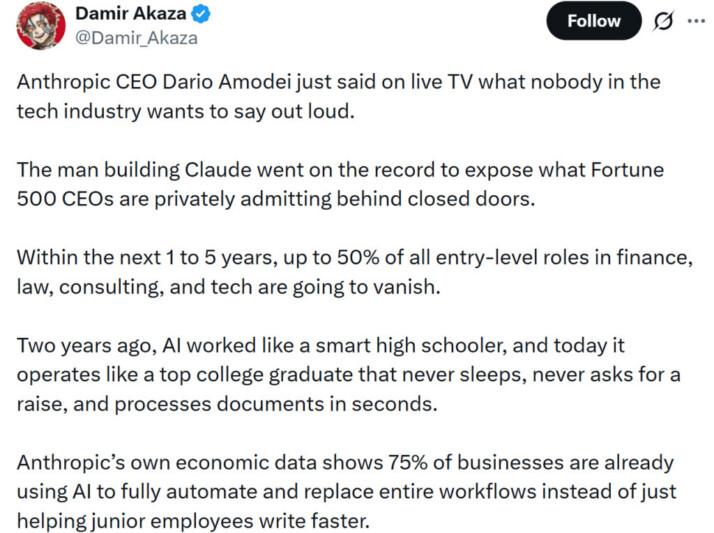
Amodei says AI is advancing toward graduate-level capabilities, accelerating the shift from employee assistance to routine task replacement. Source: Damir Akaza via X
The distinction is important because API-based business applications allow organizations to integrate AI capabilities directly into their existing software and operational systems. Instead of simply asking a chatbot to summarize information, companies can use these integrations to delegate complete tasks.
Anthropic’s findings suggest that businesses are increasingly treating AI as an operational tool rather than relying exclusively on human-AI collaboration.
Its 2026 State of AI Agents report provides further evidence of this shift. A survey of more than 500 technical leaders found that 57% of participating organizations already deployed AI agents for multistage workflows. Meanwhile, 81% planned to pursue more complex AI applications during 2026.
These applications include research, data analysis, report generation, and internal process automation.
Such developments could change how organizations structure their departments. Tasks previously divided among several junior employees may increasingly be handled by automated systems, leaving smaller teams responsible for reviewing results, managing operations and making decisions.
However, automation adoption does not automatically translate into an equivalent number of job cuts. Companies must also account for implementation costs, accuracy, regulatory requirements, and the need for human oversight.
Anthropic’s Own Hiring Patterns Reveal an Early Shift
Anthropic’s internal employment data provides another perspective on how AI adoption could reshape corporate hiring.
In an October 16, 2026 research report titled How Employment Is Changing at Anthropic, the company examined its hiring patterns, workforce composition, productivity, and internal use of AI agents.
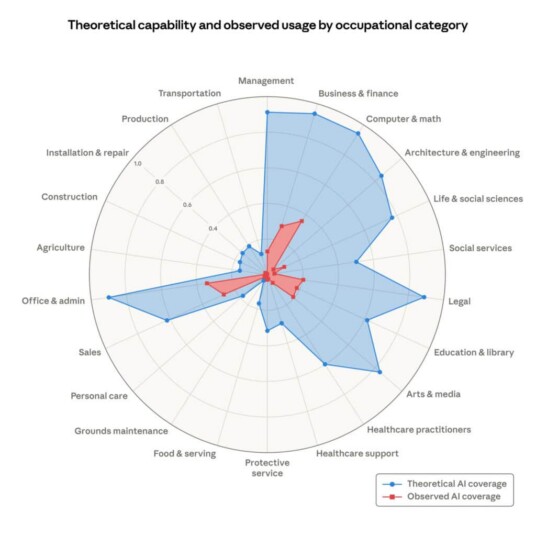
Anthropic’s observed-exposure metric compares AI’s theoretical job-task capabilities with actual usage, showing Claude handles 33% of computer and math tasks despite a potential 94% coverage. Source: @thesupermannx via X
The research found that junior-level employees accounted for 14% of Anthropic’s technical workforce, down from 21% in early 2025. The share of junior employees among new technical hires declined even further, falling from 27% to 9%.
Anthropic attributed part of the change to improved AI capabilities, particularly in software development, where employees increasingly delegate coding and debugging tasks to AI agents.
The research also found that around one-third of machine-learning managers and one-fifth of software-engineering managers reported hiring fewer employees because of AI in an April 2026 survey.
However, the findings do not indicate that Anthropic has stopped expanding its technical workforce. The company’s absolute technical headcount continued growing, while hiring in sales, finance, and recruiting increased at a faster pace.
The report also described changes in the responsibilities of existing employees. Workers increasingly spend time directing AI agents, checking their output, and building tools that help coordinate automated processes.
This development suggests that AI adoption could reshape job requirements even when positions remain available. Employees may increasingly need skills in critical thinking, decision-making, and managing automated systems rather than focusing exclusively on routine technical execution.
AI Job Displacement Remains an Uncertain Outlook
Despite growing automation capabilities, evidence of widespread AI-driven unemployment remains limited.
Anthropic’s March 2026 labor market study introduced an occupational exposure measure combining theoretical AI capabilities with actual usage patterns. It found that computer and mathematical occupations had the potential for AI to accelerate 94% of their tasks, yet observed AI coverage accounted for approximately 33%.
This gap indicates that technical capability does not automatically translate into widespread workplace replacement. Legal requirements, software integration, organizational processes, and human verification can all slow adoption.
Independent research has identified potential pressure on younger workers entering highly exposed occupations.
A Stanford Digital Economy Lab study, revised in August 2026, analyzed payroll information covering millions of US workers through June. It found that employment among workers aged 22 to 25 in AI-exposed occupations was 19% below the level it would have reached if it had followed employment trends among less-exposed peers.
The researchers found that reduced hiring, rather than increased employee separations, accounted for much of the difference. However, they cautioned that the findings represent early indicators rather than definitive evidence that AI caused the employment gap. The study also found no evidence of widespread economy-wide job displacement.
Similarly, the Yale Budget Lab’s October 14, 2026 labor market update found no clear evidence of large-scale employment disruption associated with AI in its analysis of September employment data.
These findings suggest that the immediate challenge may be a slowdown in recruitment opportunities for younger workers rather than mass layoffs across the entire white-collar workforce.
Preparing for an AI-Driven Labor Market
Amodei believes businesses, workers, and governments must begin addressing the employment risks associated with increasingly capable AI systems.
During the Fox News interview, he argued that stopping technological development would be difficult because of international competition, particularly between the United States and China. Instead, he emphasized the importance of preparing workers and measuring the economic consequences of AI adoption.
He also suggested that governments may eventually need to consider policies that help distribute the economic benefits of AI more broadly, including the possibility of taxing AI companies.
For employees, the transition could require adapting to a workplace where AI handles a growing share of routine digital responsibilities. Familiarity with prompting alone may not be enough as businesses adopt autonomous agents capable of performing interconnected tasks.
Understanding how to integrate AI into professional workflows, evaluate its output, and oversee automated processes could become increasingly important across several industries.
Nevertheless, the long-term consequences will depend on how quickly companies deploy these systems, how much human supervision remains necessary, and whether new employment opportunities emerge alongside automation.
Amodei’s warning places the future of entry-level white-collar employment at the center of the AI debate. Whether his projection materializes remains uncertain, but the changing hiring patterns and growing adoption of AI agents indicate that businesses are already reconsidering how professional work gets done.