Civil Unrest & Technological Disruption
Audio playback is not supported on your browser. Please upgrade.
TLDR: We are living through a period of rapid change, causing tremendous fear and concern about economic disruption. Most people think today is unique, but it is not. It’s not even at the top of the list of disruptions over the past 250 years. This newsletter is intended to give you perspective.
Every generation believes the crisis it is experiencing is the worst one. That instinct is human. It is also usually wrong. Many of us wake up to headlines that sound like the republic is ending and the robots are coming for every paycheck.
I scored two centuries of American upheaval on a judgment-based rubric: violence, legitimacy crisis, economic disruption, and distrust for civil unrest; jobs disruption, backlash, fear, and speed/breadth for technology. Each axis runs 0 to 10, total /40.
These are my scores, grounded in the cited data. Argue with the ranking. Do not pretend today sits alone at the summit of American trauma.
Today is not #1. On civil unrest, I put 2025-2026 at #9. On technological disruption, AI and robotics land at #7.
TOP 10 PERIODS OF AMERICAN CIVIL UNREST, POLITICAL VIOLENCE AND ECONOMIC DISRUPTION
Here is how the past 250 years stack up against what we are living through right now, ranked #1 (worst) through #10 (least).
1. Civil War and secession, 1860 to 1865 (score: 40/40). The United States literally split in two. Traditional estimates put military deaths near 620,000; newer scholarship pushes that toward ~750,000. No later American crisis matches this mix of mass death, contested sovereignty, and economic ruin.
2. American Revolution, 1775 to 1783 (score: 38/40). This was an armed overthrow of imperial rule and, at the same time, a civil war between Patriots and Loyalists. Families fractured. Property was seized. The outcome was a new republic, but the cost was paid in blood and exile before any Constitution existed.
3. Reconstruction, 1865 to 1877 (score: 35/40). After Appomattox came white-supremacist terrorism, military administration of the South, contested governments, and the violent suppression of Black voting. The U.S. Army’s task was to hold a barely reunited country together while emancipation’s political settlement was rewritten by force.
4. Civil rights, Vietnam and Watergate, 1963 to 1974 (score: 34/40). Assassinations of JFK, MLK, and RFK. Urban riots. A grinding antiwar conflict. A presidential resignation. Public trust in the federal government, which had been the postwar norm, collapsed into the low-trust era that Pew’s long series still documents today.
5. Great Depression, 1929 to 1941 (score: 33/40). Banking collapse. The deepest economic downturn in modern U.S. history. Soup lines, dust bowls, and a generation that learned scarcity as a default. The political system bent; it did not break. Hold that distinction when people talk about “collapse” in 2026.
6. Pandemic, racial-justice unrest, and election crisis, 2020 to 2021 (score: 32/40). U.S. unemployment hit 14.8% in April 2020. Cities burned. The January 6 Capitol attack marked a legitimacy shock that still shapes American politics. On my rubric this period outranks today on violence and economic disruption, even if the memory feels fresher.
7. Red Summer and Red Scare, 1917 to 1921 (score: 30/40). Racial massacres, anarchist bombings, labor conflict, and government repression stacked into a few brutal years. Returning World War I veterans walked into cities already primed for violence. The “Red” label covered communist panic and blood in the streets.
8. Gilded Age labor wars, 1877 to 1894 (score: 28/40). Panics and violent strikes defined the industrializing republic. The Pullman Strike of 1894 crippled national rail traffic and brought federal troops into the fight. Workers and capital were not debating memes. They were fighting over the shape of the American economy.
9. TODAY, 2025 to 2026 (score: 27/40). My breakdown: distrust 10, legitimacy 8, violence 5, economy 4. Pew (Sept 2025): only 17% trust the federal government to do what is right just about always or most of the time. Gallup (June 2026): average institutional confidence 27%, near the all-time low. High-profile political violence (Minnesota legislator shootings, June 2025; Charlie Kirk assassination, Sept 2025) shocked the country. Yet Princeton’s Bridging Divides Initiative rates 2025 political violence below 2020-21 peaks; of ~20,000 demonstrations in 2025 (including “No Kings”), only 0.5% were violent or destructive. October 2026 unemployment: 4.1%. Fear is real. Civil-war-level trauma is not.
10. Financial crisis and backlash, 2007 to 2012 (score: 26/40). Foreclosures, bailouts, and an anti-elite backlash that seeded Occupy and the Tea Party. Unemployment peaked at 10% in October 2009. The system held. The anger did not vanish; it relocated into the politics of the next decade.
TOP 10 PERIODS OF TECHNOLOGICAL DISRUPTION AND WHAT WE’RE LIVING THROUGH TODAY
Now the other ledger. Same /40 scale. Different axes: jobs and economic disruption, backlash, fear, and speed/breadth.
1. Railroads and national industrial networks, ~1850 to 1894 (score: 35/40). Rail overinvestment helped trigger the Panic of 1873. National rail strikes followed, and troops followed the strikes. A single technology rewired markets, timekeeping, warfare logistics, and labor conflict in one generation.
2. Textile mills and the factory system, ~1820 to 1860 (score: 34/40). Work moved out of homes and into controlled mills. The Lowell strike of about 800 workers in 1834 signaled that industrial discipline would meet organized resistance. For the people inside, the mill was not a metaphor.
3. Farm mechanization, ~1900 to 1970 (score: 32/40). Agriculture’s share of the U.S. workforce fell from 41% in 1900 to 4% in 1970. Technology was a major cause, though not the only one. Entire rural cultures remade themselves around fewer hands and more machines.
4. Electrification and the assembly line, ~1900 to 1950 (score: 31/40). Factories reorganized around continuous power and synchronized labor. Ford’s plants became a center of labor conflict as well as productivity legend. The modern industrial job was invented here, and so was the modern industrial strike.
5. Computers and industrial robots, ~1980 to 2010 (score: 30/40). An MIT estimate found roughly 3.3 fewer U.S. jobs for each added industrial robot. The spreadsheet and the robot arm quietly ate tasks that previous generations assumed were permanent.
6. Nuclear age, ~1945 to 1986 (score: 29/40). Existential fear at civilization scale. Fallout shelters. Duck-and-cover drills in elementary schools. For decades, children practiced dying. That is a different category of technological dread than a chatbot taking your draft email.
7. TODAY: AI and robotics, 2025 to 2026 (score: 28/40). My breakdown: adoption 10, fear 8, backlash 6, job disruption 4. Pew’s June 2026 survey found 52% of Americans more concerned than excited about AI, and 71% expect fewer U.S. jobs over the next 20 years. Employers cited AI in 121,401 announced job cuts through October 2026 (Challenger, Gray & Christmas; employer-stated reason, not a measured net loss). ChatGPT hit 900 million weekly users by February 2026. Figure’s humanoids logged 1,250+ operating hours at BMW Spartanburg. In Q2 2025, about 20 data-center projects (~$98 billion) were blocked or delayed by local opposition. Adoption is historic. Measured job destruction, so far, is not matching the nightmare script.
8. Automobile takeover, ~1900 to 1930 (score: 27/40). Cars remade cities, suburbs, courtship, crime, and death. Pedestrian fatalities sparked protests as the street stopped belonging to people on foot. An entire built environment was rewritten around an engine.
9. Smartphones and social media, ~2007 to 2025 (score: 26/40). Always-on attention markets. A 2025 Pew survey found 48% of teens saying social media mostly harms their peers. The device in your pocket changed adolescence, elections, and sleep.
10. Postwar automation scare, ~1950 to 1966 (score: 25/40). Fear of machines replacing workers was loud enough that LBJ created the National Commission on Technology, Automation and Economic Progress in 1964. Panic about automation is a recurring American genre, not a 2026 invention.
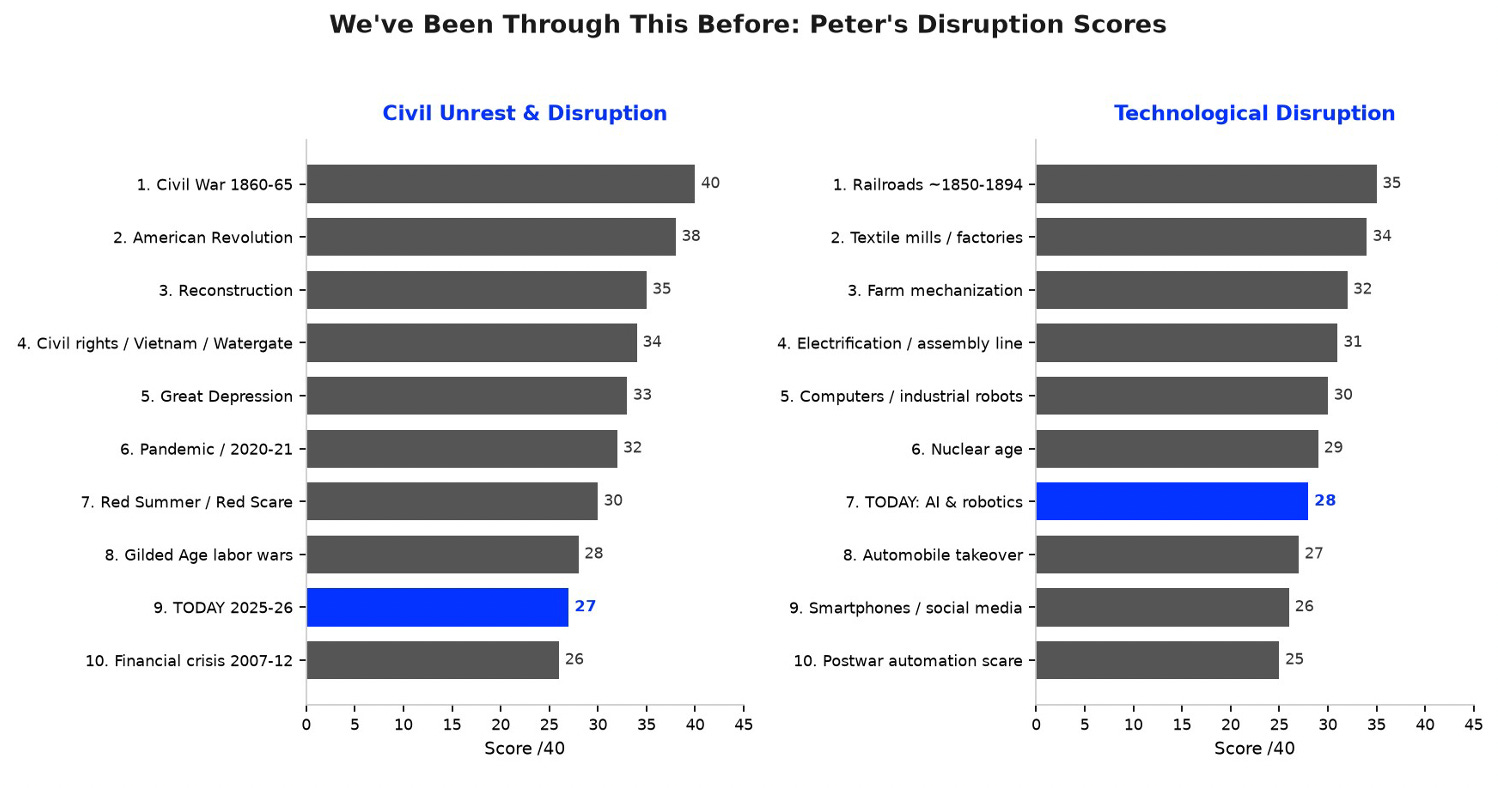
Figure: Peter’s disruption scores for civil unrest (left) and technological change (right). Blue bars mark TODAY. Judgment-based scoring /40 from cited sources; not a formal index.
We have survived secession, world wars adjacent to home fronts, nuclear dread, and 14.8% unemployment. Your feed is not the full ledger.
HISTORY’S LESSON – WHAT MATTERS
Plenty of people fear what we are living through. I take that fear seriously. Political violence is too high. Institutional trust is too low. AI will rearrange work, education, and power. Conceding the risk in one line is easy because the risk is real.
In context, it is not so bad. On my civil-unrest ranking, today is #9 of 10. On technological disruption, AI and robotics are #7. That is disruptive. It is not Appomattox, not 1933, not duck-and-cover, and not April 2020.
Remember history and the lessons it keeps teaching. Every major technology wave produced backlash, fear, and job churn, then higher living standards for people who adapted. Abundance is a choice about how we build through disruption, not a guarantee that disruption will be gentle. You get to decide which side of that choice you fund, hire for, and teach your kids.
The fork in front of you is simple: treat 2025-2026 as the end of the American story, or as another hard chapter you are equipped to navigate.
WHAT THIS MEANS FOR YOU
If you’re an entrepreneur: Build for the adaptation layer. The winners of past tech waves sold tools, training, and new markets to the people being disrupted, not nostalgia for the old equilibrium.
If you’re an executive: Measure AI by output and redeployment, not by press-release headcount. Challenger’s AI-cited cuts are announcements; your advantage is converting tools into retained talent doing higher-leverage work.
If you’re an investor: Price fear separately from damage. High concern (Pew’s 52%/71%) and low measured labor-market collapse (4.1% unemployment) can coexist for years. That gap is where mispriced assets live.
If you’re a student: Treat AI fluency as literacy, the way prior generations treated electricity, cars, and spreadsheets. The scare is old; the specific tools are new. Learn them while they are still optional.
If you’re a parent: Give your kids historical range, not doom. Show them that Americans have walked through worse winters and still built the next spring. Then make sure they can use the tools reshaping their future.
To a future of abundance,
Peter