When Shannon Kane recounts giving a low grade to an aspiring teacher for turning in a lesson plan crafted by artificial intelligence, the other students in the professor’s class naturally assume the problem was cheating.
But to Kane, the biggest issue wasn’t that this student used AI.
It was that she used it poorly.
Explore the Survey Results
“It sucked as a lesson plan,” recalled Kane, an assistant clinical professor of literacy at the University of Maryland.
The anecdote illustrates challenges teacher education programs confront as they prepare novice educators for an AI-infused world, said Kane, who worked on an AI framework the American Association of Colleges of Teacher Education released earlier this year
Ideally, she’d like her students to hone their instructional skills and develop their “own authentic teacher voice” before outsourcing tasks to the technology, Kane said.
But realistically, she knows they’ll enter a workforce where more than half of teachers use AI for parts of their jobs.
“The tools are already there for everyone to use, with or without the critical dispositions and understandings to use them well,” Kane said. “We can’t decide for [teacher] candidates whether they’ll use the tools. But we can make sure that if candidates opt to use the tools, they are prepared to judge what the tools give them.”
Many of Kane’s colleagues appear to be coming to similar conclusions, according to a national survey by the EdWeek Research Center of 268 teacher educators conducted in August and September.
More than half said their programs prepare aspiring teachers to use AI to generate teaching and instructional ideas for K-12 classrooms or to develop and revise assignments.
And nearly two-thirds reported their programs prepare prospective teachers to teach digital and AI literacy skills to K-12 students.
But the survey and more than a dozen experts interviewed by Education Week also revealed serious hurdles programs face as they navigate AI challenges.
It will be years before there’s high-quality research on whether and how AI tools can improve student learning, much less studies gauging the tech’s role in new teacher development.
It’s also unclear whether leaders of the K-12 school districts where candidates wind up teaching will prize AI skills. Districts are all over the map in how to approach AI. Some ban it. Some embrace it. Some fall in between.
Compounding the problem: Teacher preparation has long struggled—and in some cases, neglected—figuring out how to effectively prepare aspiring teachers to integrate technology into instruction. More than half of new teachers—56 percent—lack confidence in using technology when they enter the classroom for the first time, according to a 2023 report by the International Society for Transforming Education (ISTE).
Education professors have significant autonomy on decisions to integrate AI into their courses
There’s debate about whether—and how much—AI should be part of teacher-prep programs at all.
About a third of teacher educators surveyed by the EdWeek Research Center said their programs struggle to prepare prospective teachers to use AI because the faculty or instructors don’t support it.
And nearly a quarter said the prospective teachers who attend their programs don’t want such preparation.
Aspiring teachers—and current ones seeking further credentials—won’t find the technology particularly useful until they have a deeper understanding of teaching and learning, said Justin Reich, the executive director of MIT’s Teaching Systems Lab.
“Anybody can make these things spit stuff out,” Reich said of AI tools. But “sometimes what they spit out is good and sometimes what they spit out is useless.”
The only way to tell the difference is “domain knowledge,” Reich added. “We have very little time in teacher education programs, and the vast majority of that time should be spent helping teachers develop insights from the science of learning and the science of instruction.”
But Jennifer Kidd, a master lecturer in the Department of Teaching & Learning at Old Dominion University in Norfolk, Va., believes that now that AI is used widely in education and society, “it’s important for teachers to understand what it is, how it works, and the different ways that it can impact learning.”
Kidd, for example, asks her Old Dominion education students to write their own multiple-choice items for classroom tests and then have AI craft questions on the same topic. Their classmates are then asked to guess which is which and pick favorites. Kidd also has students use AI as a thinking partner to develop an image that represents their teaching philosophy.
Most teacher-prep programs don’t offer a stand-alone course on AI for either current or aspiring teachers, the EdWeek Research Center survey found. Instead, 60% of faculty members reported individual instructors decide whether to include an AI focus in their courses.
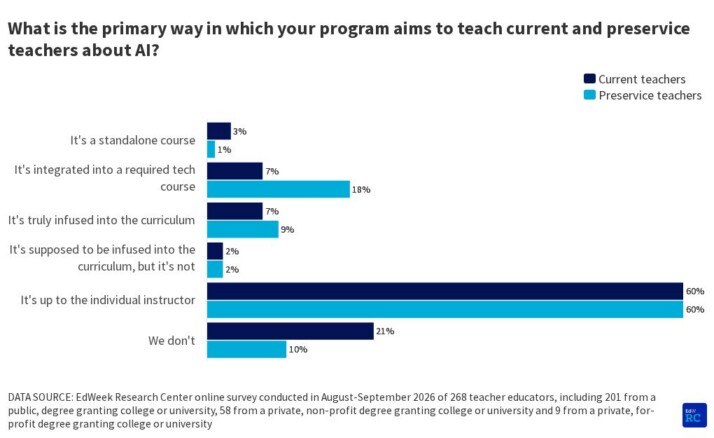
Part of the reason, experts say: College faculty typically have more say than most K-12 teachers over what they teach. If they don’t want to focus on AI as part of their courses, they likely don’t have to.
“Every faculty member gets to set their own agenda for how they’re integrating or not integrating AI,” Kidd said of the Old Dominion program. “It’s not mandated [as part of the program] right now.”
One big challenge for integrating AI into courses is that teacher-prep programs must cover certain material to meet state and national accreditation standards. That leaves little room for AI. In fact, nearly a third of respondents to the survey said their programs have found it challenging to offer AI instruction because other priorities take precedence.
Leaders in Kane’s program at the University of Maryland want to see clear expectations for AI instruction across the program. But making that a reality takes time.
“The only thing slower than K-12 education is higher ed,” Kane joked.
It’s hard for teacher training to keep pace with AI advances
The most common challenge to teaching prospective and current teachers about AI identified in the survey was AI’s rapid development. Fifty-seven percent of respondents identified that as a hurdle for teaching prospective teachers and 56 percent said the same for current teachers.
Kidd teaches an AI literacy course open to all Old Dominion students—not just education majors—and she’s found herself revamping the material every semester.
“It’s really hard to keep up,” Kidd said. “What other course needs to be tweaked every single semester because things are changing” so fast?
That rapid pace of technological change also presents problems for faculty professional development.
Education professors at the University of North Carolina at Charlotte recalled recently learning to use Google’s Gemini to create a “Gem,” or personalized chatbot, only to realize the tech is about to sunset. (Fortunately, a faculty member at the training session was familiar with the successor feature, called “Skills.”)
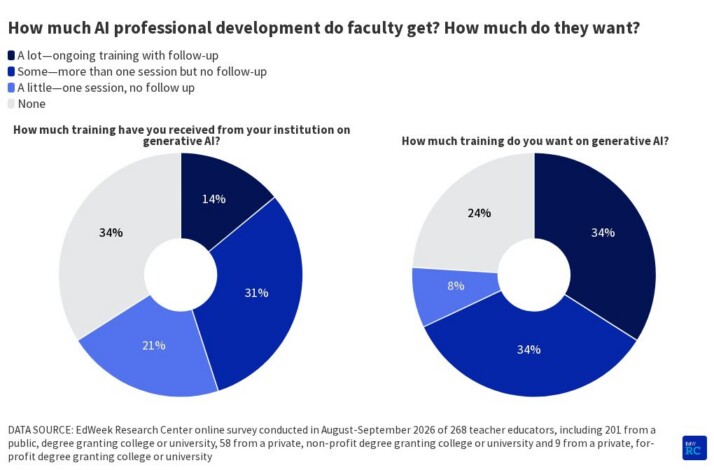
Education school faculty nationwide also don’t typically have the skills to integrate AI into instruction. In fact, faculty generally want more AI professional development than they are getting, the survey found.
About a third of respondents said they had received no training at all on AI, while roughly half said they had a single session or a few sessions, without follow-up. Fourteen percent reported receiving ongoing professional development.
But 68% said they wanted ongoing training or at least multiple professional development sessions on AI.
Resistance to AI use puts education schools in a tricky spot
Another quarter, however, didn’t want any training.
That resistance is why many education schools make faculty professional development on AI entirely optional.
For instance, the University of North Carolina at Charlotte has a “community of practice” for education faculty interested in learning more about the technology. Professors get their own grounding in AI and then can use lessons or activities that help future teachers understand the technology.
That training helped Holly Niedermeyer refine an activity for her special education class geared towards general educators. She directed students to develop an activity for a class of fictional kids with an array of learning needs, including English learners, an intellectually gifted student, and a student with a history of behavior problems.
Students could use either an AI tool or a peer as a thinking partner to gauge whether their activity or lesson worked for each of these different students.
Those who used AI were then told to reflect on the process: “How did AI help you or not? What did it know and could support? What did it not know?” Niedermeyer said. (Students that did not use AI did a similar exercise.)
The university’s AI professional development group is open to education professors with a range of experience—and even significant concerns—about the role of AI.
“We don’t want to force faculty or students to use AI,” said Tracy Rock, a professor of reading and early education. “When we started this community practice, we made sure that everyone knows that this was a space where we could be critical. We’re not just AI cheerleaders here.”
At the same time, Rock hopes early AI users—such as Niedermeyer—can help skeptics consider how the tech might be used thoughtfully, without replacing the critical thinking teachers and teacher-candidates need to engage in.
Old Dominion and George Mason University in Fairfax, Va., offer similar, optional professional learning groups. And instructors at Ball State University in Muncie, Ind., had the opportunity to receive AI training designed by ISTE.
K-12 AI policy is all over the map, complicating university-district partnerships
For now, about half of faculty report they are partnering in some way with school districts on the role of AI in teaching and learning, the EdWeek Research Center survey found.
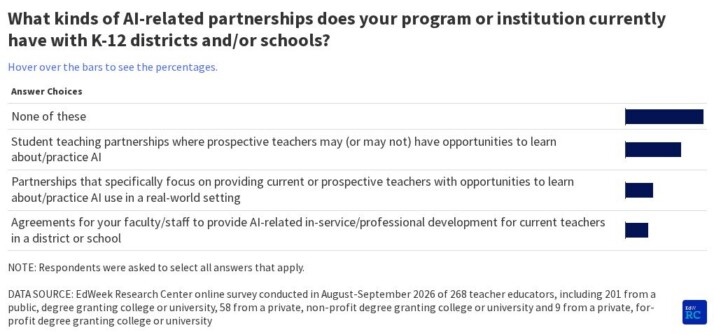
One complicating factor: Districts—even neighboring ones—may have radically different AI policies, faculty said.
The University of North Carolina at Charlotte, for example, supports “12 different school districts, with 12 different superintendents, and they are approaching it 12 different ways,” said Tisha Greene, the associate dean for undergraduate education and teacher preparation in the university’s college of education.
She recalled attempting to demonstrate an AI tool during a professional development session for a local district, only to find the platform was blocked on both the district’s network and on educators’ work-issued laptops.
Still, most superintendents tell Greene they want teachers and principals to learn more about AI, so they have a better understanding of how students might be using it.
But “whether or not their district is allowing use of [the tech] in the schools varies greatly,” she added.
For her part, Melanie Huss, the assistant superintendent of academics for the Lincoln County schools in North Carolina, which hires the university’s graduates, is grateful that the program isn’t trying to “pretend through the preservice work that AI is not going to be part of [future teachers’] lives as educators,” she said. “That cat is out of the bag, and that train has left the station.”
Still, Huss wants aspiring teachers to spend most of their time on the building blocks of instruction—not on playing around with the latest AI tools.
“We don’t want practitioners to learn how to create a lesson plan using AI,” Huss said. “We want them to learn how to create a lesson plan,” or instructional materials, on their own.
“That way,” she added, “when they use AI, they use it with a critical lens. They’re able to evaluate. They’re able to see where the gaps are.”
That’s the kind of thinking Kane, the University of Maryland professor, ultimately encouraged for the student who turned in that clunker of an AI-written lesson plan.
“I gave her a ton of feedback,” explaining why the lesson wouldn’t work, Kane said. The student was more thoughtful in creating plans and instructional materials going forward.“She was so reflective.”