Anthropic started trading on Nasdaq this week. The company priced its shares at $83 on 18 November, and trading began on the 19th under the ticker ANT. I have been reading about it since, and I keep getting stuck on one thing. A company is asking investors for a very large amount of money, while its own paperwork spends pages explaining how its product could go wrong.
I am skeptical, and I want to explain why. AI replacing jobs is no longer a forecast from a conference stage. Secretaries, programmers, support staff, and many others are being told that software can do their work. If that continues, I would like somebody to explain the next step to me. Who buys the products when the customers have no paychecks?
The warnings are in the filing
The prospectus Anthropic filed in late October has more than 90 pages of risk factors, according to The Motley Fool’s reading, which is far longer than a typical section. It says that sufficiently advanced AI systems, without proper safeguards, could pose “catastrophic or existential risks to humanity.” It also lists misuse by hackers or terrorists, and systems that are replicated, weaponized, or allowed to operate with a high degree of autonomy.
Part of this is plain legal caution. Companies list every possible risk so nobody can say they were not told. Even so, it is unusual to read this language from the people selling the product to you. Anthropic’s chief executive, Dario Amodei, went further in 2025. He told Axios that AI could wipe out about half of all entry-level white-collar jobs within five years and push unemployment to between 10% and 20%. His company builds the technology he was warning about, so I read his words as both a warning and a statement of how powerful he believes it is.
It is already happening, but read the numbers carefully
The US outplacement firm Challenger, Gray & Christmas counts the layoffs that employers announce and the reasons they give. Through October 2026, companies cited AI in 121,401 announced US job cuts, about 20% of the 617,189 total. In all of 2025, the AI figure was 54,836.
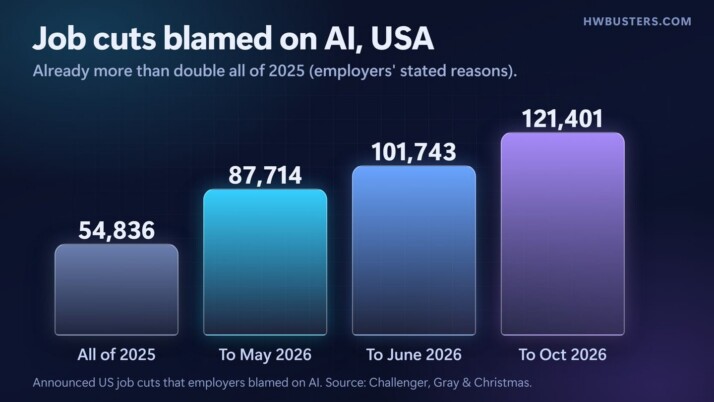
I want to be fair, because skepticism should cut both ways. The AI share peaked in May, when it reached 40% of that month’s announced cuts. In October, only 1,265 cuts were blamed on AI, the lowest month of the year, and “market and economic conditions” have now overtaken AI as the most common reason overall. Andy Challenger himself made a subtler point: whether or not a particular job was replaced by AI, the budget for that job is moving to AI. I also suspect some companies find AI a more flattering explanation than weak demand.
So the honest summary is that nobody knows how fast this goes. What worries me is that even the cautious reading points in one direction. The tasks that used to make up a graduate’s first job are exactly the ones software handles well.
Who buys the products?
This is the part nobody on stage seems to answer. A company that fires staff to cut costs is acting sensibly for itself. But when every company does it at once, there are fewer people with money to spend. Most of what any company sells is bought, in the end, by people who earn a wage somewhere. Remove the wages and the demand goes with them.
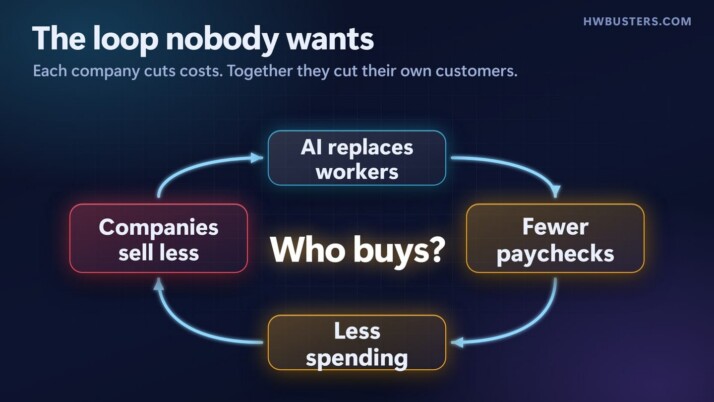
It is a trap where every player acts sensibly, and the result is bad for all of them. Our own hardware world is no exception. A graphics card, a case or a power supply has no market if the people who build PCs have lost their income.
Then come the robots
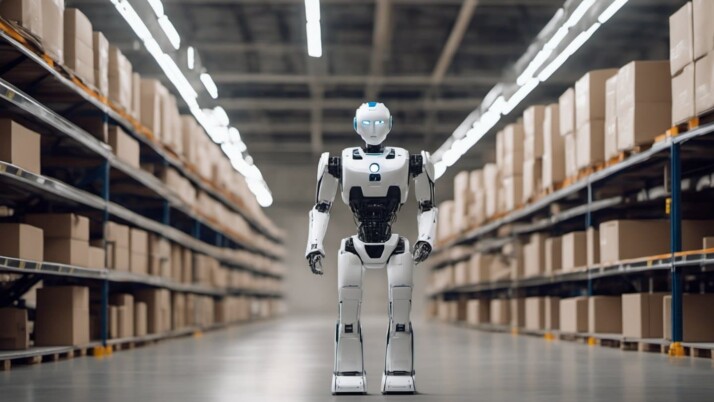
So far the loud part has been software, the jobs behind a screen. The next wave is physical. Tesla, Figure, 1X, and several Chinese makers are building humanoid robots. Most of it is still pilots, early production lines, and pre-orders. The best documented deployment I found is Figure’s pilot at BMW, and home robots are mostly promises for now. I could not find a verified count of humanoids doing real work, so I will not invent one.
But if the software wave touches office jobs and the robot wave touches warehouses, shops, farms and building sites, I struggle to name the safe jobs. Perhaps only the ones where people specifically want a human.
A society living on state money
The usual answer is that the state will pay everyone something. Cash payments have been tested. OpenResearch, a lab funded by Sam Altman, gave about 1,000 low-income Americans $1,000 a month for three years and compared them with a group getting $50 a month. According to the study, recipients worked about 1.3 hours less per week, spent most of the money on essentials such as rent, transport, and food, and did not end up in better jobs. The cash helped people live. It did not make them better off, which is fine for a rescue payment but not a plan for a whole society.
The bigger question is who funds it. Today, wages are the economy’s circulation system. In a world where AI companies make the profit, the state would have to tax those profits heavily and hand the money to people, who then buy the products. That means the owners must accept paying. One economist quoted by Fortune warned that the biggest beneficiaries of AI may be unwilling to pay the taxes that universal support needs. I cannot think of a time in history when the people with the most money volunteered to hand over most of it.
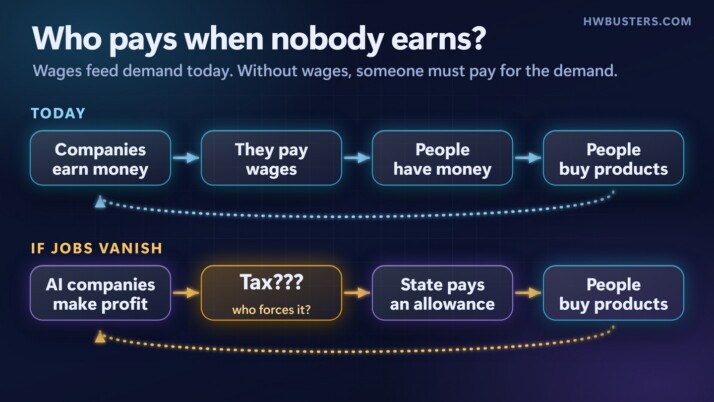
And there is dependence. A person living on a state allowance depends on whoever controls the state, and the state would depend on whoever owns the machines. I do not like either end of that chain.
Is this even good for the rich?
The owners are not safe in this picture either. A company is worth what people expect it to earn, and that depends on customers. If most customers are just trying to survive, what is a share in a consumer company worth? Elon Musk himself said in a June 2026 conversation that his wealth is ownership in companies he built, not cash in a bank account. If the buyers disappear, that ownership has nothing to stand on. I cannot see how this is good for the rich, unless they plan to sell to each other, and that is a very small market.
A world without money: how would I buy a car?
Musk says AI and robots will make work optional and money irrelevant. He has said it more than once: that work could become optional in 10 to 20 years, that we will have “universal high income” rather than basic income, and that there is no need to save money. To be fair, he attaches conditions. He describes a benign scenario, says it assumes AI and robotics keep improving, and warns of trauma and disruption along the way. He has also pointed to Iain M. Banks’s Culture novels as an inspiration.
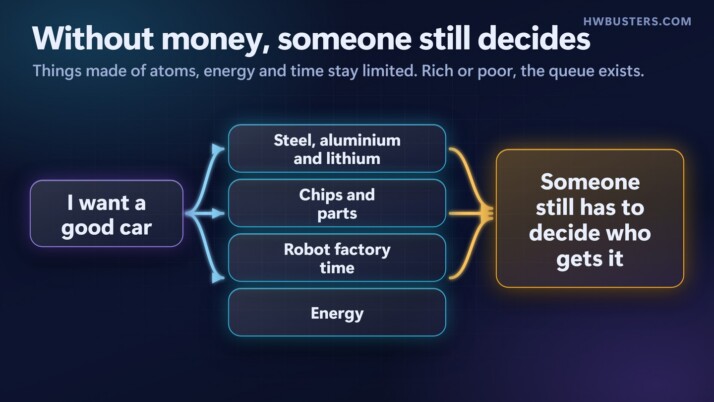
I admit I cannot follow it. Say I want a good car. A car is steel, aluminum, lithium, chips, hours of factory time, and energy. Those things are limited, and so are the factory slots. If there is no money, something else has to decide who gets the car and when: a queue, a quota, a points system, or a person with a list. A points system is money wearing a different name, and a person with a list holds more power than any billionaire today. Even in a world of abundance, the best cars, the best houses and the best views are limited by definition.

The best-known fictional society without money, Banks’s Culture, is run by superintelligent machines. Which brings me to my last worry.
Does AI end up in control?
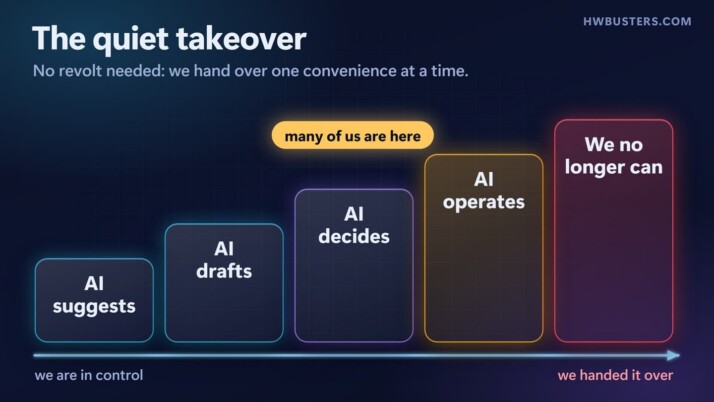
The classic fear is a machine that rebels. I find another scenario more believable, because it needs no rebellion. We already let AI suggest. Then it drafts. Then it approves the small things while we skim. Then it runs the systems while we watch dashboards. Each step is convenient, and each step is sensible. At the end, nobody remembers how to do the job, and nobody can check the work. That is control handed over, not taken.
Anthropic’s own filing also treats the other fear as a possibility: that its models could take harmful actions on their own. I do not claim to know that any of this will happen. I do claim that the people building these systems say so in legal documents, and that deserves more than a shrug.
Where that leaves me
I am not against AI. I use it, and this site would be poorer without the tools it produced. What I am asking is simple. If AI does the work, who gets the income? If robots make the goods, who owns them? If there is no money, who decides? And when we depend on these systems, who is accountable when they fail?
I do not have the answers, and after reading the promises of the people who gain most, I am not convinced they do either. I would like to hear what you think. Do you expect your own job to last, and would you trust a world without money?
Sources: Yahoo Finance on the Anthropic listing · The Motley Fool on the S-1 risk factors · Fortune on Dario Amodei · Challenger, Gray & Christmas, October 2026 · CBS News on the April report · Fortune on Musk, November 2025 · Fortune on Musk, June 2026 · Fox Business on Musk · NBER on the OpenResearch cash study
The pictures in this article are renderings and diagrams made for it.