…The Bigger Picture: if billions of AI agents do the work, it’s not who gets a check. It’s who owns the agents.
(Intro Note: ‘Handoverism’, a three-part series: Part 1, Who Wants to Hand AI the Keys? (Friday) · Part 2, Who Owns the Agents? (today) · Part 3, Who Decides? (Monday))
The Bigger Picture, Sunday, November 22, 2026
On Friday, in Part 1 (AI-RTZ #1276), I laid out ‘handoverism’: the idea, held by more people building this AI Tech Wave than most of us realize, that humanity will, or should, hand control of its future over to AI. I mapped who’s resigned to one or two AIs running things, and who expects billions of AIs working with and for eight billion of us.
Today, the money. Because the most concrete version of handoverism isn’t about robots or ballots. It’s about the economy. Bill Gurley put his finger on it in his post on X last Monday, pointing to a passage in Dario Amodei’s ‘Machines of Loving Grace’ that imagines a capitalist economy of AI systems, handing out resources to humans based on what the AIs judge worth rewarding.
That’s handoverism, applied to your paycheck. So today’s question is a simple one, with no simple answer: if billions of AI agents end up doing much of the work, who owns them? And who owns what they produce?
Let me unpack, in five parts.
1. The handover economy
Put the pieces from the essays together, and the handover economy looks something like this:
-
The AIs do the work. The team behind ‘AI 2027’ opens its new ‘AI 2040’ scenario with America running two workforces by 2027: 165 million people, and millions of AI agents spun up and shut down every hour.
-
The AIs allocate the output. That’s the passage Gurley flagged in Dario’s essay: an economy where AI systems decide who gets what.
-
The humans get a check. Elon Musk said in April that ‘universal high income’, paid as federal checks, is the best way to deal with AI unemployment, with work becoming optional, per The Washington Times.
It can sound like a utopia. Ruxandra Teslo, whose essay ‘Handing over humanity’ kicked off this series, explains why it worries her. Work isn’t just income. It’s leverage, economic and political. The paycheck is how most people get a say: they can quit, bargain, strike, start something, and vote with all of that behind them. And talk of a future where people live off owning capital rarely explains how most people would come to own that capital.
The authors of ‘Gradual Disempowerment’ make the same point at the scale of whole countries. They borrow the idea of the ‘rentier state’, where governments funded by oil, not taxes, answer less to their citizens. If states and companies no longer need human work, the quiet incentive to keep humans happy weakens. No takeover required.
2. The proposals on the table
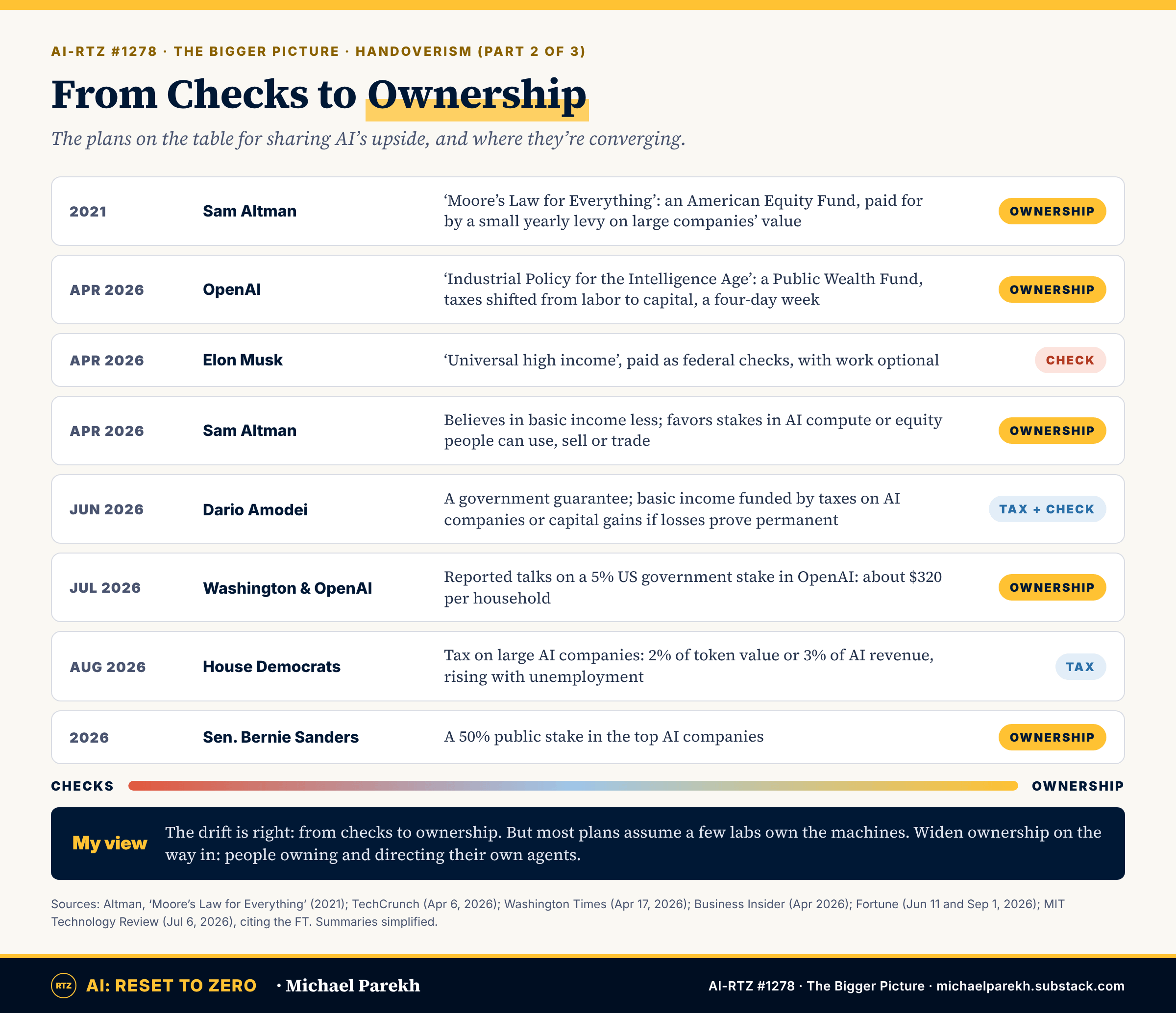
The good news: the people building AI aren’t ignoring this. In the last year or so, nearly every major voice has put a plan on the table. What’s striking is where they’re converging:
-
Sam Altman, 2021: his ‘Moore’s Law for Everything’ essay proposed an American Equity Fund, with large companies paying a small share of their value each year into a fund that pays out to every American adult.
-
Altman, 2026: in April he told The Atlantic he believes in basic income less than he used to, and favors collective ownership instead, like stakes in AI compute or equity that people can use, sell or trade, per Business Insider.
-
OpenAI, April: its policy paper, ‘Industrial Policy for the Intelligence Age’, proposed a Public Wealth Fund giving every American an automatic stake in AI companies and infrastructure, a shift in taxes from labor to capital, and a subsidized four-day week, per TechCrunch.
-
Washington and OpenAI, July: the Financial Times reported talks on a 5 percent US government stake in OpenAI. MIT Technology Review did the math in ‘Your family’s $300 stake in OpenAI’: at OpenAI’s $852 billion valuation, about $320 per household.
-
Dario Amodei, June: a new essay called for a government guarantee for people hurt by AI, with basic income funded by taxes on the relevant companies or higher capital gains taxes if job losses prove permanent. Anthropic put $200 million into an Economic Futures research fund, per Fortune.
-
Congress, August: Representatives Sara Jacobs, Greg Casar and Valerie Foushee proposed a tax on large AI companies of 2 percent on the value of tokens, or 3 percent of AI revenue, rising automatically as unemployment rises, to fund jobs in housing, infrastructure and care, per Fortune.
-
Senator Bernie Sanders: a 50 percent public stake in the top AI companies.
Read them in order and the drift is clear. From checks, to taxes, to ownership. Even Sam Altman, who funded one of the biggest basic income studies, now says a check isn’t enough. That’s the right direction. But notice the starting assumption almost all of them share: a few AI labs own the machines, and the rest of us get a slice after the fact.
3. Who owns the agents?
That assumption is the handover picture again, moved from politics to economics. A few big systems produce everything, and the question is just how to share the proceeds.
The economy actually being built looks different. As I laid out in Part 1, it’s billions, then trillions, of AI agents, working for people and companies, negotiating machine to machine over an agent-to-agent web. Each of those agents has an owner. And each one runs on tokens, which is where the real money in this wave flows. As I put it in September, in ‘Your Day in Tokens’:
“Every errand like that is tokens, and tokens are what the gigawatts are for.”
So ‘who owns the agents?’ is already a live business fight, not a 2040 question:
-
Who directs your agent: Meta’s Muse agent app hit number one in the US App Store in September, and Amazon promptly blocked it from shopping on Amazon, as I noted in that piece. The gatekeepers of the app era want to be the gatekeepers of the agent era too.
-
Who your agent pays: Google’s Agent Payments Protocol and its commerce standards for AI agents are early rails for agents spending money on our behalf.
-
Whose agent it is: Mark Zuckerberg’s pitch of a personal superintelligence for each person is, whatever you think of Meta, an ownership claim on the user’s behalf.
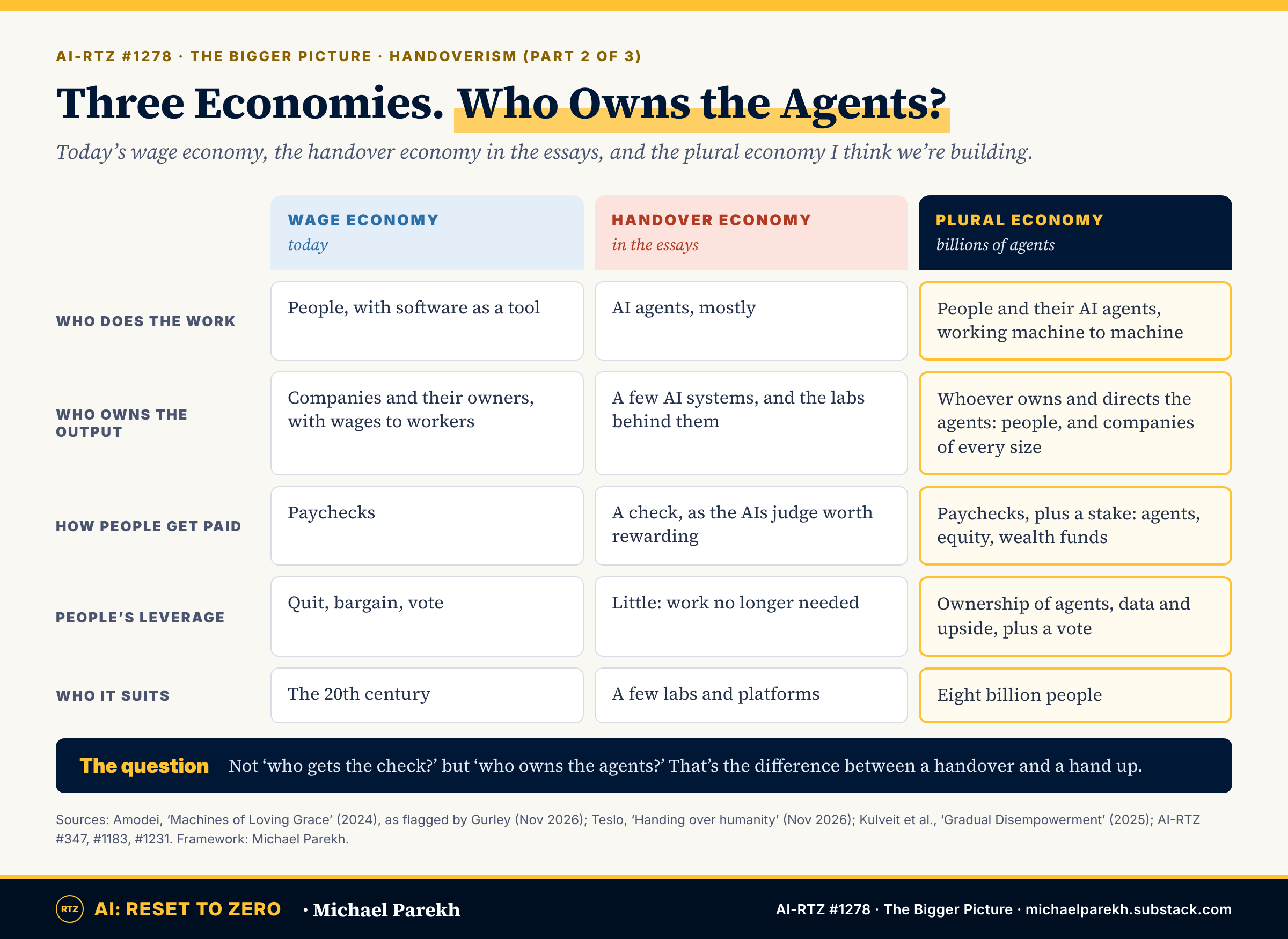
In the handover economy, the AIs own the output and hand it out. In today’s wage economy, people own their labor. In the economy I think we’re heading toward, people own, or at least direct, their agents, and own pieces of the companies and infrastructure those agents run on. That last part is already happening, in public markets, this very week.
4. The IPO test
The most practical answer to ‘who owns the AI?’ played out this week. Anthropic went public on the Nasdaq as ‘ANT’, in one of the largest IPOs ever, and what stood out for this series was who wanted in.
Ahead of pricing, Anthropic planned to set aside up to 20 percent of the shares for individuals, per The Wall Street Journal in ‘Anthropic Plans to Raise IPO Price After Strong Demand’. Retail orders approached $100 billion, next to about $400 billion from institutions. Those were non-binding indications, but more demand than SpaceX saw for its $85.7 billion offering in June, per CNBC in ‘Anthropic IPO: AI lab considers increasing the offering as investor demand surges’.
That’s ownership widening on the way in, not handed out after the fact. It’s imperfect. The shares sold were a small slice, roughly 5 percent of a company valued at well over a trillion dollars, as I discussed when it put a price on its IPO in AI-RTZ #1267. Insiders and early backers keep most of the upside.
And the price of entry is steep. But with Anthropic and SpaceX/xAI now public, and soon OpenAI, the AI companies themselves are moving into public hands, and in time into index funds and retirement accounts. A very different picture from an AI economy handing out checks.
5. And the jobs?
The handover economy assumes the jobs are gone. I’ve been more measured on that than most. When Dario and Jensen Huang squared off on AI and jobs last year, I wrote in AI-RTZ #789:
“These are early days in this AI Tech Wave, and important to note that the progression of technology waves almost always takes longer than earlier expected.”
I still think that. AI Agents are doing real work, and some jobs will go. But every wave I’ve tracked created more work than it destroyed, over decades, not quarters. And the economy at stake isn’t just America’s. In the global polls last month, people in Nigeria, Vietnam, India and Brazil were far more optimistic about AI than Americans or Europeans. For most of the eight billion, AI looks like a ladder up, not a handout.
The Bigger Picture
Step back, and the three questions in this series are really one. Friday’s, who wants to hand over the keys, is about belief. Today’s, who owns the agents, is about money. Monday’s, who decides, is about power. And money is where belief turns into power: whoever owns the agents will have the loudest voice in who decides.
So here’s how I see it.
First, ‘who owns the agents’ is the economic question of this wave. Not ‘who gets the check’. In a plural economy, billions of agents work for whoever owns and directs them. Make sure that’s people, small businesses and companies of every size, not just a handful of labs and platforms, and the handover economy never arrives.
Second, the proposals are moving the right way, from checks to ownership. Altman’s shift, OpenAI’s wealth fund and even Gurley’s disclosure ask all point there. But redistributing after the fact starts from the handover picture. Better to widen ownership on the way in: open and closed models, personal agents people control, competitive agent payments rails, and public markets that let more of us own the AI companies themselves, as this week’s Anthropic IPO began to show.
Third, keep the leverage. Teslo is right that work is leverage. As AI Agents take on more tasks, people need new forms of it: owning their agents, their data and a share of the upside. Not a check from a benevolent system. That’s the difference between a handover and a hand up.
Tomorrow, in Part 3, the hardest question of the three: who decides? From the labs asking governments to pace them, to Washington, Beijing and the UN all reaching for the controls.
Who owns the agents in this AI Tech Wave will shape how much say the rest of us get in that answer. Stay tuned.
Sources
-
Thomas Larsen, Daniel Kokotajlo and colleagues, ‘AI 2040: Plan A’
-
Jan Kulveit and colleagues, ‘Gradual Disempowerment’, Jan 2025
-
The Washington Times, on Elon Musk’s ‘universal high income’ post, Apr 17, 2026
-
Business Insider, on Sam Altman’s changing view of basic income, Apr 2026
-
MIT Technology Review, ‘Your family’s $300 stake in OpenAI’, Jul 6, 2026
-
The Wall Street Journal, ‘Anthropic Plans to Raise IPO Price After Strong Demand’, Nov 17, 2026
For longtime readers
-
AI-RTZ #1267: Anthropic Puts a Price on Its IPO, $1.4 Trillion
-
RTZ #784: Meta’s ‘Zuck’ focused on Personal AI Superintelligence for billions vs peers
(NOTE: The discussions here are for information purposes only, and not meant as investment advice at any time. Thanks for joining us here.)