PROCON employee using a LiDAR scanner to capture the interior of a building. (Photo Courtesy of PROCON)
As the safety director for Plaistow-based Piquette & Howard (PH) Electric Service, Aaron Harmon can’t be on all jobsites, all the time. But in the past year, he’s been able to use an artificial intelligence (AI) platform to help keep PH Electric’s roughly 350 employees safe and ensure they have the tools to meet federal regulations and building codes.
When a safety or compliance issue arises, Harmon can more easily relay a solution to electricians, foremen, project managers, and general contractors, using StepoAI, a platform focused on the construction industry.
“We’re using it every day,” says Harmon. “We’re helping these guys focus on doing their jobs as electricians, while staying compliant and proactive in the safety world, using AI.”
Harmon and the two other members of his safety team have been using StepoAI for about a year, and they’re slowly introducing it to more of the workforce. He estimates 25 employees have access to the platform. These workers use their mobile phones to get instant answers to questions about standards and protocols and log safety incidents. PH Electric has uploaded regulations from Occupational Safety and Health Administration (OSHA), the National Fire Protection Association Safety Standards (NFPA 70E), and the company handbook.
Workers can type a question—or even snap a photo of an area they’re working on—and know quickly whether they’re compliant with best practices and regulations.
Harmon uses safety incident data to identify the most high-risk aspects of a particular job. He then prompts StepoAI to draft toolbox talks, the safety briefings that take place on many construction sites each morning.
“Every week we’re staying ahead of trends we’re seeing,” he says, “so no one else is making similar mistakes.”
This expansion of AI into construction is part of a nationwide trend. Houston-based Persona AI is developing industrial humanoid robots designed specifically for construction, and earlier this year the heavy equipment company Caterpillar announced a collaboration with the tech company NVIDIA to advance autonomous heavy machinery powered by AI. In Massachusetts, Boston Dynamics markets its AI-powered dog-like robot, Spot, to help survey and inspect construction sites.
While robotics and self-driving machines are flashy, AI is showing up at Granite State job sites in more mundane ways. The construction industry can now access AI-driven platforms to help with scheduling, estimating, project management, and health and safety, as well as office tasks like communications and accounting.
“There’s a lot of administrative work that goes into construction, and that’s something AI is great with,” says James Grant, COO at PROCON, a Hooksett-based design-build construction management firm. While construction firms might use AI for similar applications to other industries, Grant believes there will be a bigger benefit in construction because of the sheer volume of administrative tasks.
“We’ve really tried to embrace it,” he says, “and fully adopt it.”
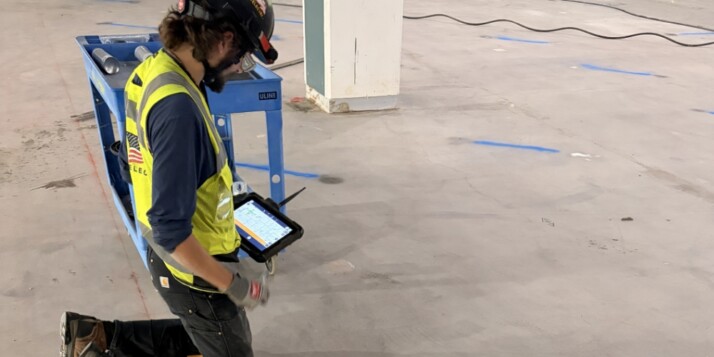
PH Electric employee using AI technology that links 3D building plans to mark out precise locations of pipes, walls, and other electrical systems (Courtesy of Construction Media Team)
Evaluating Safety in Real Time
When Harmon joined PH Electric three years ago, the engineering department was using AI-powered tools to help with design and modeling. That got him thinking about how AI might be applied to making the three-person safety team more efficient.
“We need to prioritize our time as much as we can,” he says.
Harmon started looking into AI platforms, but found none were quite right. Then, he began seeing LinkedIn posts from his former professor, Brady Keene, department chair for Safety and Construction Sciences at Keene State College. In December 2024, Keene joined forces with a Seattle-based tech entrepreneur, Houman Farokhzad, to co-found StepoAI.
The company’s demo product was simple: Anyone on a job site could call a number and instantly get answers to questions about compliance. Since then, the product has evolved, but the core service has remained the same.
“We collect data, analyze it, and provide learning opportunities in high-risk and variable industries,” says Keene, who is now COO at StepoAI, in addition to his role at Keene State College.
A Custom Team of AI Agents
Rather than using a construction-specific product like StepoAI, PROCON uses Anthropic’s Claude. Most of PROCON’s roughly 160 employees have a company provided account and use it to assist across an array of document-heavy work, including reviewing subcontractor bids against specifications, proposals and contracts and routine administrative tasks.
“AI is taking [these tasks] 80% of the way,” Grant says. “Then you need a human touch to go back through and review it.”
Recently, PROCON used Claude to streamline the reconciliation of hundreds of pages of invoices, landfill weight tickets and change of order requests related to a large, contaminated soil project in Portland, Maine, that involved eight different vendors.
“What would have taken hours turned into 15 minutes of data crunching,” Grant says. The savings on that alone is enough to pay for an employee’s Claude subscription for the year, he notes.
The biggest impact has come from using AI agents and coding within Claude to replace “clunky” software tools with “homegrown solutions based off our processes,” Grant says.
When leadership at PROCON was frustrated with the company’s Customer Relationship Management (CRM) interface, the technology team created a new, customized system with Claude that has been “fantastic,” according to Grant. They can make tweaks immediately, rather than lodging complaints with a software company and waiting for a possible solution.
“It’s a breath of fresh air,” Grant says.
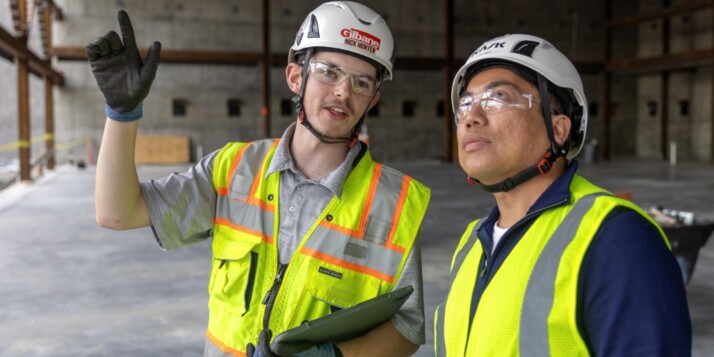
Nick Hunter, ’25 from Keene State College, shows Professor Lito Amit details of his internship worksite at Gilbane Construction. (Courtesy of Keene State College)
Questions Remain
While AI is efficient, it’s not widely used in the Granite State construction industry. High costs, legal concerns, and some skepticism of technology mean that AI integration has “been an incremental thing,” says Joshua Reap, president and CEO of Associated Builders and Contractors of NH and Vermont.
Experts say adoption is higher by mid-sized and large commercial construction companies. “On the residential side, the jury’s still out,” says Keene. “I haven’t found a good use case for that.”
In large part, that’s due to cost. Residential operations are generally smaller, with fewer subcontractors and less need for pricey AI platforms, experts say. Keene acknowledged that even for commercial operations, technology like StepoAI is often prohibitively expensive, despite being “subsidized with [venture capital] money.”
Grant of PROCON says Claude has a lower price tag than industry-specific products, while still meeting the business’s needs. Harmon said that PH Electric pays a discounted price for StepoAI due to a smaller scale of use and providing detailed feedback to the company.
Even as he moves forward with his own AI company, Keene says that the AI-driven technology doesn’t make financial sense for all contractors. “There are a lot of people exploring with AI, who are realizing that the [return on investment] isn’t there,” Keene says.
There are also security and legal concerns, according to Frank P. Spinella, a construction attorney with Wadleigh, Starr & Peters in Manchester. “It’s efficient, it helps bring down costs, but occasionally it can create problems,” he says, “and those can become legal problems.”
Some AI tools can now read plans and project specifications, but uploading those documents to AI—especially an open-use platform—could violate copyright law or confidentiality agreements within a contract, Spinella says. “Contractors need to be aware of the potential risk,” he says.
In addition, companies need to know how reliable their AI agents and AI-built applications are. Vibe-coding—using AI to write code—is fast and effective, but the applications it produces often don’t have the same storage, backup, and security as enterprise-grade software, Grant says. At PROCON, the technology team knows how to code, and has taken steps to ensure the agents and applications that the team creates are reliable.
Even so, the team is cautious and conservative when transitioning from established software to AI-based technologies. When the company puts a new AI agent or application into use, the team runs it alongside the current tool or manual process until it’s proven. They haven’t fully replaced any critical software, such as the project management tool Procore. “We’re not really messing with anything I’d consider an enterprise tool,” Grant says.
Not a Replacement for Workers
With the construction industry facing a workforce shortage, AI can help fill the gap, Reap says. “It’s a force multiplier,” he says. “You can’t fill all those jobs with AI, but you can use AI to make people more efficient and more comfortable in the jobs.”
At Keene State College, which is recognized nationally for its occupational safety and health and construction management programs, AI is being integrated into the classroom, according to Lito Amit, associate professor of safety and occupational health applied science.
Amit encourages his students to use AI while also thinking critically about the technology and learning some “old but gold” methods. “Just because there is a strong presence of a technology, we don’t assume that it’s going to be effective or accepted without questions,” he says. “Just like any tool, there will always be something that will be compromised.”
None of the experts interviewed were concerned about AI cutting into jobs in the construction sector. “I don’t think you’ll ever have it where a computer with AI can build a building on its own,” Reap says. “It’s always going to be humans leading the charge.”
And yet, those humans and their companies are increasingly adding AI as another tool in their belt. “If you’re not,” says Grant, “you’re going to get left behind.”