When AI Can Generate Code, What Must Computing Students Still Learn, And How Should We Teach It?
On 13 November 2026, over 200 attendees participated in the International Workshop on Computing Education in the AI Age, hosted by NTU’s College of Computing and Data Science.
Professor Luke Ong, NTU’s Vice President for AI and Digital Economy and the Dean of the College of Computing and Data Science, opened the event by acknowledging that the entire computer science community is experiencing rapid change due to the increasing availability and reliability of AI platforms.
Ong set the stage by describing the balancing act of using LLMs to code: they are efficient and useful, but over-reliance on them can cause problems in learning and problem-solving. For that reason, CCDS established the Learn with AI initiative, with its three principles: “Human–AI Collaboration,” “Students Must Own Their Thinking,” and “Meta-Skills for Adaptability,” or learning to learn.
Ong then invited the presenters to answer, in their own ways, the question of the day: When AI can generate code, what must computing students still learn, and how should we teach it?
After the formal event, attendees toured live showcases of featured AI-supported educational systems from NTU, NUS, SMU, SUTD and SIT. Visitors were encouraged to try the systems, which spanned coding support, personalized learning, assessment design, misconception-driven learning, student-AI collaboration and inquiry-driven learning.
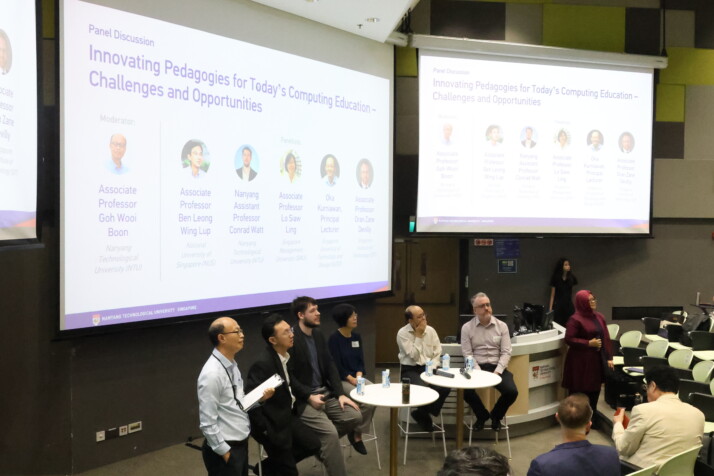
Across the morning keynotes, afternoon talks, and two panel discussions, three themes arose: what kind of job market awaits students, how educators can best prepare them both with and without AI, and what the role of humans is when AI is so widely available.
State of the Software Job Market
A university education has a responsibility to prepare its students to be working professionals; recent trends in AI have disrupted the software job market. A number of speakers directly addressed the issue.
The first morning keynote speaker, Bertrand Meyer, Professor Emeritus at the Department of Computer Science at ETH Zürich and the originator of Design by Contract, gave a talk, “Software Engineering in the Age of AI: What Changes, What Remains, What Do we Do, What Do We Teach?”
Meyer spoke about the trends he has observed in software engineering and posited that what he called “casual” software development—defined as relatively low-level coding—may no longer be a viable career, because AI excels at this level. However, more complex tasks still require humans to set requirements and verify the software. Meyer also pointed out, optimistically, that during every point in history that professionals thought that software development as a career was ending, more jobs were ultimately created.
Kailash Sethuraman, who leads developer productivity and services at GovTech Singapore and is an NTU alumnus, was similarly optimistic about the job market, but cautioned that the pathway to a career in software has changed.
“The senior engineer of tomorrow is not going to take the same path as a senior engineer of today,” Sethuraman said. He gave many examples of the shift within GovTech, including the concept of a “Team of One”, which is a single product engineer in charge of building out a system, using a team of AI agents instead of a team of humans.
In addition, Sethuraman had concrete advice for students: don’t compete with the machine; aim higher instead.
“Become more capable because AI exists, lean into it, and understand what it can do,” Sethuraman said. “The successful leaders and engineers in this profession ask: if building becomes dramatically easier, what can I attempt now that I couldn’t before?”
Teaching and Grading with AI
Before entering the job market, however, students need to be taught and assessed. Traditionally, this has been done with classes, homework, and exams—all of which have been affected by AI, which can code faster and better than many students. This also reduces motivation to attend class, as several speakers noted.
The second morning keynote was given by Paul Denny, Professor of Computer Science at the University of Auckland and an ACM Distinguished Member. Using examples from his own classes, Denny offered an expert perspective on the state of computing pedagogy today.
Due to the wide availability of AI, Denny described a “two-lane” system for AI usage at his university.
“We have adopted what’s known as the two-lane model of assessment,” Denny said. “Lane 1 is all of the secure assessments: tests, oral examinations, written examinations, where we want to see that the student actually understands without AI available. Lane 2 is everything a student does at home. We often encourage students to use AI at home, but there we’re not grading their learning or the artifact.”
Others changed what they mark. NTU Nanyang Assistant Professor Conrad Watt, who gave an afternoon talk, “SC2006 Software Engineering Learn with AI Initiative” explained that in his course, students are not graded on their requirements document.
“So one of the things we brought into this lab was the concept that they could write up an initial attempt at a requirements document and then have a dialogue with an AI to critique it,” Watt said. “But we do not mark them on how good their requirements document is. The thing we mark them on is how well they describe the process of iterating with the AI in a reflective document.”
Oka Kurniawan, Principal Lecturer and Director of Education at the Office of AI and Digital Innovation at the Singapore University of Technology and Design (SUTD), gave a talk in the afternoon, “Embedding Design AI into Software Studio Course” in which he expressed a similar view.
“Our focus is not so much on the fullness or the completeness of the features, but on how reliably they build the process and the product,” Kurniawan said.
Ben Leong, Associate Professor of Computer Science at the National University of Singapore (NUS) and Director of its AI Centre for Educational Technologies, offered a high-level guideline in his afternoon keynote, “Not Broken, but At Risk: Computing Education in an AI-Driven Future.”
“AI shouldn’t be used to do the work directly, but to help improve the work,” Leong suggested. “We should still do the work ourselves. I don’t think AI skills is the key. The key is actually better judgment.”
Capping off this theme was Associate Professor Oran Zane Devilly of the Singapore Institute of Technology (SIT), who gave an afternoon talk, “Rethinking Collaborative Learning in the Age of AI.” During the afternoon panel, Devilly offered an anecdote that hinted at a potential lever for student behaviour.
“I was doing a game-based learning intervention study recently. It was fully experimental, so there was no GPA involved,” Devilly said. “I said to the students, try not to use AI. And not one student turned on ChatGPT for four days.”
However, the speakers agreed on one point: teaching the foundations of computer science is still crucial.
“Strong foundations in computing, mathematics, and engineering matter even more in the age of AI, not less,” said Ong in his opening address, a view echoed by the presenters.
What Humans Offer
Although the focus of the workshop was on AI, all participants highlighted the shifting but always important role of humans in computing, as students, instructors, or professionals.
Lo Siaw Ling, Associate Professor of Information Systems at Singapore Management University (SMU), discussed the limitations of AI systems in her afternoon talk, “Generative Agents for Pre-Assessment Question Evaluation.” Ling described her research into creating LLMs to simulate either students or educators, and ultimately found that the current systems are incapable of completely simulating the human factor.
Ling also described “Debunkr”, an AI system that assists educators by using student pre-lesson assessments to predict what misconceptions the student is likely to hold. Using that as a guide, an educator can better tailor a lesson to their students.
“Our key role now is as a facilitator,” Ling said, discussing the role of the human educator in this system. “We are the one who make sure that they learn the right concept.”
Denny agreed, saying that learning is not just about accessing content, regardless of quality.
“We know learning also involves social connection, feeling like part of a learning community, and being taught by someone who inspires you, motivates you and holds you to high standards,” Denny said. “I think it’s very important that we don’t lose that human connection as we look for the next thing we can automate.”
Beyond the classroom, many speakers were quick to point out that professional software development still requires a skilled human practitioner.
“I think the future belongs to people who master a technical topic, in this case software engineering, very well, and master AI,” said Meyer. “In particular, people who can focus on the exceptions, because AI takes very good care of the general case. For exceptions, we need experts.”
Devilly emphasized that AI is not better than humans at everything.
“AI is very, very, very, very, very fast,” Devilly said. “And AI is good at patterns. But humans are better at innovation.”
Learn With AI, But Think For Yourselves
Throughout the day, the speakers emphasized that although AI has changed the computing and software space, humans have not been displaced. The challenge for students, professionals, and educators is to adapt to their new roles, and leverage the new capabilities of AI to accomplish even more.
As Ong said in his opening remarks, “The future of computing education is not a choice between human intelligence and artificial intelligence. It is about developing people with the understanding and judgment to advance AI, to work effectively with AI, and to remain responsible for the systems that they build. The more capable our machines become, the more deliberately we must cultivate human intelligence.”