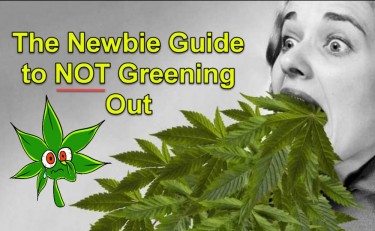
A “Psychedelic State” Produced by Cannabis Isn’t as Fun as It Sounds
A new study out of Johns Hopkins just confirmed something a lot of us already learned the hard way, usually on a couch, usually with someone asking if we were okay: enough THC can knock you into a headspace that looks a lot like a classic psychedelic trip. Researchers gave a small group of adults either psilocybin, THC (as the pharmaceutical dronabinol or as a whole-plant distillate), or a placebo, then had them lie on a couch in eyeshades, listen to music, and report what happened. The takeaway, published in the journal Psychopharmacology, was that a 25-milligram dose of THC produced a subjective experience close enough to 25 milligrams of psilocybin that participants sometimes couldn’t tell the two apart. Push the THC to 50 milligrams and it read as heavily sedative and dissociative, with some genuine psychedelic character mixed in.
I want to be clear about why this study exists, because it’s not just cannabis nerds confirming what stoners have known since the first person ate an edible on an empty stomach. Psychedelic researchers have a real methodological headache: in a clinical trial, if you give someone psilocybin and someone else a sugar pill, everybody in the room knows within twenty minutes who got what. That “unblinding” problem wrecks the science. The Hopkins team is floating THC as a stand-in active placebo, something that alters consciousness enough to fool a participant into thinking they might have gotten the real hallucinogen, without actually being one. It’s a clever fix to a genuine problem, and it happened to produce a very useful piece of public information for the rest of us: high-dose cannabis is not simply “more stoned.” At a certain threshold, it becomes a different animal entirely.
I can vouch for that, and not because I read a journal abstract.
I’ve had what you’d call an active relationship with mind-altering substances. Cactus, mushrooms, LSD, MDMA — I went through a stretch where I treated altered states like a course of study rather than a party favor. I came to respect these substances the way you respect the ocean or a chainsaw: enormously powerful, occasionally beautiful, and fully capable of hurting you if you get cocky. I learned to navigate that terrain. I learned my limits, mostly by finding them.
And out of every psychedelic experience I’ve had, the cannabis-induced ones were, hands down, the least fun.
That’s a strange sentence to write about a plant I’ve spent decades defending. But the “heroic dose” cannabis trip is its own particular beast. Most people hit it through edibles, and there’s a pharmacological reason for that. When you eat cannabis, your liver processes the THC into a metabolite called 11-hydroxy-THC, which crosses the blood-brain barrier more efficiently and is commonly cited as several times more potent than the Delta-9 THC you get from smoking — some estimates put it around ten times stronger, though the honest answer is that potency varies wildly by person, dose, and what else is in your stomach. That’s why the beginner edible mistake is so universal: nothing happens for an hour, so you eat another one, and then both doses land at once. Congratulations, you’ve booked yourself a twelve-hour weed coma with a side of existential dread.
But it’s not exclusively an edibles phenomenon, and I know that firsthand. Years ago I smoked some genuinely absurd flower on the Santa Monica Pier and ended up with full acid-style visuals — trails, patterns, the whole production. For me, honestly, that one was closer to pleasant. For my friend, it was not. He described it less as visuals and more as total sensory overload, everything happening at once until his brain essentially threw a breaker and shut the whole system down. We sat on a bench for about an hour. I got him some food. He slept it off and was completely fine the next day. But in the moment, that wasn’t a fun place for him to be.
Then there’s my mother, who once ate too much cannabis and watched demons climb out of her ceiling. I don’t say that for shock value — I say it because it’s the clearest example I have of what these heavy doses actually do. They don’t hand you a generic “trip.” They open a door, and whatever’s standing behind it in your own head is what walks through. That’s true of psilocybin and LSD too, to a degree, but there’s usually some runway — some warning, some ramp-up — that lets you brace yourself. Cannabis, especially eaten, has a way of skipping the runway and landing you straight in the deep end.
Compare that to my experiences with mushrooms or LSD, which, even at their most intense, tended to carry an undercurrent of wonder. There was awe in it, even when it was hard. Cannabis-induced psychedelia, in my experience, skips most of the wonder and goes straight for the lesson. It’s less “look at the beautiful fractals” and more “here is a thing about yourself you have been avoiding, please sit with it for the next several hours, thank you.” I’ve come to think of these as lesson trips rather than fun trips — the kind that teach you where your walls are, what’s living under your floorboards, and exactly how much respect you owe a plant you’ve been casually smoking for twenty years.
I want to be upfront that this is subjective. I’m one guy with one nervous system and a few decades of anecdotes, not a controlled study. But the Hopkins research gives some scientific backbone to the vibe check every long-time smoker has run privately: THC at a high enough dose isn’t just “really high,” it’s a different category of experience, with its own risks and its own texture, and it deserves to be treated that way instead of getting waved off as “just weed.”
That distinction matters for reasons beyond bragging rights about your worst trip. It matters for harm reduction. If we keep telling people that cannabis has a ceiling — that the worst-case scenario is falling asleep and maybe eating too many chips — we leave them completely unprepared for the version of the experience my friend or my mother had. Set and setting, the two concepts psychedelic researchers treat as sacred, apply here too. Where you are, who you’re with, and what headspace you’re in before you take a dose all shape whether “high-dose THC” turns into a curious afternoon or a genuinely rattling few hours. The Hopkins study built its entire protocol around controlling for exactly that — couch, eyeshades, music, a facilitator in the room. That’s not incidental. That’s the whole ballgame.
So take this as both a data point and a public service announcement from a guy who’s logged more hours in altered states than he probably should admit to a reporter. Cannabis can absolutely take you somewhere that looks like a classic psychedelic experience. It just doesn’t always bring the fun that label usually implies. Respect the dose. Respect the setting. And if you’re about to eat an edible strong enough to summon demons, maybe don’t do it alone.
Source: Marijuana Moment, “High Doses Of THC From Cannabis Can Produce ‘Psychedelic-Like States,’ Study Shows,” Sept. 1, 2026, reporting on a study published in Psychopharmacology, funded by the Wana Brand Foundation.
WHAT IS GREENING OUT? READ ON…