One 22-year-old has applied for 511 jobs and can’t get a human being to interview her. A 27-year-old has been given unlimited AI resources to reinvent Cisco’s software. Same technology. Same timeline
Audio playback is not supported on your browser. Please upgrade.
We are living through one of the most extraordinary and contradictory moments in the history of work.
For more than 30 years, I’ve been obsessed with exponential technologies and how they transform industries, economies, and human potential. I’ve long argued that artificial intelligence will become the most powerful tool for individual empowerment ever created.
I still believe that.
But two stories that crossed my feed this week illustrate something important: The AI revolution is not unfolding equally for everyone.
For some young people, AI is becoming a wall that keeps them out of opportunity.
For others, AI is becoming a superpower that gives them access to opportunities previously reserved for people with decades of experience and enormous resources.
The contrast is astonishing.
And it tells us something profound about the future of education, employment, and entrepreneurship.
As the father of two 15-year-old boys, this question is personal for me. My sons will enter a job market that looks nothing like the one I entered. My hope for them is they become entrepreneurs and take their future into their own hands.
The First City: 511 Job Applications and No Human in Sight
Earlier this week, Mike Vorkunov shared a deeply unsettling New York Times story about what it means to be a young person entering today’s job market.
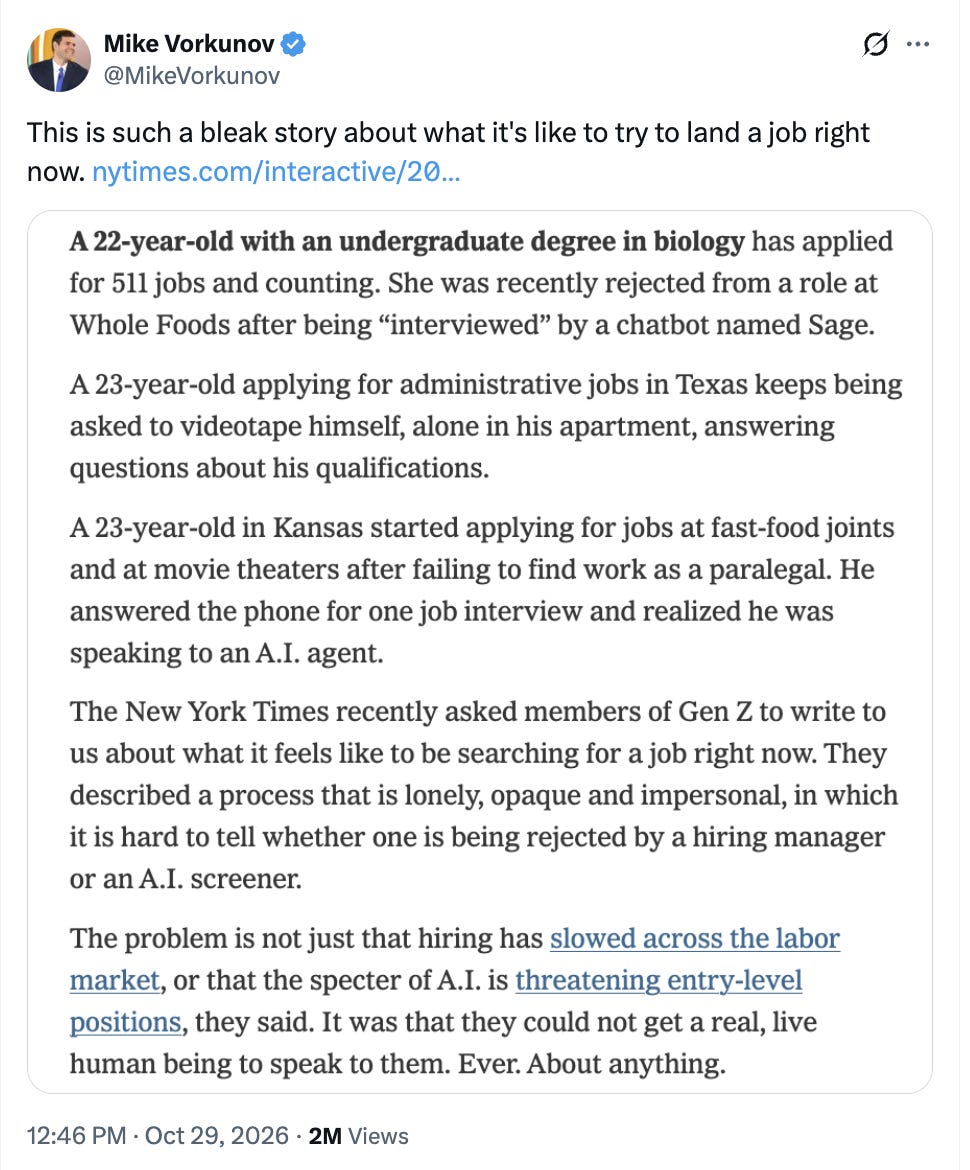
One 22-year-old biology graduate had applied for 511 jobs.
Five hundred and eleven.
She even applied to Whole Foods, only to be rejected after an interview conducted by an AI chatbot named Sage.
Another young graduate, a 23-year-old in Kansas, unable to find work in his chosen field, began applying to fast-food restaurants and movie theaters. When he finally received a phone interview, he discovered that the person interviewing him wasn’t a person at all.
It was an AI agent.
Imagine spending four years earning a degree, investing tens of thousands of dollars in your education, preparing for the beginning of your professional life, and then discovering that you cannot get another human being to speak with you.
The New York Times article describes an employment experience that has become profoundly lonely, opaque, and impersonal.
We’re watching the traditional entry-level career ladder begin to fracture.
For generations, the formula was relatively straightforward:
Get an education. Earn your credentials. Apply for jobs. Get hired. Learn from experienced colleagues. Work your way up.
That system was never perfect. But at least there was a ladder.
Today, companies are increasingly automating the very tasks that once justified bringing in inexperienced employees. At the same time, AI-powered recruiting systems can process enormous numbers of applications, often removing the human contact that makes rejection, or acceptance, meaningful.
To be clear, AI isn’t responsible for every weakness in today’s labor market. Economic cycles, corporate hiring decisions, and longstanding problems in recruiting all play a role.
But AI is accelerating a fundamental shift.
We are automating the bottom rungs of the career ladder before we’ve figured out how the next generation is supposed to climb it.
And that’s a problem we cannot ignore.
The Second City: A 27-Year-Old Gets Unlimited AI Tokens to Rewrite Cisco
Now consider another story from the very same week.
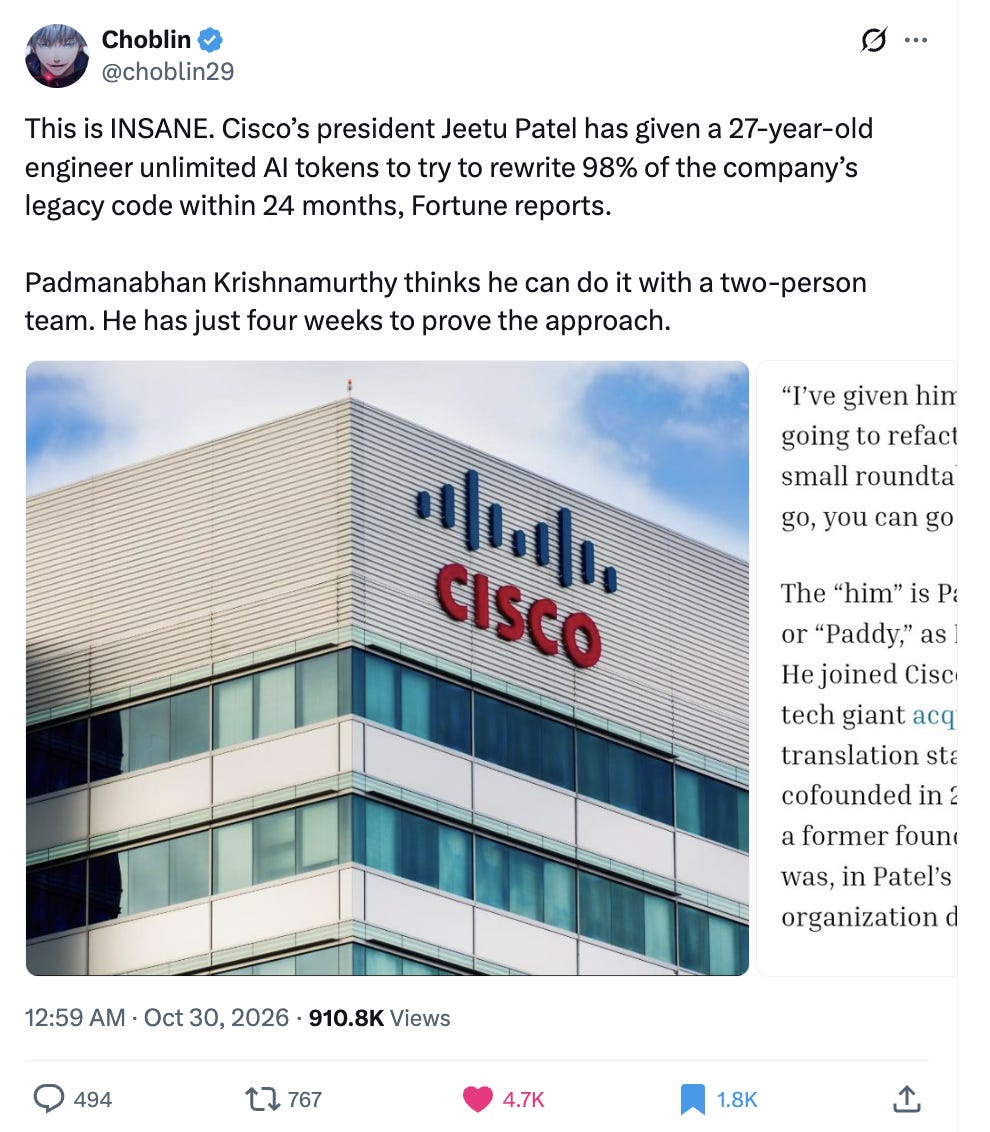
As highlighted by @choblin29, Fortune reported that Cisco president and chief product officer Jeetu Patel has entrusted a 27-year-old engineer named Padmanabhan Krishnamurthy, known as Paddy, with an extraordinary mission.
His goal?
Use AI to rewrite 98% of Cisco’s legacy code within 24 months.
With a team of just two people.
And unlimited AI tokens.
Patel found Paddy “five levels” below him in the org chart. As he told Fortune: “I’ve given him unlimited tokens because he’s going to refactor code. So I’m like, you can go, you can go nuts.”
Let that sink in.
Cisco is one of the world’s most established technology companies, with decades of accumulated software infrastructure.
A project like this would traditionally require armies of experienced engineers, extensive planning, and substantial organizational resources.
Instead, a company president is betting that a young, AI-native engineer with extraordinary ambition and access to powerful AI tools might accomplish something previously unimaginable.
According to Fortune’s reporting, Paddy had joined Cisco through its acquisition of EzDubs, a translation startup he co-founded.
Despite his entrepreneurial background, he was working on something Patel considered relatively unstrategic.
Then they started talking.
Paddy explained what he believed AI could accomplish.
Patel listened.
And rather than telling him to stay in his lane, Patel gave him four weeks to demonstrate the approach, with the ambitious 24-month objective beyond that.
The ultimate outcome remains to be proven. But the opportunity itself is remarkable.
Here’s what fascinates me most.
Paddy got this opportunity because he could imagine accomplishing something that people with 25 years of experience might never have considered possible.
This is a critical distinction.
In a world of exponential technologies, experience remains valuable. But experience can also create assumptions about what is and isn’t possible.
Sometimes the greatest advantage is not knowing that something is supposed to be impossible.
I’ve seen this firsthand. When we announced the $10 million XPRIZE for private spaceflight in 1996, the experts told us it was impossible. In 2004, Burt Rutan and a small team flew SpaceShipOne to space twice in two weeks to win it. The day before something is truly a breakthrough, it’s a crazy idea.
And remember: during Apollo 11, the average age of the flight controllers in Mission Control was just 28. Young people have always been the ones who do the impossible, when we give them the chance.
Patel understands this. He is actively looking for more young people willing to challenge established thinking, while emphasizing the importance of combining their perspectives with those of experienced operators.
This is what exponential leadership looks like.
The AI-Native Talent Shortage Is Already Here
Sarah Guo, founder of Conviction, made a fascinating observation in a post this week.
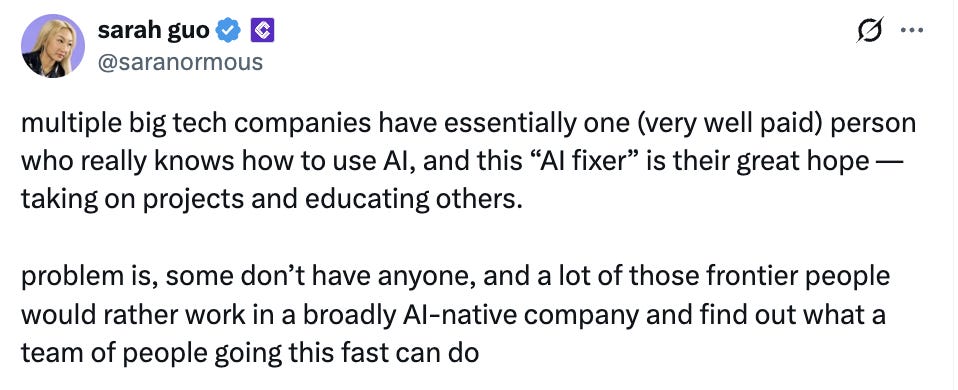
She described major technology companies where essentially one highly compensated employee truly understands how to use AI at the frontier.
That person becomes the organization’s indispensable AI fixer.
The individual everyone turns to when they need to accomplish something difficult, ambitious, or previously impossible.
Some organizations don’t have anyone like that.
Think about the implications.
We are simultaneously watching young graduates struggle to find entry-level employment while some of the world’s largest corporations are desperate to identify people who can fundamentally rethink how work gets done.
And the shortage goes far beyond software engineers.
It’s a shortage of people who understand how to combine human imagination, technical judgment, and AI capabilities to create extraordinary outcomes.
And these individuals don’t necessarily have advanced degrees.
They don’t necessarily have impressive résumés.
They don’t necessarily have decades of professional experience.
What they have is agency: the willingness and ability to identify a problem, assemble the tools needed to solve it, and take action without waiting for permission.
AI massively amplifies that agency.
I know something about youthful agency. As an undergraduate at MIT, I co-founded SEDS, Students for the Exploration and Development of Space. A few years later, while still in medical school, I co-founded the International Space University. Nobody gave us permission. We just started.
Today’s 20-year-olds have something we never had: AI.
A motivated young person with the right AI tools can now prototype software, conduct sophisticated research, build products, create media, automate workflows, and launch businesses at a fraction of the cost that would have been required just a few years ago.
We’re moving from an economy where access to talent and capital determined what you could build, toward one where imagination, judgment, and execution increasingly determine what’s possible.
That’s an extraordinary opportunity.
But only if people know how to use it.
The Great Divide: Are You Using AI, or Is AI Being Used on You?
This is the central question.
Consider our two young people.
The 22-year-old submitting hundreds of applications is interacting with AI as an obstacle. The technology is screening her, evaluating her, and potentially rejecting her before she ever meets a hiring manager.
The 27-year-old at Cisco is interacting with AI as a force multiplier. He is directing it, experimenting with it, and using it to pursue a mission that would once have required enormous teams.
Same technology. Radically different relationship with it.
And I believe this difference will become one of the most important economic divides of the coming decade.
Historically, opportunity was often determined by where you were born, which university you attended, who you knew, and how much capital you could access.
Those advantages haven’t disappeared.
But AI introduces a new variable: how effectively you can turn intelligence into action.
Jensen Huang, NVIDIA’s founder and CEO, recently offered advice to young people that captures the moment: become exceptionally good at using AI.
It’s a powerful idea. The most valuable skill in the AI era may not be memorizing answers or mastering a specific software tool.
It may be learning how to ask better questions, decompose complex problems, evaluate AI-generated results, and orchestrate intelligent systems toward meaningful outcomes.
In other words, learn how to direct intelligence to accomplish a mission.
That is a fundamentally different educational philosophy.
And it is one we urgently need to embrace.
We Need to Stop Preparing Young People for a World That No Longer Exists
Our education system was largely designed during the Industrial Revolution, to produce graduates capable of entering established organizations and performing defined functions. The formula looked like this:
-
Study the curriculum.
-
Pass the examination.
-
Earn the credential.
-
Apply for a job.
But what happens when AI can perform many of those defined functions faster, cheaper, and increasingly well?
What happens when the employer no longer needs as many people performing routine entry-level tasks?
And what happens when one ambitious teenager with AI tools can accomplish work that previously required an entire department?
The answer cannot simply be to tell young people to submit more applications.
Nor can it be to tell everyone to become a software engineer.
We need to rethink what education is for.
I believe the future belongs to an educational model built around three core capabilities:
First, AI fluency. Every young person should learn how to work effectively with AI. That means far more than asking a chatbot questions. It means using intelligent tools to research, build, create, and solve real problems.
Second, agency and entrepreneurship. Students need opportunities to identify problems worth solving, take initiative, experiment, fail, iterate, and ultimately create something of value. Entrepreneurship is becoming a fundamental life skill, as basic as reading and math.
Third, ambitious, mission-driven thinking. We should challenge young people to stop asking, “What job can I get?” and start asking, “What problem can I solve?” and “What can I create that would have been impossible five years ago?” As I often say, the world’s biggest problems are the world’s biggest business opportunities.
These capabilities reinforce each other.
AI increases what an individual can accomplish.
Agency determines whether they take action.
Purpose determines what they choose to build.
When you combine all three, you begin to unlock extraordinary human potential.
This is why, after spending 30 years on space and 15 on health and longevity, I’ve made education my next great frontier, and why Max and I are so passionate about reinventing it for the AI era.
We should be creating environments where teenagers have access to powerful tools, real-world problems, ambitious mentors, and the freedom to build.
Instead of simply preparing them to compete for fewer seats in yesterday’s organizations.
The Job Is Not Promised. But the Tools Are Becoming Available.
A post from @AutismCapital made a provocative point about this new reality: no one is promised a job, and young people should increasingly consider entrepreneurship, self-direction, and the extraordinary tools now available to them.
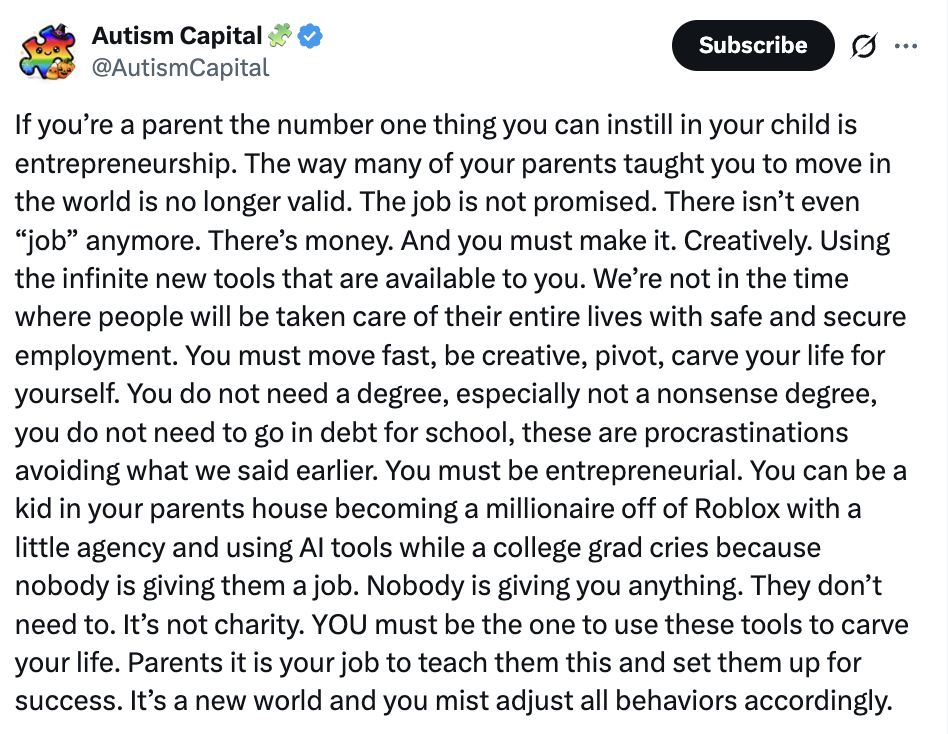
There’s an important truth in that message.
But I want to add a critical nuance.
The young woman who submitted 511 applications is not lacking ambition.
She is not lacking effort.
She is doing exactly what previous generations taught her to do.
The problem is that the rules are changing faster than our institutions are adapting.
We cannot celebrate a future of abundant intelligence while accepting a system where millions of young people are left without meaningful pathways into economic participation.
And we shouldn’t pretend that every 22-year-old has the financial security, mentorship, or technical background to immediately become an entrepreneur.
The opportunity may be expanding exponentially, but access to that opportunity is not yet universal.
That is our challenge. And it’s one worth solving.
We’ve seen what’s possible when access is universal. The $15 million Global Learning XPRIZE, backed by Elon Musk, challenged teams to build software that lets children teach themselves to read, write, and do arithmetic. In 2019, two winners, Kitkit School and onebillion, proved their tablet apps in remote villages in Tanzania, producing real gains in literacy for children with little or no access to a school. That’s the model: put powerful tools directly in the hands of young people, and get out of the way.
A Call to Action for Young People, and the Leaders Who Hire Them
If you’re a young person struggling to enter the workforce, here’s my challenge.
Don’t abandon the job search if you need a job. But don’t allow an automated hiring system to determine your sense of possibility.
Start building.
Choose a problem that genuinely interests you. Use AI to research it. Create something useful. Publish your work. Demonstrate what you can accomplish.
Instead of relying exclusively on a résumé that says what you’ve studied, create a portfolio that shows what you’ve done.
A functioning prototype, a useful automation, an original research project, or a product with real users can communicate capabilities that a conventional application cannot.
You don’t need to become the world’s greatest programmer.
You need to become exceptionally good at turning ideas into outcomes.
And if you’re a CEO, founder, or business leader, I have an equally important challenge.
Somewhere inside your organization, there may be a Paddy.
A young engineer, analyst, designer, or intern who understands AI in ways your most senior executives do not.
Are you giving that person the freedom to experiment?
Are you looking beyond seniority and conventional credentials?
Are you creating opportunities for young people to teach your organization something new?
Or are you using AI to automate your recruiting process while simultaneously overlooking the very talent that could reinvent your business?
The smartest organizations won’t simply replace entry-level workers with AI.
They will redesign early-career roles around AI-augmented capability, pairing experienced mentors with ambitious young builders and giving them meaningful problems to solve.
Instead of asking how many people AI allows them to eliminate, they’ll ask how much more their people can accomplish.
That is where I believe the greatest value will be created.
The Future Is Not Predetermined. We Get to Build It.
I remain fundamentally optimistic about the future of AI.
I know every transition brings pain, and technology doesn’t distribute its benefits equally on its own.
I am optimistic because, for the first time in human history, we are making extraordinary levels of intelligence accessible to ordinary individuals.
Capabilities once available only to large corporations, elite research institutions, and well-funded startups are becoming available to anyone with curiosity, connectivity, and the willingness to learn.
That’s a genuinely revolutionary shift.
But technology alone doesn’t create abundance.
Abundance happens when we deliberately use technology to expand human opportunity.
When Steven Kotler and I wrote Abundance in 2012, our core argument was that technology is a resource-liberating force. Intelligence is the ultimate resource, and AI is liberating it at a scale we’ve never seen before.
The 22-year-old rejected by a chatbot and the 27-year-old entrusted with transforming Cisco should not represent two permanently divided classes of young people.
They should represent a transition we have an obligation to navigate.
Our mission must be to make the second story possible for far more people.
To replace passive credentialism with active creation.
To replace artificial barriers with intelligent tools.
To replace fear of technological disruption with the confidence and capability to shape what comes next.
The future of work is about what becomes possible when humans learn to work with intelligence that is increasingly abundant.
And ultimately, I believe the most important question we can ask young people is no longer: “What do you want to be when you grow up?”
It is:
“What extraordinary thing do you want to create, and how can AI help you make it real?”
To a future of abundance,
Peter H. Diamandis, MD, and Max Song
P.S
Help Us Build the Future of Opportunity for Young People
Max and I are doing more than writing about this transformation. We’re actively developing new solutions that empower young people to thrive in the age of AI.
Our focus is on creating new educational experiences, entrepreneurial pathways, and opportunities that help the next generation develop AI fluency, agency, and the confidence to build extraordinary things.
If you’re a student, parent, educator, entrepreneur, investor or simply someone passionate about reimagining the future of education and work, we’d love to hear from you.
Fill out this short interest form to tell us a little about yourself and what interests you. Our team will use your information to connect with you as we develop new initiatives and opportunities.
The future of education and work isn’t something we should simply wait for.
Let’s build it together.