THE WIDESPREAD ADOPTION of AI technology has the potential to transform society – though many people are sceptical about whether this is a good thing.
While proponents suggest that AI can help increase productivity and reduce human error, there are also concerns about its environmental impact and the possibility for it to cause massive job losses.
Ireland’s government is arguably in the former camp, and has sought to play down concerns that AI could replace many jobs.
In fact, Minister for Enterprise Peter Burke said last week that AI is creating so many jobs here that Ireland is a frontrunner in that area.
But what does the data say?
The Claim
Minister for Enterprise Peter Burke claimed that Ireland is generating AI jobs at a rate that is up to triple that of other countries.
Writing in the Irish Sun on 27 October to outline the government’s response to AI and its impact on workers, Burke said: “Ireland is generating AI jobs at two to three times the pace of peer countries.”
He cited research from the Expert Group on Future Skills Needs (EGFSN), an independent body that advises the government on future skills requirements and labour market issues.
The Evidence
The Journal first sought a response from Burke and the Department of Enterprise on what the claim was based on.
A spokesperson told us that the minister relied on “a cross-section of data” from within the department itself and from “engaging with wider stakeholders”, as well as a study published in September.
They said that study indicated “a strong demand for AI roles ranging from adoption to application developers to systems and infrastructure specialists”.
That report by the EGFSN contains almost the exact same claim made by the minister: that Ireland is “generating AI-related jobs at roughly two to three times the rate of neighbouring countries”.
For clarity, it should be noted that the data in that report only goes up to the end of 2025; the department’s spokesperson told us that the figure could be even higher now, but that “it is preferable to wait until more quarters of the year are available”.
Their response also said that data from jobs website Indeed, the recruitment platform LinkedIn and the Organisation for Economic Cooperation and Development (OECD) pointed to “high demand” for AI roles here.
Minister for Enterprise, Tourism and Employment Peter Burke Alamy Stock Photo
Alamy Stock Photo

So what’s in the report that the minister based his claim on?
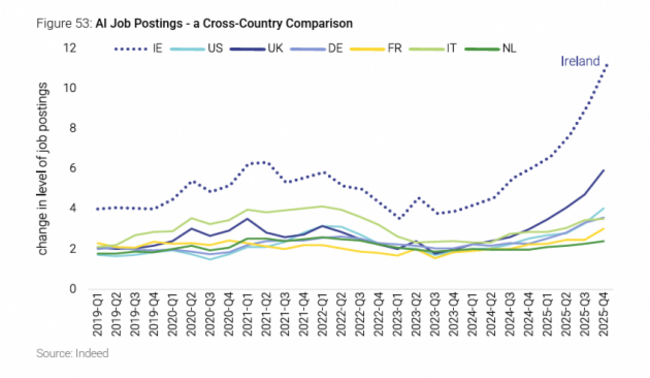
The claim in the EGFSN cites a chart that is titled ‘AI Job Postings – a Cross-Country Comparison’; the source for the data is jobs website Indeed.
The chart shows that around 12% of the Irish jobs listed on LinkedIn for the final quarter of 2025 “referenced AI terms”, up from about 4-6% of jobs that did so between 2019 and 2023.
To be clear about those terms, Indeed’s AI tracker measures the proportion of job adverts containing keywords associated with AI, including machine learning, data science and generative AI.
The chart also shows data for job listings on Indeed, which likewise “referenced AI terms” in six other countries over the same period of time: the United States, the United Kingdom, Germany, France, Italy and the Netherlands.
Although the chart shows an increase in job postings on Indeed that referenced AI terms in all those other countries, Ireland is way out in front.
At the end of 2025, the UK was in second place on about 6% of job postings, while the United States was in third place on about 4% of job postings.
The chart published in the report EGFSN
EGFSN
But does this actually show what the minister claimed?
It’s not the strongest basis for a claim, because it simply interprets data from one website rather than independently demonstrating the claimed rate of job creation.
The chart underpinning the comparison between Ireland and other countries measures the share of adverts mentioning AI, or specific terms around AI, rather than actual jobs created.
The figures show that AI mentions were more prevalent in Irish recruitment advertising, but not whether Ireland was generating jobs at those multiples of other countries.
Indeed also explained that there are caveats to using its jobs listing data in an FAQ.
One is that employers continue to recruit when workers change jobs, even without employment growth.
If you leave the company where you work, a job is not ‘created’ when your employer looks to hire a replacement: unless you have moved into a new position yourself, there will have been a net-zero effect in the jobs market.
“It is important to remember that there will still be people changing jobs even when there is not growth in employment,” the FAQ says.
Indeed also says that job advertisements on Indeed don’t represent a precise number of available positions, because a posting can cover multiple vacancies, remain online after a job is filled, or advertise an opening listed elsewhere.
That distinction is extremely important because it means that an employer seeking a replacement worker with AI skills has not necessarily created an additional job: it could simply be that the new job will involve AI use where the previous one did not.
The claim relied on data from jobs company Indeed – a limited form of analysis Alamy Stock Photo
Alamy Stock Photo

There’s also an issue around the minister’s claim about speed.
Burke didn’t suggest that Ireland has a higher number of AI-related jobs than other countries; he said Ireland’s proportion of those jobs was growing two or three times faster than comparable countries.
But a spreadsheet supplied by the department in its response highlighted a difference between the proportion of adverts that mention AI terms and the speed at which that proportion has grown over time.
The data supplied showed that AI-related adverts accounted for approximately 11.27% of Irish postings in the final quarter of 2025, compared with 5.95% in the UK and 4.03% in the US.
However, the rate at which countries reached those percentages can be looked at in different ways depending on the point you start from.
Between the final quarters of 2024 and 2025, Ireland’s share of AI job postings on Indeed rose from approximately 6.05% to 11.27%, an increase of 86.2%.
Over the same period, the UK’s share rose from approximately 2.99% to 5.95%, an increase of 98.8%
In other words, Ireland had the higher share of AI job postings on Indeed, but the UK recorded faster percentage growth.
The Journal asked the department whether Burke’s comparison between Ireland and other countries concerned the percentage of growth, percentage-point increases or the numbers of AI jobs advertised on Indeed.
A spokesperson referred us back to a previous response without specifying which calculation it had used.
There are other sources that show a substantial growth in advertised demand for AI skills in Ireland, including when compared to other countries.
A 2026 AI Jobs Barometer by PricewaterhouseCoopers, using Lightcast data, shows that Irish adverts requiring AI skills rising from approximately 16,000 in 2024 to 29,000 in 2025.
That represents growth of approximately 81% over the last two full calendar years.
The equivalent UK findings show AI job advertisements increased from 112,000 to 180,000, or approximately 61%, over the same period.
But based on those figures, Ireland’s growth was roughly 1.3 times the UK rate, rather than two to three times as claimed by the minister – and again, the PwC data relied on job listings, rather than actual jobs created.
Interestingly, data shows that a significant number of people in Ireland now use AI as part of their work.
A release from the Central Statistics Office (CSO) last year found that 42% of internet users aged 16 and over used AI in the three months before the agency carried out a survey.
It said that around half of those users (about one in five people) had used AI for work purposes.
Again, this isn’t the same as the minister’s claim that Ireland is generating AI jobs at a faster rate than other countries, but it does provide an indication into how the technology is being adopted in Irish workplaces.
Verdict
Peter Burke claimed that Ireland was generating AI jobs at two to three times the pace of peer countries.
Evidence provided by the Department of Enterprise supports the finding that AI is increasingly featuring in recruitment advertising on Irish jobs websites, and that advertised demand for AI skills has increased substantially.
That data comes from a study by the Expert Group on Future Skills Needs (EGFSN), and is based on a chart showing job listings with terms relating to AI on Indeed in each quarter up to the end of 2019.
However, the chart underpinning the minister’s comparison measures the share of adverts mentioning AI on one website, rather than actual jobs created.
The chart compared Ireland to other countries, but our higher comparable share of AI jobs does not establish a faster rate of AI job creation.
Indeed itself says its jobs data does not always show job creation, because a job advertisement cannot be assumed to show the creation of one job.
It’s also the case that a job listing for a position that replaces a former employee can seek the use of AI as a skill as part of that role, rather than being a brand new job created because of AI.
Meanwhile, calculations using the department’s own figures – based on the Indeed data – show that the UK recorded faster percentage growth in AI-related job ads on Indeed between 2024 and 2025.
Other figures examined by The Journal from PricewaterhouseCoopers also show increased demand for AI jobs in Ireland.
However, that also did not establish the specific claim that Ireland’s rate of AI job growth is two to three times higher than other countries.
In that case, the same caveats also apply with Indeed’s figures around job creation and how roles are advertised.
The department defended the minister’s statement when asked, but did not supply a calculation connecting the advertising figures to the claimed comparative pace of job creation.
By presenting a higher prevalence of AI-related advertising as evidence that jobs are being generated two to three times faster in Ireland, the claim suggests that many more jobs are being created in Ireland than in other countries as a result of AI.
There is no basis for this from the figures provided.
We therefore rate the claim as FALSE. As per our verdict guide, this means the claim is inaccurate.
The Journal’s FactCheck is a signatory to the International Fact-Checking Network’s Code of Principles. You can read it here. For information on how FactCheck works, what the verdicts mean, and how you can take part, check out our Reader’s Guide here. You can read about the team of editors and reporters who work on the factchecks here.