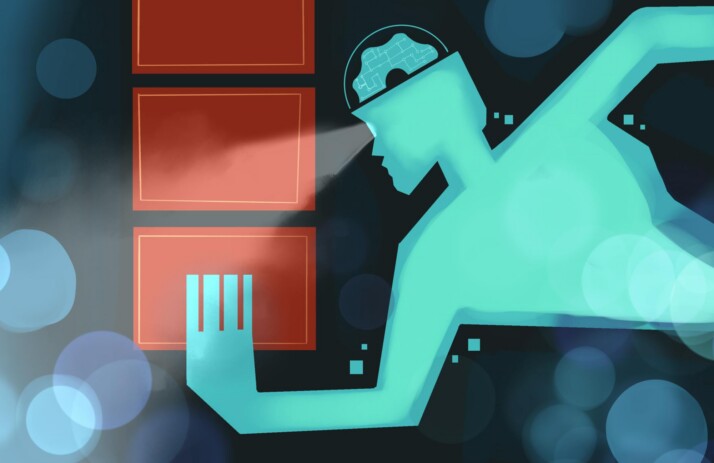
In just a few years, AI has gone from a way to cheat in English class to something that threatens jobs — or even potentially threatens the human species.
Those are some pretty significant jumps, and, for college students deciding what career path to pursue, the rapid evolution of AI raises an increasingly difficult question: should people in “at-risk” majors change course or stick to their interests?
According to a CNBC and SurveyMonkey Quarterly AI and Jobs Survey released in Aug. 2026, 39% of students have considered changing their field of study or coursework due to AI.
At the University of Wisconsin-Madison, freshman computer science major Ethan Manuel did not hesitate when asked whether he had concerns about his future career.
“Yes, every day,” he told The Daily Cardinal.
“Coding is dead,” Manuel said. “All the coding that I’m learning in my classes is just to learn the fundamentals of coding. Eventually if I have coding in my job, it’s just looking at what the AI does — it will be using agents to monitor agents.”
Despite his concerns, Manuel does not think he would ever consider changing his area of study.
“Having that computer science knowledge and knowing the fundamentals will help you use AI better than every other field,” Manuel said. He added AI makes coding more accessible; however, it still needs to be understood and adapted by humans.
Manuel shared that many computer science majors are adding certificates to their degrees in an attempt to diversify their skills. He said he is considering a business certificate because it is one of the popular certificates among his peers.
The fear of declining jobs in the tech industry is real. A 2025 study conducted in the UK found that the number of tech jobs advertised dropped by 50% between 2020 and 2025.
However, AI’s impact extends far beyond the world of coding.
UW-Madison freshman Nikolas Raisanen is a mathematics and economics major planning to go into equity research. He said the impact of AI on math depends on how people use their math degrees.
Enjoy what you’re reading? Get content from The Daily Cardinal delivered to your inbox
“In order for AI to replace doing math, the people using it would have to understand how the math works, and when it’s wrong,” Raisanen told the Cardinal.
Raisanen said AI is great at the math necessary for typical classes; however, the more advanced and qualitative the math gets, the more AI makes mistakes.
Raisanen’s mathematics major focuses on statistical analysis and risk assessment. He said he is not particularly concerned with AI impacting his career path, and he frequently uses AI for help with understanding class concepts.
Raisanen emphasized the perception of the impact of AI varies greatly among math majors and their career aspirations. He said he could see AI taking opportunities away from students wanting to pursue careers in theoretical research or mathematics education because he already sees his classmates utilizing resources from AI rather than talking to the professor.
“If I didn’t know something and I couldn’t ask AI, I would have to find a way to contact my professor. Now, when I don’t understand something I can ask AI to explain it until I do,” Raisanen said.
His statement reflects larger questions about how AI is going to impact the field of education from college campuses to kindergarten classrooms.
UW-Madison freshman Peppe Storniolo, an engineering student, said while he does not worry about AI taking jobs from engineers, he does see it hurting recent college graduates.
“A lot of the bigger corporations are switching lower level positions to be fully done by AI,” Storniolo told the Cardinal, expressing the most concern for entry-level coding and computer science jobs.
A Forbes article published Sept. 2026 explains that entry-level jobs are not disappearing, but they are narrowing with the increase of AI.
“A lot of beginner positions lean on knowledge that can be easily automated by AI,” according to the article.
Many of the students interviewed reflected concern for finding work fresh out of college. Manuel said the popularity of computer science has “oversaturated the field” and made it difficult to find entry-level positions.
Despite their fears, UW-Madison students are staying the course, sticking to their strengths and choosing to adapt to a world with AI, rather than letting it scare them away from their passions. After all, at the end of the day, there is no replacement for human intelligence, at least for now.
The Daily Cardinal has been covering the University and Madison community since 1892. Please consider giving today.