How might artificial intelligence reshape tax policy? What impact might it have on future elections? What might the future workforce look like?
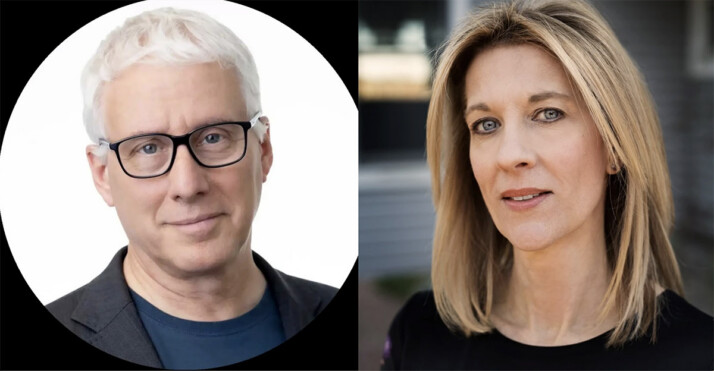
These questions and more were discussed when Stephanie Kelton, Stony Brook University professor of economics and public policy, appeared with American Public Media’s Marketplace correspondent David Brancaccio for a live, on-campus presentation of WSHU Public Radio’s signature program, Join the Conversation.
The discussion, hosted by WSHU Public Radio and the School of Communication and Journalism, was held at November 10 at the Charles B. Wang Center and was followed by an audience Q&A session.
The acclaimed Join the Conversation series brings together noted speakers and local audiences for informative discussions about the issues shaping our world. Brancaccio, a senior correspondent, covers the challenges and solutions of today that will affect the long-term view. At the top of that list is AI.
Brancaccio said a key variable tied to AI as we move ahead will be our expectation of the economy and jobs, specifically citing entry-level jobs.
“How do we train younger people who, years ago, might have gotten their start in the mail room of an advertising firm? How are they going to get early knowledge? The workforce hasn’t answered that question, but it’ll be an interesting journey to find out.”
Kelton, author of the The New York Times bestseller The Deficit Myth: Modern Monetary Theory and the Birth of the People’s Economy, noted that a national survey on what Americans fear the most included AI as a top 10 concern — just behind world war. “Do you think people should be this afraid?” she asked.
“I can’t find any expert who says that the nearer term is not going to be disruptive, and that’s code for layoffs,” said Brancaccio. “There’s going to be an intense period of reshuffling, in which economic security is taken away from people, and they’ll be asked to do something else… And it’s going to have political consequences because if people are feeling insecure, financially or otherwise, they’re a force to be reckoned with politically, and that can be corrosive.”
Brancaccio said AI CEOs understand the distrust in the technology, and tout life-changing solutions to world problems – a cure for cancer or clean energy solution – to illustrate AI as a force for long-term good.
“And that’s exactly what we’re not seeing,” he said. “There may be really interesting medical improvements that the large language models and other AI provide for us. But we can easily see the downside for so many, the disruptiveness and the job-eating. They haven’t proven the benefits yet.”
Brancaccio noted the potential decrease in tax dollars that a move from human labor to robot labor would bring, as tax receipts go down for the federal government and people need to be re-trained. He asked Kelton how she envisioned a government response to be. “When we need that money, can we come up with it?”
“That’s usually what we do,” said Kelton. “It’s like the banks in 2008. We came up with the money. We came up with the money after the global financial crisis. We came up with the money during COVID — $5 trillion in the span of 12 months that was essentially created out of thin air. It’s the power of the purse. The federal government can do what state and local governments can’t.”
Kelton pointed to recent jobs data where 165,000 jobs were created last month, which she said was not a number that suggests that AI is starting to destroy jobs.
“This last month was a really good indication, at least for the moment, that AI is not leading to a ‘jobpocalypse.’ But the argument is out there that it’s a number of years away and it’s unavoidable,” she said. “And if you think that that’s where we’re headed, and you think training people is the way to go, then what jobs are we training them for?”
Kelton and Brancaccio also discussed the impact of AI in elections in the wake of the midterms.
“People started using chatbots to help them understand ballot questions and how they might want to vote on certain things, and campaigns started understanding how to sort of shape the campaign around how the query might go,” said Kelton. “Do you think that that is a good idea — should people trust AI to help them decide how to vote?”
Brancaccio described discrepancies he found doing his own research, with three chat bots looking for discrepancies and commonalities of the results. He looked up California Proposition Four, about rolling back a prohibition on government-funded elections.
“I asked ChatGPT, and it said California Proposition Four was not on the ballot,” he said. “As it turns out, there was another Proposition Four on the ballot two years ago, which was about the environment. But the software didn’t think I would be asking about the upcoming election, it thought I meant the old one. If you didn’t know, you’d be like, ‘Oh, that’s environmental.’ But the information was very wrong.”
Brancaccio also mentioned the emergence of a field called ‘answer engine optimization.’
“Many of you know search engine optimization,” he said. “Businesses spend a lot of time and money thinking about how when you put in a query, their business comes up high on the list of answers to your query. Answer engine optimization has potentially dangerous forms.”
Brancaccio mentioned an election for a minor office in Colorado that the search engines didn’t know anything about.
“They just didn’t know, the information wasn’t available,” he said. “So they had to teach ChatGPT. All the candidates had to populate their web pages. After they did, that helped Ballotpedia know they existed, which the large language model fed on. But think about the potential for manipulation with different chat bots run by different people with different political agendas. And that’s before we even get to the information manipulation AI makes possible. But that’s going to be the future, and most of us are going to turn off from all of this. We’re going to say, ‘I just don’t believe anything anymore. You can’t tell what’s fake.’”
Evidence of that, said Brancaccio, can be found in the midterms.
“I think political ads are just not going to work anymore,” he said. “Elon Musk just spent half a billion dollars in Texas and it didn’t have the effect that he intended. I think people are beginning to just not believe the stuff they see.”
– Robert Emproto