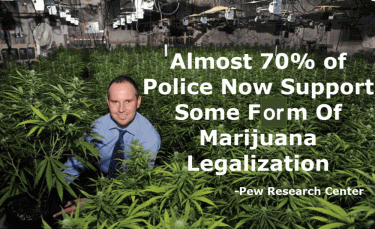
Even the Cops Are Done With Pot Prohibition
When the people who enforce the law stop believing in it, the law has a problem
I have a soft spot for police officers, which may surprise readers who expect a guy named Reginald Reefer to spend his time dodging them. Here’s why. For more than fifty years, we’ve handed law enforcement a job that cannot be done: stop people from buying a plant that tens of millions of them want, grown by organizations that make billions from it, across a border nearly 2,000 miles long. Then we’ve blamed them when they couldn’t do it.
So it’s worth paying attention when cops themselves start saying the plan doesn’t work.
This month, Massachusetts voters faced Question 8, a ballot measure that would have repealed the retail portion of the state’s legalization law and recriminalized home growing. It was backed by SAM Action, the political arm of Smart Approaches to Marijuana, the country’s best-known prohibitionist group. It would have made Massachusetts the first state ever to dismantle a legal adult-use market after creating one.
It lost badly. Roughly 76 percent of voters said no.
Before the vote, the Law Enforcement Action Partnership commissioned a survey of 161 current and former Massachusetts police officers, as reported by The Hype Magazine. Four in five had served both before and after the state opened legal sales, so they’d seen both systems up close. The results were not close:
-
92 percent favored keeping licensed adult-use sales; 8 percent wanted legal retail shut down.
-
79 percent predicted a comeback of unlicensed street sales if legal stores closed.
-
84 percent expected more unsafe, contaminated products.
-
70 percent said a return to the underground market would make it easier for minors to get cannabis.
-
Only 19 percent named drug enforcement as an urgent priority for extra officer hours, ranking it above only paperwork.
That last number is my favorite. When you ask police where they’d like to spend more of their time, chasing weed ranks just above filling out forms.
Now, the honest caveat, because I’d be a hypocrite to skip it. This was an opt-in survey commissioned by an organization that has opposed drug prohibition for more than two decades. It isn’t a random sample of Massachusetts police, and the officers who chose to respond may lean toward reform. I wouldn’t hang a national conclusion on 161 people. But it’s worth noting who else showed up. According to the same report, no major state police association endorsed Question 8. The only police organizations that took a public stance, LEAP and the National Association of Black Law Enforcement Officers, both opposed it. If cops believed legal weed was a public safety disaster, this was their moment to say so. They mostly didn’t.
The Law Enforcement Action Partnership didn’t arrive at this position yesterday. It was founded in 2002 by five officers, including retired police captain Peter Christ and retired lieutenant Jack Cole, under the name Law Enforcement Against Prohibition. In 2017 it rebranded and broadened its focus to criminal justice reform more generally, but the founding idea stayed the same: the drug war makes officers’ jobs harder and communities less safe.
You can see why that idea came from inside the profession. A patrol officer knows what a marijuana arrest actually costs: hours of processing, court time, a criminal record for someone who usually isn’t a threat to anyone, and one more person in the neighborhood who now sees the police as the enemy. Multiply that by the numbers. According to NORML’s analysis of FBI data, police made at least 218,000 marijuana arrests in 2025, most of them for simple possession. Texas alone accounted for more than 29,000. Each of those is time an officer didn’t spend on a burglary, a domestic violence call or an unsolved homicide.
This is where I think the conversation gets most important, and where cops have the most to gain.
For decades, police on both sides of the border have fought cartels with seizures, raids and arrests, and for decades the cartels have absorbed the losses and kept going. Then states started legalizing, and something happened that no border wall or troop surge had managed to do.
The Cato Institute found that after Colorado and Washington opened legal markets, Border Patrol marijuana seizures per agent fell 78 percent between fiscal years 2013 and 2018, from 114 pounds per agent to 25. Cato concluded that state legalization did more to reduce marijuana smuggling than doubling the Border Patrol and building hundreds of miles of fencing had done. By 2023, NORML calculated, seizures at the southern border were down 98 percent from 2013, when agents intercepted more than 2.4 million pounds.
That’s not because smugglers got sneakier. It’s because Americans who want cannabis increasingly buy it from a licensed shop down the street instead of a supply chain that runs through Sinaloa. You can’t outcompete a store that’s legal, tested and cheap.
The geography tells the same story. InsightCrime, citing Customs and Border Protection data, reports that marijuana seizures along the whole southern border fell from just under 1,350 metric tons in fiscal year 2013 to around 70 metric tons in 2022. In southern Arizona, which legalized, agents went from seizing more than 450 metric tons in 2012 to about 5 metric tons in 2021. Meanwhile, smuggling routes shifted toward Texas, the one border state that hadn’t legalized in any meaningful form. Texas is also, not coincidentally, the state that leads the nation in marijuana arrests. If you designed an experiment to show that prohibition creates the black market it claims to fight, you couldn’t do much better.
I want to be precise here, because overselling this hurts the case. Legalization did not destroy the cartels. Cannabis was only ever one revenue stream, and the cartels diversified into fentanyl, methamphetamine, human smuggling and extortion, which are more profitable and far deadlier. Anyone who promises that legal weed will end organized crime is promising too much.
But that’s actually the point. Cannabis is the proof of concept. It’s the one drug where we’ve run the experiment at scale, and the result is clear: when you legalize, regulate and tax a product, you take the market away from criminals more effectively than any amount of enforcement ever did. What’s left for police is the truly violent part of organized crime, the trafficking of people, the fentanyl pipeline, the guns. That’s where we should want cops spending their hours, and it’s where the Massachusetts officers said they want to spend them.
So who’s still fighting for prohibition? The Question 8 campaign was the best-funded ballot fight in Massachusetts this cycle, with nearly $6.5 million spent on both sides. SAM and SAM Action reportedly put $3.7 million into the effort to recriminalize a market that had passed $10 billion in all-time sales and sends tax money to the state and to local governments every year. Voters looked at a decade of legal cannabis, saw the sky still in its usual place, and voted to keep it.
The police who responded to LEAP’s survey seem to have reached the same conclusion. They’ve watched the legal market for ten years. They know what the illegal one looked like. Most of them would rather not go back.
I said I had a soft spot for police, and I mean it. We’ve asked them to fight a war they couldn’t win with tools that made enemies of the communities they serve. We’ve told them to bust teenagers and gardeners while the real money and the real violence moved on to harder drugs. Then we’ve wondered why trust in policing is so fragile.
Legalization isn’t anti-cop. It may be one of the most pro-cop policies on the table. It frees up officers’ time, drains money from criminal organizations, and replaces an adversarial street market with a licensed one that has every reason to follow the rules. The officers in Massachusetts seem to understand that.
Prohibition promised to protect the public. Cannabis legalization has shown that regulation does the job better. When even the people who were sent to enforce the old system are telling us so, maybe it’s time Washington listened.
-
The Hype Magazine, “Why Law Enforcement Is Turning Against Marijuana Prohibition” (LEAP survey): https://www.thehypemagazine.com/2026/11/21/police-turn-against-marijuana-prohibition-new-poll/
-
Axios Boston, Question 8 results: https://www.axios.com/local/boston/2026/11/04/massachusetts-cannabis-marijuana-repeal-campaign-industry
-
The Harvard Crimson, 2026 ballot question results and spending: https://www.thecrimson.com/article/2026/11/5/2026-ballot-question-results/
-
Foley Hoag, Massachusetts adult-use sales history: https://foleyhoag.com/news-and-insights/blogs/cannabis-and-the-law/2026/november/mass-voters-reject-prohibitionist-ballot-initiative-in-landslide/
-
MJBizDaily, SAM Action and the Question 8 campaign: https://mjbizdaily.com/?p=617064
-
Law Enforcement Action Partnership, “Who We Are”: https://lawenforcementactionpartnership.org/about-us/who-we-are/
-
NORML, FBI marijuana arrest data for 2025: https://norml.org/blog/2026/08/25/fbi-nearly-1-in-4-drug-arrests-nationwide-are-for-marijuana-possession/
-
Cato Institute, “How Legalizing Marijuana Is Securing the Border”: https://www.cato.org/policy-analysis/how-legalizing-marijuana-securing-border-border-wall-drug-smuggling-lessons
-
Marijuana Moment / NORML, 2023 southern border seizure data: https://www.marijuanamoment.net/marijuana-seizures-at-u-s-mexico-border-continue-to-fall-as-more-states-legalize-federal-data-shows
-
InsightCrime, “With Legalization, Marijuana Trafficking Routes Evolve Along US-Mexico Border”: https://insightcrime.org/news/with-legalization-marijuana-trafficking-routes-evolve-along-us-mexico-border/
-
Drugfree.org, cartels shifting to heroin and methamphetamine as marijuana seizures fall: https://drugfree.org/?p=51302
COPS ON LEGALIZATION, READ ON…