As artificial intelligence tools become more capable, and more visible, anxiety about their impact on jobs continues to grow. From stories about workflow automation to everyday encounters with generative AI, many people are asking the same question: is AI going to replace my job?
It’s an especially live question right now, because AI has evolved rapidly over the past few years. While this research looks at trends between 2020 and 2023, before generative AI became widely used, it provides an important window into how Australian workplaces respond when AI is adopted.
Research from CSIRO suggests a different story is unfolding in Australian workplaces.
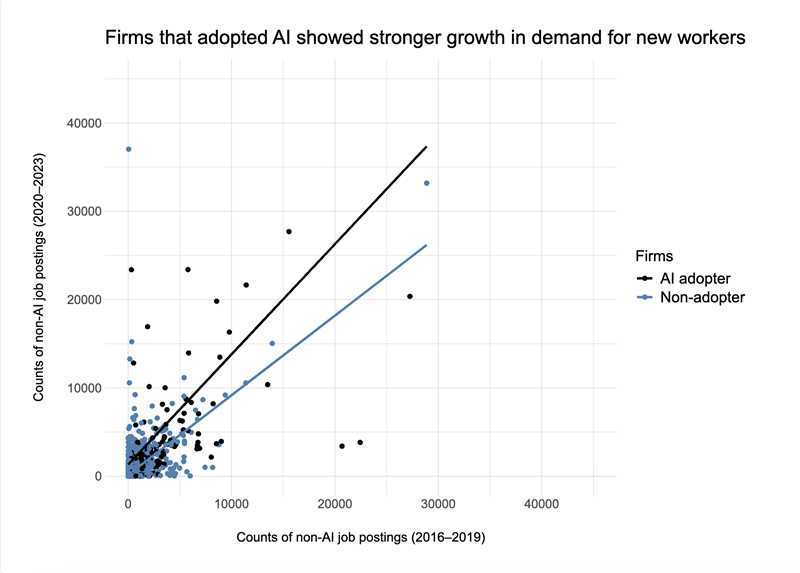
By analysing the hiring patterns of thousands of firms over several years, researchers found that companies adopting AI are not shedding workers. In fact, they are advertising for more jobs, and jobs with broader skill requirements, than comparable firms that haven’t adopted AI.
According to Dr Claire Mason, lead author of the study and Workforce and Productivity research team lead at CSIRO, firms across the board increased their hiring, but those that had adopted AI did so at a significantly faster rate.
Tracking what employers actually want
The study, published in the Australian Journal of Labour Economics, analysed a national dataset of online job advertisements from more than 4,000 Australian firms. The researchers identified AI adopting and non-adopting firms (based on signals in job postings) prior to 2020 and then compared the two groups of firms over the next three years, focusing on their demand for new workers and skills.
“Rather than speculating about future impacts, the study focused on what employers were actually doing – the roles they were advertising and the skills they were asking for. The findings were surprising and offer reassurance for those with concerns about AI’s impact on the labour market,” said Dr Mason.
After accounting for factors such as firm size, industry and location, AI-adopting firms posted 36 per cent more non-AI job ads over time than non-adopting firms. In other words, firms leaning into AI were hiring more people, not less.
The real divide in AI-exposed jobs
Researchers looked more closely at occupations that are considered ‘AI-exposed’ – or, in layman’s terms, roles that involve some tasks that AI systems can now perform.
Many of these roles are not manual or routine jobs, but rather professional and knowledge-intensive ones, such as those of accountants, lawyers, and analysts.
“These are highly skilled, often well-paid roles. They’re the occupations people often worry about when we talk about AI,” explained Dr Mason.
The study found that demand for AI‑exposed roles did not decline in firms that adopted AI. What was evident though was a slight (and statistically significant) decline in demand for these AI-exposed workers in firms that were not adopting AI.
“That suggests AI-exposed workers may be disadvantaged if they’re in firms that aren’t using AI. Their peers in AI-adopting firms are potentially more competitive because they’re able to use these tools to augment their work.”
The findings point to a growing gap – not between humans and machines, but between organisations that embrace AI and those that don’t.
More skills, not fewer
Another common fear about AI is that it will ‘deskill’ jobs, stripping away complexity and reducing the need for human expertise. The evidence from the study points in the opposite direction.
Across the dataset, job ads began listing more skills over time, with the increase being strongest in AI-adopting firms and in AI-exposed roles.
“In many ways, the data counters commonly held fears about deskilling. What we’re seeing is workers being asked to bring more skills to the table, including the ability to work effectively with AI.”
The data also revealed that AI skills were not confined to technical or IT-heavy roles. As the researchers dug deeper, they found that AI-related skills were starting to appear in jobs you might not expect – from sales representatives to security officers and architects.
“This tells us that the distinction between ‘AI jobs’ and ‘non-AI jobs’ is starting to blur. AI is becoming a core part of many roles, not a separate category,” Dr Mason explained.
Change is happening, but gradually
The data analysed in the study covered the period from 2020 to 2023, but more recent Australian labour market data shows similar patterns.
“Even with widespread adoption of new generative AI tools, occupations that are highly exposed to AI continue to be in strong demand,” she said.
“Rather than sudden disruption, the study suggests jobs are evolving incrementally. Tasks are being redistributed, skill sets broadened and roles expanded – without the role itself disappearing.
“The latest AI tools are very user-friendly, but using them well takes knowledge, judgement and experience. We’re finding that domain experts, those with deep, hands‑on expertise in a field, tend to get the strongest results.”
That brings distinctly human strengths to the forefront.
The human advantage in an AI-augmented world
AI excels at processing data, handling large volumes of information and performing repetitive tasks with well-defined boundaries. But the research highlights growing demand for skills that AI struggles to replicate.
“AI isn’t sentient, it can’t reflect on its own thinking. Humans bring awareness, nuance and judgment. That’s where our competitive advantage lies.”
The findings suggest that AI adoption isn’t just about efficiency or automation. It may also be linked to firm and worker competitiveness and growth.
“We see signs of a competitive advantage when firms are using AI. There’s strong evidence from other research that these tools can lift productivity and even improve the quality of work.”
What this means, and what comes next
For many organisations, these findings raise practical questions not just about whether to adopt AI, but how to do so in a way that strengthens both their workforce and competitiveness.
The research suggests AI adoption isn’t simply a technology decision. It is closely linked to skills, job design and how work is structured.
To help organisations navigate these choices, CSIRO released a playbook to support smarter AI investment decisions, bringing together evidence on AI value, readiness and organisational alignment, alongside training and professional development in generative AI and its responsible use.
For workers, the message is not that jobs are disappearing, but that jobs are changing.
“AI isn’t replacing workers. Australians need to be working with and harnessing AI, and learning how to use technology to augment their human intelligence,” explained Dr Mason.
The study doesn’t claim AI is risk-free or that disruption won’t occur. But it offers grounded, local evidence that AI adoption has been associated with stronger demand for workers and richer skill profiles, rather than mass displacement.
“It’s not a zero-sum game. The future of work includes human workers with inherently human skills, embracing technology like AI. It’s the trend we’ve seen with every wave of technological disruption. Technology creates new opportunities,” Dr Mason concluded.
“We must not shy away from this technology. What we’re actually seeing is that the firms and the people who are embracing AI and using it intelligently are doing better as a result.”