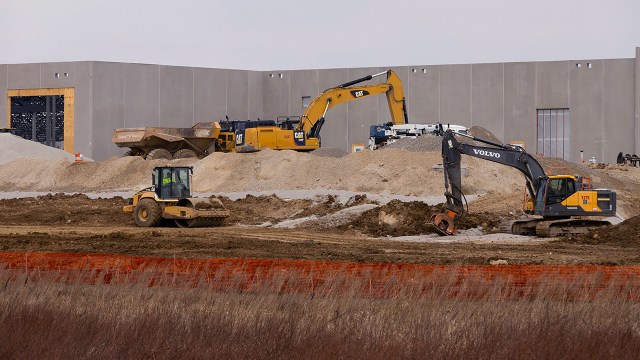
The United States has more than 3,000 operational data centers, and that number is expected to grow substantially in the years ahead. More than 1,500 new data centers are in various stages of development nationwide, according to a Pew Research Center analysis of data from Data Center Map.
In a shift, most planned data centers in the U.S. are in rural areas
% of data centers in the U.S. that are in __ areas

Note: Urban/rural categories based on U.S. Census Bureau. Planned category includes data centers listed as “under construction,” “planned” or “land banked.”
Source: Data Center Map, accessed Feb. 19, 2026.
PEW RESEARCH CENTER
In a shift, most planned data centers in the U.S. are in rural areas
% of data centers in the U.S. that are in __ areas
| Data center status | Urban | Rural |
|---|---|---|
| Planned | 33 | 67 |
| Currently operating | 87 | 13 |
Note: Urban/rural categories based on U.S. Census Bureau. Planned category includes data centers listed as “under construction,” “planned” or “land banked.”
Source: Data Center Map, accessed Feb. 19, 2026.
PEW RESEARCH CENTER
These planned data centers are largely in different parts of the country from those that currently exist:
- 67% of planned data centers are in rural areas, while 87% of existing data centers are in urban ones.
- 39% of planned data centers are in counties that currently don’t have any.
South, Midwest lead in planned data centers
Most of the planned construction of U.S. data centers will happen in the South and Midwest. Three-quarters of all planned data centers will be built in these two regions, with the South alone accounting for nearly half of them (48%).
Virginia, Texas and Georgia lead the country in planned data centers
Number of data centers in each state, by operating status

Note: Planned category includes data centers listed as “under construction,” planned or “land banked.” Only the top 15 states by total are shown.
Source: Data Center Map, accessed Feb. 19, 2026.
PEW RESEARCH CENTER
Virginia, Texas and Georgia lead the country in planned data centers
Number of data centers in each state, by operating status
| State | Total | Currently operating | Planned |
|---|---|---|---|
| Virginia | 685 | 398 | 287 |
| Texas | 466 | 296 | 170 |
| California | 331 | 277 | 54 |
| Illinois | 262 | 139 | 123 |
| Georgia | 235 | 94 | 141 |
| Ohio | 223 | 166 | 57 |
| Arizona | 184 | 98 | 86 |
| New York | 154 | 148 | 6 |
| Oregon | 142 | 115 | 27 |
| Washington | 135 | 124 | 11 |
| Pennsylvania | 129 | 78 | 51 |
| Florida | 128 | 120 | 8 |
| North Carolina | 113 | 72 | 41 |
| Iowa | 105 | 64 | 41 |
| Indiana | 92 | 38 | 54 |
Note: Planned category includes data centers listed as “under construction,” planned or “land banked.” Only the top 15 states by total are shown.
Source: Data Center Map, accessed Feb. 19, 2026.
PEW RESEARCH CENTER
Here’s a look at the regional breakdown of planned and existing data centers:
- The South has 754 planned data centers and 1,209 existing ones – a 62% increase from its current total.
- The Midwest has 419 planned data centers and 655 existing ones – a 64% increase.
- The West has 277 planned data centers and 807 existing ones – a 34% increase.
- The Northeast has 106 planned data centers and 397 existing ones – a 26% increase.
Virginia and Texas have the most planned data centers (287 and 170, respectively). They are followed by Georgia (141), Illinois (123) and Arizona (86).
Virginia and Texas also have the most currently operating data centers (398 and 296, respectively). They are followed by California (277), Ohio (166) and New York (148).
How many Americans live near a data center?
Currently, 38% of Americans live within 5 miles of at least one operational data center.
These structures tend to be built in clusters: Nine-in-ten data centers are within 5 miles of another one. As a result, a majority of Americans who live near one data center also live near at least one more.
Another 4% of Americans don’t live near a currently operational data center but live within 5 miles of one that’s planned. Taken together, that means 42% of the population lives close to an existing or planned data center.
Living near a data center doesn’t have much of an effect on public opinion about the facilities, however. Americans who live near a data center – whether existing or planned – are about as likely as those who do not to say they’ve heard or read at least a little bit about them. And the two groups of Americans have similar views about the impact that data centers have on things like the environment, home energy costs and local jobs.
Note: Here are the survey questions, the detailed responses and the survey methodology.