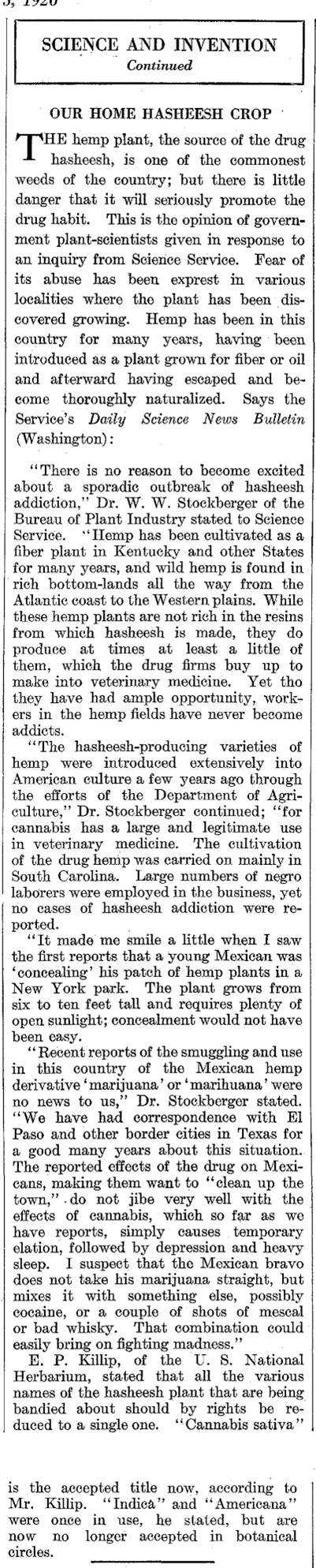
The clipping in the image above this article is dated 1926. It’s a piece from Science and Invention magazine, reporting on an inquiry to the Bureau of Plant Industry about hemp growing wild across the country. The headline: “Our Home Hasheesh Crop.”
Read it carefully and you’ll find something remarkable — not alarm, not moral panic, but a measured, almost bored scientific assessment. Dr. W.W. Stockberger of the Bureau of Plant Industry told the publication there was “no reason to become excited about a sporadic outbreak of hasheesh addiction.” Hemp had been growing wild across America for years. Workers labored in hemp fields their whole lives and “never became addicts.” Cannabis had a “large and legitimate use in veterinary medicine.” It grew wild from the Atlantic coast to the Western plains. It was, in the view of the government’s own plant scientists, a weed.
That was the official American scientific position on cannabis in 1926. Not dangerous. Not alarming. A plant with uses, growing everywhere, harming nobody.
Eleven years later, it was a federal crime.
What America Had Before It Threw It Away
To understand what prohibition actually cost, you have to understand what existed before it.
Cannabis had been listed in the United States Pharmacopoeia since 1850. [1] Not as a fringe remedy — as a recognized treatment for over 100 conditions including pain, insomnia, menstrual cramps, and convulsive disorders. By the late 1800s and into the early 20th century, major pharmaceutical manufacturers including Eli Lilly were producing standardized cannabis tinctures sold openly in pharmacies. [2] There were at least 2,000 cannabis-based medicines on the American market before 1937, produced by more than 280 manufacturers. [3]
Your grandmother’s headache tonic almost certainly had cannabis in it. The pain medicine in the cabinet, the sleep remedy, the stomach tonic — cannabis was woven into American medicine the way aspirin is today, except it had a far longer track record. [4]
On the industrial side, the picture is even more striking. Hemp seed oil was a standard industrial lubricant and the primary ingredient in paint and varnish — by 1935, over 116 million pounds of hemp seed went into paint and varnish production alone. [5] Hemp fiber made rope, canvas, clothing, and paper. The Constitution’s draft was written on hemp paper. Betsy Ross’s first American flag was sewn from hemp cloth. Early Virginia colonists could legally pay their taxes in hemp harvest shares. [6]
Then in 1938 — one year after the Marihuana Tax Act effectively banned all of it — Popular Mechanics published what became one of the most bittersweet documents in American agricultural history. They called hemp “the new billion-dollar crop,” capable of producing more than 25,000 different products, with fiber stronger than any synthetic alternative, and paper yields four times more efficient per acre than timber pulp. [7]
The article was published after hemp was already illegal. Congress had banned the future while Popular Mechanics was still describing it.
How You Destroy a Civilization’s Most Useful Plant
The 1926 article is interesting for another reason beyond its scientific calm. Dr. Stockberger made a telling observation about the Mexican-grown cannabis being smuggled across the border. He said the effects he’d heard described — people wanting to “clean up the town” — didn’t match what cannabis actually did, which in his experience “simply causes temporary elation, followed by depression and heavy sleep.” He speculated that Mexican users were mixing it with something else. Cocaine, mescal, bad whisky.
What he was observing, without fully naming it, was the beginning of the racialized propaganda campaign that would eventually destroy the entire industry. “The Mexican bravo” taking his cannabis mixed with hard substances was the kernel of the myth. By the mid-1930s, that kernel had been fertilized by William Randolph Hearst’s newspaper empire into full-blown Reefer Madness — jazz musicians, Black men, Mexican immigrants, white women led astray, violence, insanity, death. [8]
Harry Anslinger, who became the first commissioner of the Federal Bureau of Narcotics in 1930 after alcohol prohibition collapsed and he needed a new mandate, ran with it. Cannabis historians have documented that Anslinger’s campaign was driven not by evidence of harm but by the institutional need to justify his own bureau’s existence. [9] The science didn’t change. The politics did.
And so a plant with 10,000 years of documented human use, a formal place in the American Pharmacopoeia, an established industrial base, and the active endorsement of the government’s own plant scientists was reclassified as one of the most dangerous substances on earth. It happened in about a decade. It has stayed that way for nearly nine.
The Crime Against Humanity Nobody Calls a Crime
Calling cannabis prohibition “one of the greatest crimes against humanity” is a phrase that sounds hyperbolic until you add up what it actually cost.
The endocannabinoid system — the network of receptors throughout the human body that cannabis directly engages — wasn’t discovered until the 1990s because research was effectively impossible under prohibition. [10] We lost half a century of understanding our own biology because the plant that illuminated it was illegal. The medical applications that were already documented in 1850, in 1900, in 1926, had to be rediscovered from scratch after a 50-year blackout.
Over 20 million Americans have been arrested for cannabis possession since 1970. [11] Disproportionately Black, disproportionately poor, disproportionately stripped of employment, housing, and voting rights — not for harm caused to anyone, but for carrying a plant that government scientists in 1926 called a common weed with no serious addiction risk.
The industrial applications that were estimated to be worth billions — the fiber, the paper, the oil, the building materials — were simply handed to petroleum, synthetic fiber, and timber industries that lobbied hard to keep their competitors illegal. The economy that hemp could have built, the carbon sequestration it could have contributed, the farmland it could have regenerated — all of it was foreclosed by a propaganda campaign built on racism and bureaucratic self-preservation.
The man who read that 1926 article in Science and Invention and set it aside had no idea that his government was about to execute one of the most consequential acts of economic and scientific sabotage in modern history. He just read that the hemp growing by the railroad tracks was nothing to worry about.
He was right. They were wrong. And we’re still paying for it.
Reginald Reefer writes about cannabis culture, policy, and the history that keeps repeating itself.
Citations: [1] PMC/NCBI — “Medicinal Cannabis: History, Pharmacology, And Implications for the Acute Care Setting.” https://pmc.ncbi.nlm.nih.gov/articles/PMC5312634/ [2] Grokipedia — “Tincture of Cannabis.” https://grokipedia.com/page/Tincture_of_cannabis [3] Wikipedia — “History of Medical Cannabis.” https://en.wikipedia.org/wiki/History_of_medical_cannabis [4] ACS Compassion — “A Brief History of Medical Cannabis in the United States.” https://acscompassion.com/a-brief-history-of-medical-cannabis-in-the-united-states/ [5] Michigan Medical Marijuana — “Some History About Marijuana.” https://michiganmedicalmarijuana.com/some-history-about-marijuana/ [6] Earth Island Journal — “Hemp: The Next Billion-Dollar Cash Crop?” https://www.earthisland.org/journal/index.php/articles/entry/hemp_the_next_billion-dollar_cash_crop/ [7] Popular Mechanics, February 1938 — “New Billion-Dollar Crop.” https://www.globalhemp.com/1938/02/new-billion-dollar-crop.html [8] Origins, Ohio State — “The Illegalization of Marijuana: A Brief History.” https://origins.osu.edu/article/illegalization-marijuana-brief-history [9] Medium/2030 Magazine — “The Would-Be Billion-Dollar Crop.” https://medium.com/2030magazine/the-would-be-billion-dollar-crop-6aa6db20a1f [10] PubMed — “History of cannabis as a medicine: a review.” https://pubmed.ncbi.nlm.nih.gov/16810401/ [11] NORML arrest data, referenced across multiple prior citations.
HEMP AND CANNABIS HISTORY, READ ON…