An appellate court in China just ruled that a tech company violated the law when it fired an employee after AI took over his job. The April ruling from the Hangzhou Intermediate People’s Court sets a precedent that companies with employees in China should pay attention to. What happened and what do you need to know about this ruling?
What Happened
A tech company in Hangzhou, China’s eastern AI hub, deployed AI large language models to take over a quality assurance supervisor’s core responsibilities (which, ironically, focused on verifying the accuracy of AI-generated outputs). Rather than eliminate his position right away, the company attempted to reassign him to a lower-level role at a 40% salary reduction. When the employee (identified only by his surname Zhou) refused, the company terminated his contract, citing organizational restructuring and reduced staffing needs driven by AI adoption.
Zhou fought back and filed an arbitration claim. After he won, the company (which was also unnamed in the court ruling) sued to overturn the arbitration decision. But it lost at the district court level and just last week lost again on appeal.
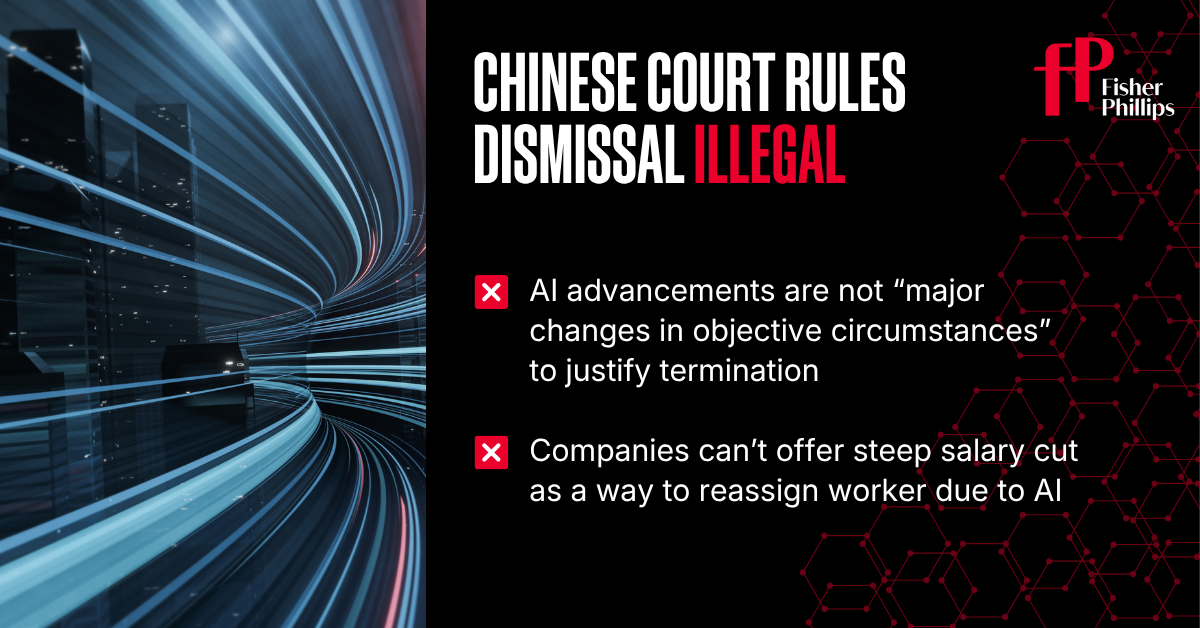
The Hangzhou Intermediate People’s Court ruled the dismissal unlawful on two grounds:
- First, AI-driven workforce reduction does not constitute a “major change in objective circumstances” under China’s Labor Contract Law, which is the legal threshold required to justify termination based on redundancy.
- Second, the steep salary cut embedded in the reassignment offer was itself unreasonable. The court’s conclusion was that companies cannot shift the costs of technological transformation onto their employees.
Similar Legal Standards Exist Around the Globe
The Hangzhou ruling is not an isolated development. It builds on a December 2024 arbitration decision in Beijing involving a data mapping worker whose job was automated away. That panel reached a similar conclusion: an employer’s decision to adopt AI is not an uncontrollable event, and the costs of that business choice cannot be unilaterally passed to employees through dismissal or demotion.
But the significance extends well beyond China. Most US employers operate in an at-will environment and have grown accustomed to broad latitude in workforce decisions, including those driven by technology (although there is simmering tension when it comes to unionized work). By contrast, many countries impose robust statutory protections governing how, when, and under what circumstances employees can be dismissed. The integration of AI adoption is a key factor being considered in an increasing number of situations.
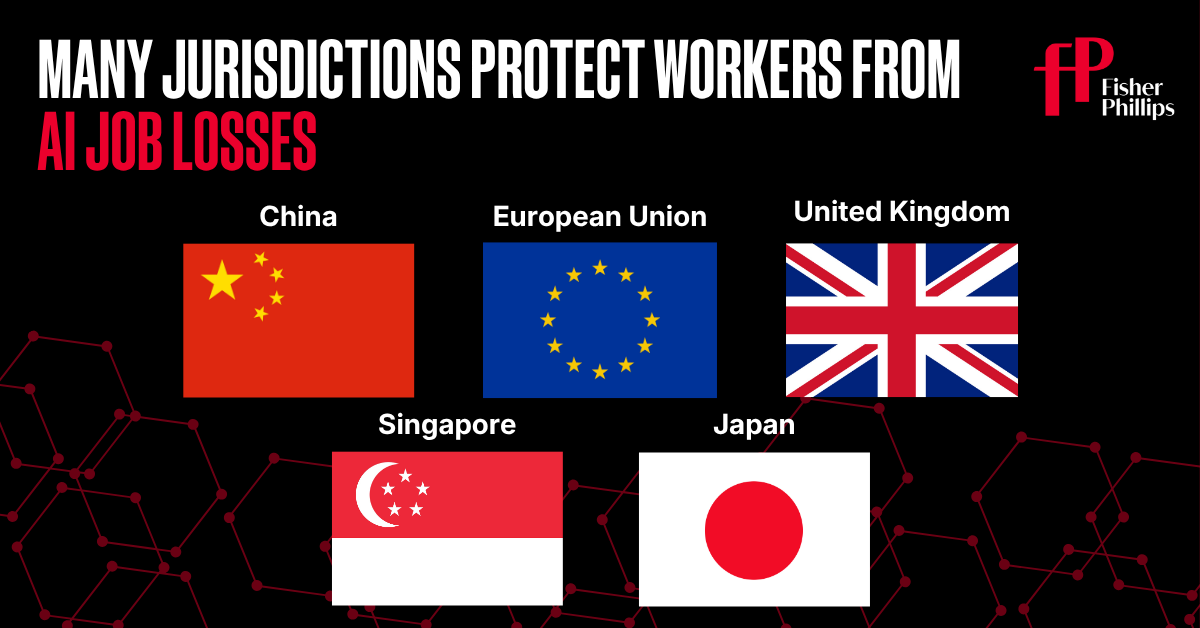
- In the European Union, for example, mass layoffs driven by automation may trigger consultation obligations under the Collective Redundancies Directive. This law requires employers to notify and engage works councils before redundancies are implemented.
- The EU AI Act adds a separate compliance layer for high-risk AI systems used in employment contexts, including hiring, performance management, and task allocation.
- In the United Kingdom, dismissals linked to technological change may engage unfair dismissal protections, with tribunals scrutinizing whether employers followed fair processes and genuinely considered alternatives.
- Across Asia-Pacific in jurisdictions such as Singapore and Japan, mandatory reemployment obligations, notice periods tied to seniority, and sector-specific labor rules can create significant exposure for employers who treat AI-related restructuring as a straightforward business decision.
What Does This Mean for Your International Operations?
Whether you have employees in China, Europe, or elsewhere, the Hangzhou ruling can teach lessons about what you should be doing right now.
- Audit your AI deployment plans jurisdiction by jurisdiction: Before rolling out AI tools that will displace or materially alter existing roles, understand the legal framework in each country where affected employees work.
- Don’t assume reassignment is a safe harbor: The Hangzhou court’s scrutiny of the pay cut shows that a demotion or material reduction in compensation can itself constitute a constructive dismissal and expose employers to liability.
- Engage local counsel before you make decisions: AI-fueled restructuring decisions that look clean from a US perspective can carry significant legal risk abroad. You should work with employment counsel in each jurisdiction at the planning stage.
Conclusion
If you have questions, contact your Fisher Phillips attorney, the authors of this Insight, or any attorney in our AI, Data, and Analytics Practice Group or our International Practice Group. Make sure you subscribe to Fisher Phillips’ Insight System to gather the most up-to-date information on AI and the workplace.