The common area of the Accelr8 “hacker hotel” is on the fourth story of a Market Street inn two blocks from City Hall. On one side is an enormous flat-screen TV unplugged on the carpet; on the other is a wooden dining table where half a dozen AI kids (male startup founders in their 20s and 30s) are waiting. Pat Santiago, the 28-year-old founder of Accelr8, led me past a bathroom used for storage and a handful of residents peering into code or Zoom calls. He was in shorts and a baseball cap from a friend’s bar, fielding a call between puffs of his vape. Because he’s a polite young man, he furtively exhaled the smoke into the collar of his short-sleeve button-up instead of blowing clouds.
The men in front of me wore hiking boots, rubber slides, white sneakers, noise-canceling headphones, and facial scruff of varying densities. One late arrival had a thick silver chain with a gold padlock around his neck. Most have been in San Francisco for less than a year. The newest arrival was Shreyansh Anand, who moved from Canada three weeks ago to build a company that automates admin work in medical clinics. “Every day there are 12 events going on with free food and people talking about really interesting things,” Anand said. “That energy is unmatched anywhere in the world. That density of people building is just crazy.”
The other founders were drawn to San Francisco for similar reasons: to network and secure funding, yes, but also to meet like-minded young dreamers whose ideas went unappreciated in their hometowns. “A lot of these guys legitimately want to change the world,” Santiago, who moved from Pittsburgh in 2024, told me. “That can be shitty if you’re in, like, rural Pennsylvania. If you tell people, they’re probably gonna mock you.”
San Francisco — with a mythology written during the dot-com boom and the “move fast and break things” 2000s — has become the global center of a technology that might lead to utopia or “Mad Max”-style horror. Where else would these young seekers go?
“Those stories over time have just compounded to where it’s this super strong magnet pulling these people out here,” Santiago said. “The shocking experience for most of the people who are drawn out here is that they’re like, ‘Oh, there are other people like me.’ That’s pretty cool.”
But the other shocker is the San Francisco outside the AI bubble. Founders at the hacker hotel said they didn’t expect street homelessness to be so visible (one copes by staying indoors). Others were dismayed by how hard it was to find friends. For city residents not in tech, this — the billboards, the bus ads, the idea that SF is an AI playground awash in VC cash, and the naivete of the new arrivals — is annoying. It doesn’t help that many locals are nervous about AI and skeptical that it will help anyone but a wealthy few.
Optimists like the ones I met at the hacker hotel and doomers warning that a rogue superintelligence will kill us all may have defined San Francisco’s AI moment in the popular imagination, but many residents still don’t know what all the fuss is about. “Ah, A1? I only know the guy who is on trial, Musk, who has A1,” said María, a woman I met while walking the Mission last week who has seen but apparently misread the abbreviation for artificial intelligence. The Mission served as the first headquarters location for OpenAI, and the neighborhood, which gets invoked in every local gentrification debate, is a sort of battleground for the city’s identity. Is San Francisco a city for lowriders, small businesses, 49ers fans, and families? Or is it for disruptors building agentic AI?
‘They’re shoving it down our throats’
San Francisco has always absorbed waves of romantics who arrived to remake the world — and the people who’ve lived here long enough to recognize the pattern are watching this latest wave break with a familiar mix of amusement and dread.
A few apparent tech workers in mustaches and chore coats declined to comment when I approached them. Most people who agreed to talk were unclear on how AI works and how widely it could be applied. If the AI subculture is a sort of Vatican City nestled within SF, these are the Romans who live all around it. They do not exalt their new god. Many raised concerns about water usage from data centers, job replacement, further concentration of wealth among tech moguls, and an erosion of critical thinking and creativity. They conceded that AI could be useful, perhaps revolutionary, in fields like medical research. But that doesn’t mean they have to like its ubiquity.
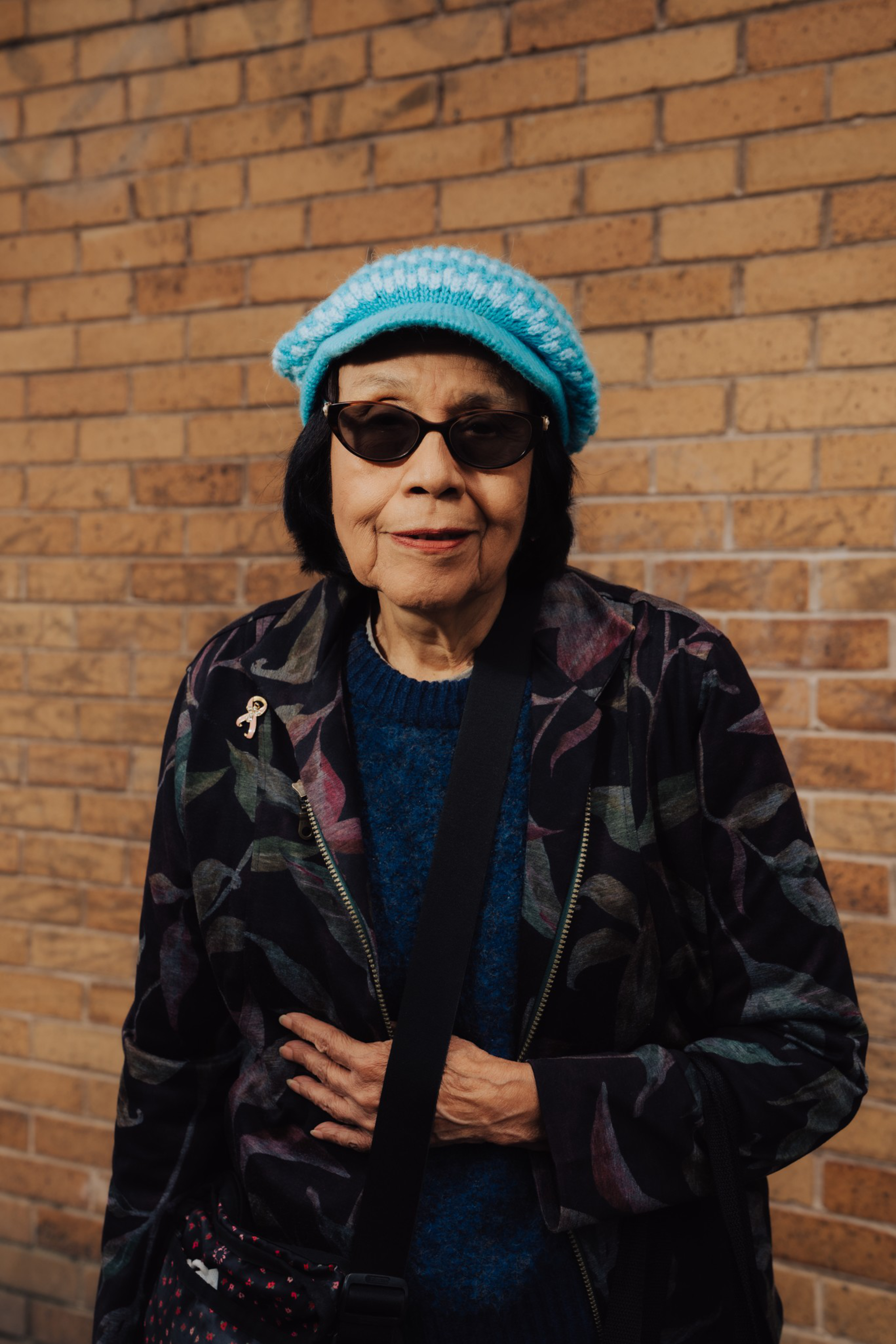
“I’ll start throwing up at your feet,” 60-year SF resident Kate Goldberg said when I asked her about AI. “They’re shoving it down our throats way before it’s ready to do anything decent.” She was walking her tiny dog, Estella, on Valencia Street and wearing sunglasses that were expansive but inexpensive. (“I never pay more than $12,” she said.) Goldberg understands why AI kids flock to the city based on a fantasy — before she moved to San Francisco in the 1960s, she imagined the city would be full of Beats. Then she arrived. “It’s not a city of poets. It’s a city of bankers!” she said, laughing.
Today’s wide-eyed techno-optimists bear little resemblance to the Beats and hippies who once defined San Francisco, but they fulfill the same role. Even during the Summer of Love, hippies were only a tiny sliver of SF’s population, but the reputation they created enticed true believers to the capital of their romantic ideology. In that way, they’re not so different from the guys who gathered around the dining table at Accelr8, eager to share their dreams of AI-enabled utopia.
“Hippies didn’t have that much money back then,” Anand said after thinking about the comparison. “That’s a big difference.” His peers laughed and agreed. Goldberg did too.
“Clearly somebody’s getting very rich very fast,” she said, “and it isn’t me.”
‘The goal is full unemployment’
So how worried should we be? I asked Nick Bostrom (opens in new tab), the “Swedish superbrain” philosopher whose book on superintelligence is a seminal AI text. Other than Eliezer Yudkowsky and Arnold Schwarzenegger, he might be the person most responsible for raising the idea of the technology’s existential risk. Also on his résumé is the fact that Peter Thiel has identified him as a potential agent of the Antichrist.
“I do think we are building toward a general automation technology that will be able to do more and more tasks and then more jobs and, in the ultimate limit, basically all jobs,” Bostrom said. “You could say the goal is full unemployment.”
That sounds scary, but Bostrom said it could cut either way; AI might impoverish us all or liberate us from toil so we can spend hours painting or learning to play the clarinet. The key factor is whether governments — or the big firms themselves — will intervene to care for the workers that AI disenfranchises, either through universal basic income or a jobs guarantee or some other system. Despite OpenAI’s recent white paper arguing for wealth redistribution (opens in new tab), it’s hard not to wonder whether industry leaders wouldn’t rather keep their riches for themselves.
“Obviously, we’ve never had [artificial general intelligence] or superintelligence before, so there’s a lot of uncertainty about how it will play out,” Bostrom said in a measured tone not befitting an alleged minion of Beelzebub. “The sensible attitude would be a kind of fretful optimism — an anxious hopefulness. Each person would internalize both of these in some uneasy tension. What we often seem to see instead is a division of labor.”
Pedestrians in the Mission, even those who appreciate AI’s power as a “super search engine,” said the technology is “spooky,” oversold, and sure to be abused by bad actors. They brought up hallucinations, the prospect of widespread unemployment, and the techno-dystopian television series “Black Mirror.” Polling shows that other parts of the state are even more skeptical; Bay Area residents are less likely (opens in new tab) than Californians overall to believe AI will eliminate jobs and more likely to use AI at work every day.
That contrasts with how most people outside the bubble feel about it. A TechEquity survey found that 55% of Californians are more worried than enthusiastic (opens in new tab) about AI advances. Nationally, Pew Research Center found that 57% of Americans rate the societal risks of AI as high (opens in new tab) — more than double the 25% who say the technology will have major benefits.
‘I think I got a few years’
I found Alex Meistas on a ladder, threading wire into a roof panel outside the Mission location of the upscale local grocery Bi-Rite. He shrugged when asked whether he’s worried about AI replacing him. “I think I got a few years,” he said. After decades of automation replacing factory jobs and hollowing out the Rust Belt, it’s no small irony that AI is poised to replace “knowledge workers” before anybody else. The yuppies working as software engineers, paralegals, data analysts, and (gulp) journalists who moved to SF for its market-competitive salaries now fear they’ll be first on the chopping block.
Despite recent advances in robotics — or, as some boosters call it, “physical AI” — it’s hard to imagine a humanoid electrician bot completing the job Meistas was working on while we chatted. But he recognizes he’s part of a fragile ecosystem. If Bi-Rite’s well-heeled patrons lose their jobs and are unable to pay top dollar for Alphonso mangoes and artisanal chili crisp, that imperils the store’s bottom line and, in turn, his paycheck. This is also true of janitors in office buildings, shopkeepers, and even the region’s ailing public transit systems. For better or worse, San Francisco has staked its future on AI. If the bet crashes the local economy, tech employees aren’t the only ones who will suffer.
Have thoughts on this story?
There was no consensus among the hackers at Accelr8 on whether an AI bubble existed or would pop, or what would become of the working masses if it did. Some founders were certain that AI would create jobs and solve the economic problems it caused. Others were so confident in the technology that they didn’t believe a bubble was possible at all. Tigran Voskanyan, a 24-year-old app founder from Armenia, had a more extreme view. “When we achieve AGI, it should dominate humans,” he said.
Voskanyan’s argument, elaborated in an essay on X (opens in new tab), is that a dominant superintelligence would force humans to evolve. Those incapable of evolution would meet the same fate as the Neanderthals, swept into the dustbin of history. Those who survive would be stronger for it. The other founders pushed back, arguing that AI should empower people to improve their lives. But perspectives like Voskanyan’s have traveled widely. To some people, these ideas call for drastic measures.
On April 10, around 3:40 in the morning, a person went to the Russian Hill home of OpenAI CEO Sam Altman and threw a Molotov cocktail at the front gate. Prosecutors allege the suspect, a baby-faced 20-year-old named Daniel Moreno-Gama, traveled from his home in Texas to kill Altman. His online footprint included posts under the name “Butlerian Jihadist,” a reference to a war waged against AI thinking machines in the sci-fi classic “Dune.” He was found with a three-part manifesto and a list of names and addresses of CEOs and investors. Two days later, a pair of young adults not affiliated with Moreno-Gama were arrested after firing a round near the same residence.
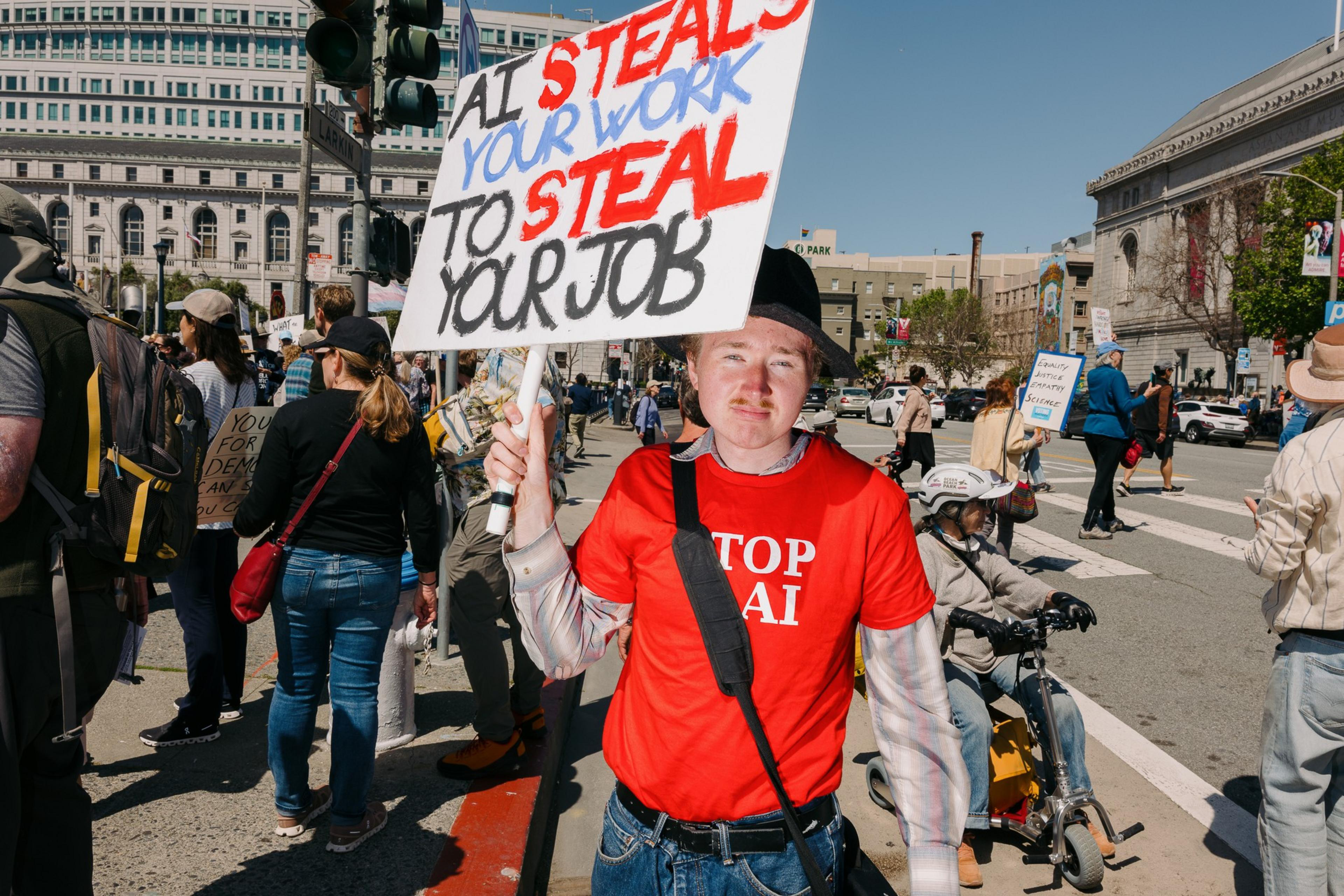
These are the few who took their grievances to Altman’s front door, but hundreds more echo their rhetoric on Reddit, X, and Discord. The Oakland-based group Stop AI has organized protests to call for AI companies to pull the plug. Across the country, resistance is mounting to the construction of new data centers. It’s hard not to draw a line between what AI chiefs have been saying about the technology’s likelihood to drive unprecedented societal change and the radicalization of those who want to hit the brakes by any means necessary.
The attacks on Altman’s house triggered a tsunami of op-eds and thinkpieces about AI’s messaging problem, which many seemed to blame for the violence. “How do you think people will react if there are clips of you saying the thing you build will wipe out most jobs and then, God forbid, unemployment goes to 15 or 20%?” reads a tweet from the X account powerbottomdad1 (opens in new tab), which posts about tech and tech culture. “It will not be peaceful.” Historically, when unemployment skyrockets, civil unrest does too. What we’re seeing now may just be the warning shots.
‘Find any gray hair, and they’ll say, fuck AI’
Most of the hackers at Accelr8 agreed that if AI does eat the economy, company owners need to share the wealth. Some proposed universal basic income programs that could distribute revenue from a capital gains tax on AI firms. One suggested a trading bot that could make enough money to feed all Americans. All expressed faith that things would work out in the end, even if the rocky transition could last decades.
People in San Francisco seem more concerned with economic upheaval and other immediate impacts than with AI’s existential risks. During my sidewalk conversations, two themes came up again and again: critical thinking and creativity. Even if AI doesn’t cause human extinction, people worry that it could kill the human soul.
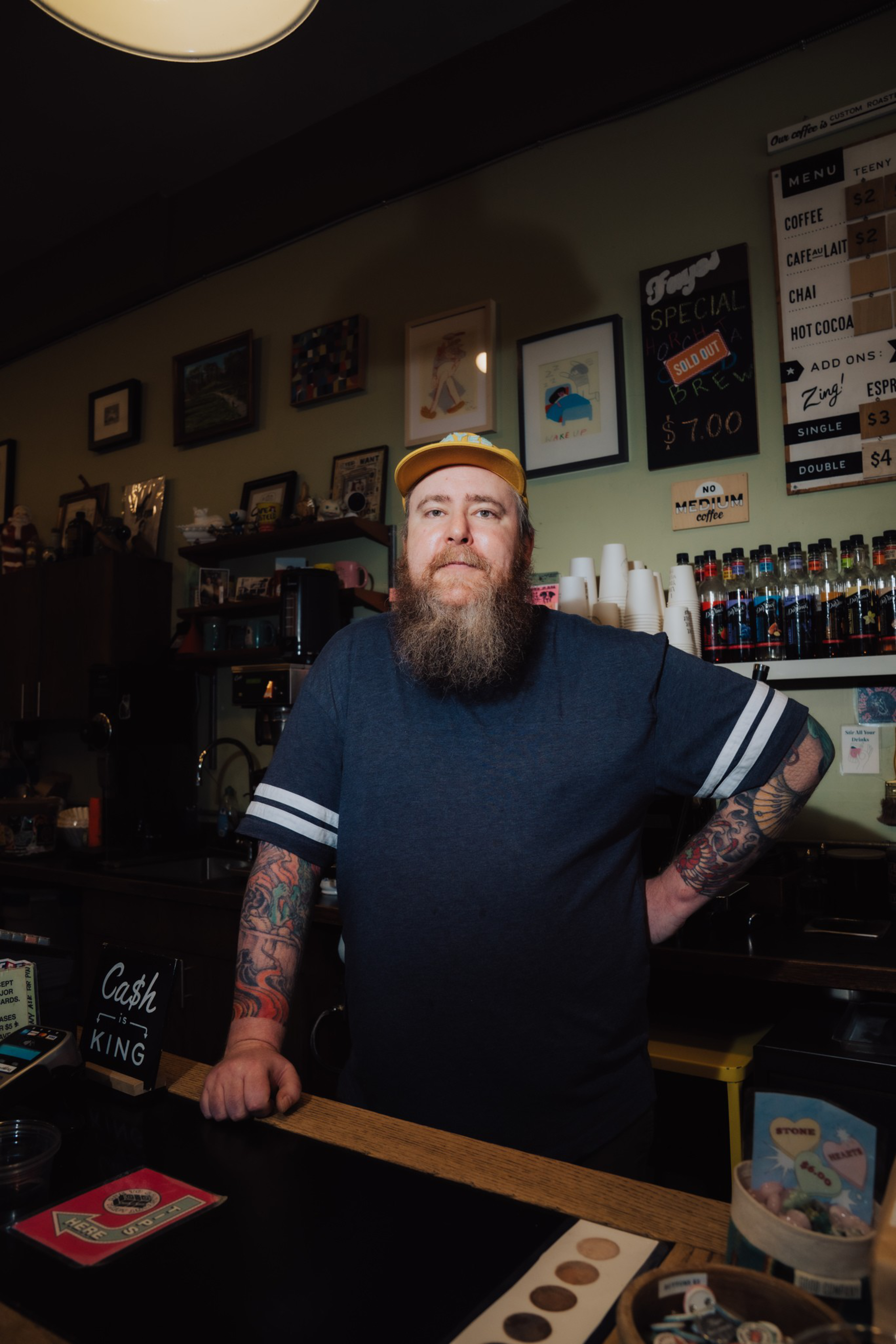
Justin Lawrence, 52, works as a barista at Fayes Coffee in the Mission. It’s the kind of quirky neighborhood hole-in-the-wall that showcases local artists on its walls and rents out DVDs by auteurs. “All you gotta do is find any gray hair, and they’ll say, ‘Fuck AI,’” Lawrence said from behind the counter, salt-and-pepper beard bristling under a wry smile. “This instant gratification is adding to the general sense of despair everyone is experiencing. There’s a reward when you work hard.” Lawrence said he suffers from a rare neurological condition and hopes AI can help medical researchers make a breakthrough, but he doesn’t want to see regular people’s minds atrophy as they let chatbots do their thinking for them.
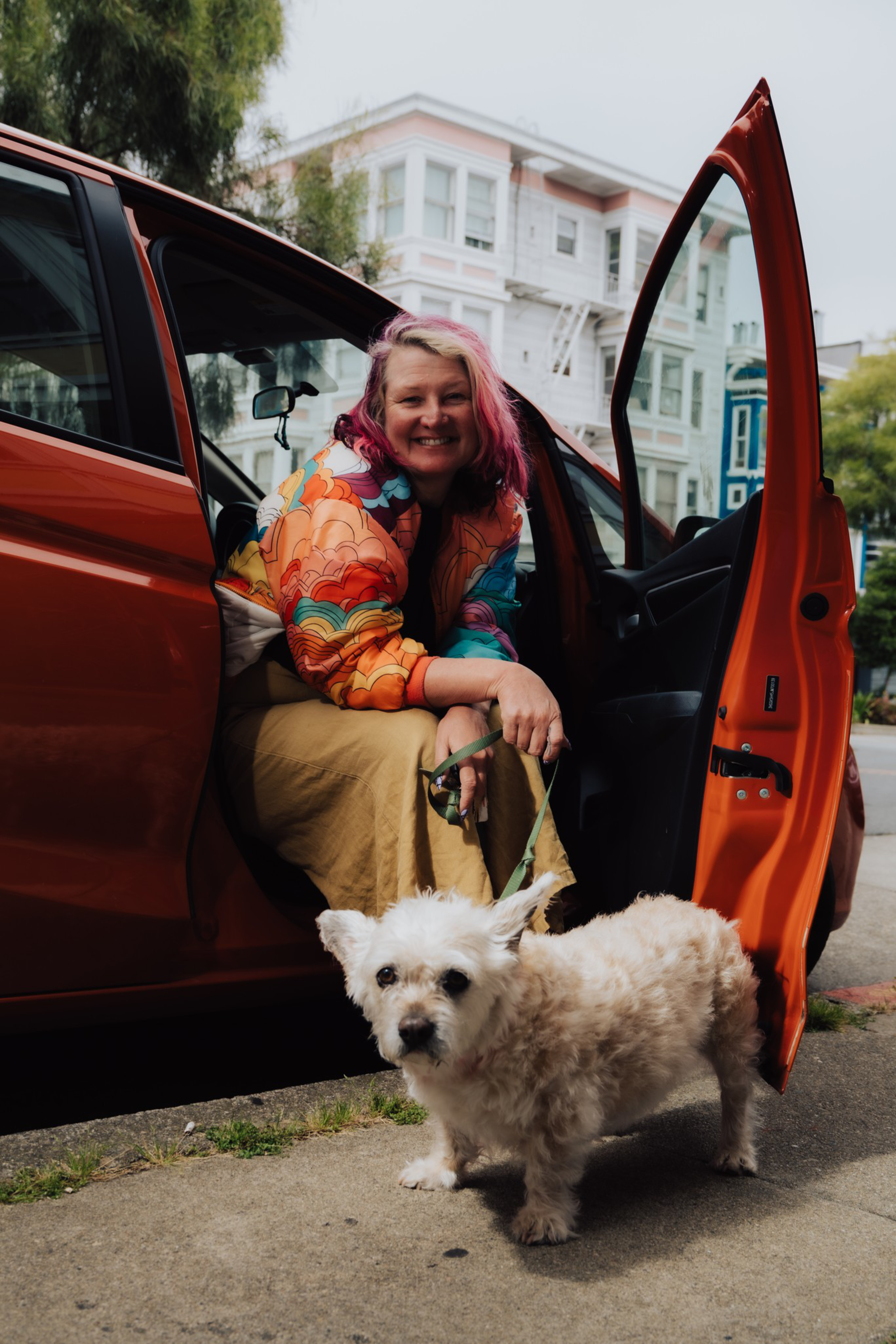
A local artist named Jenny argued that people lose their humanity when they forfeit their ability to reason. “I will see people, instead of thinking through an issue, ask AI,” she said, sitting in her tomato-red sedan. In Jenny’s experience, this can even extend to matters of personal preference. She has breast cancer but doesn’t want that to be the center of her identity, so when an acquaintance referred to her as a “cancer patient,” she let them know she doesn’t like the term. The acquaintance responded that, actually, a chatbot said that’s how people with cancer like to identify, Jenny said. It pissed her off.
AI could also imperil Jenny’s livelihood. Will there even be a market for handmade art when AI tools advance enough to produce high-quality original music, images, and literature? Readers of The New York Times already prefer some machine-generated prose, as a recent quiz (opens in new tab) showed. And surviving in SF was near impossible for working artists even before the AI boom. When I asked the hackers what would happen to San Francisco if the bubble popped, one responded immediately: “Knock on wood, our [investment] round is big enough that we can survive.”
As far as the soul of the city goes, there’s still plenty of appreciation for human creativity, even within tech circles. Anand, the founder working on automating medical admin work, recalled a recent encounter with artistry: “I got an email the other day where their email signature said, ‘This email was written with 0% ChatGPT and manually handcrafted,’” he said, smiling.
Lawrence, the barista, said he’s able to stay in the city only because he lives in a rent-controlled apartment. If his building burns down, he said, who’s going to make people coffee? Who will make art for AI models to steal? He’s seen SF boom and bust before and is strapping in for the same cycle now. “I’ve been here long enough to see things bubble and burst,” he said. “We’ll see what it’s like on the other side.”