President Trump announced late last night that, at the request of leaders in the Middle East, he’d scrapped planned strikes in Iran for Tuesday.
This will be a relief to Wall Street, with investors nervous about the conflict between Iran and the U.S. escalating once more, delaying the reopening of the Strait of Hormuz and choking global oil supply as a result.
But traders were cautious about jumping on a jolly bandwagon too soon. Markets moved only modestly on the news, perhaps because investors viewed it as the avoidance of bad news rather than confirmation of good news.
Trump also made it clear he wouldn’t hesitate to re-engage militarily in Iran if a deal couldn’t be reached. He added on Truth Social that the U.S. is “prepared to go forward with a full, large-scale assault of Iran, on a moment’s notice, in the event that an acceptable Deal is not reached.”
ONE BIG THING
Fed may be forgetting Inflation 101
Sit down in any entry-level econ class, and one of the first things you’ll learn is a graph: The equilibrium between supply and demand.
Somehow, the Fed has overlooked this in its monetary policy response, according to William Luther, an associate professor at Florida Atlantic University. Speaking to Fortune’s Shawn Tully, Luther says Powell’s reasoning for “transitory” price rises due to Iran and tariffs is ill-advised and could land the economy in an inflationary scourge akin to 2021 and 2022.
To find the source of inflation, the Fed must remember the basics, Luther says, explaining that the overall dollars Americans pay for goods and services is rising a lot faster than the quantities of cars, appliances, or hotel rooms we’re producing and supplying.
“The fundamental problem is that more money is chasing the same number of goods. We have an aggregate demand issue, not a supply disruption issue,” he said.
AI
Huang’s plumber prediction isn’t reality just yet
Nvidia CEO Jensen Huang predicted last year that as the AI boom ramps up, plumbers and electricians will be needed by the hundreds of thousands.
That may well prove true, but Goldman Sachs analyst Elsie Peng highlights in a recent note that, so far, there are few signs of a labor market mismatch. There are no perfect ways to test the theory that there are “too many coders and not enough plumbers,” Peng wrote but highlights that the market has slowly been transforming itself since 2019.
There have been 450,000 fewer roles in office occupations where AI is already being deployed, she writes, and jobs highly exposed to AI substitution have seen recruiting drop to pre-pandemic levels.
Overall, Goldman’s occupation-level version of the Lazear-Spletzer mismatch index (which captures the share of job searchers who would need to be reallocated to equalize labor market tightness across occupations) has declined from its 2022 peak and is now below its pre-pandemic level.
MORE FROM FORTUNE
CHART OF THE DAY
Asia’s chip pipeline is looking healthy
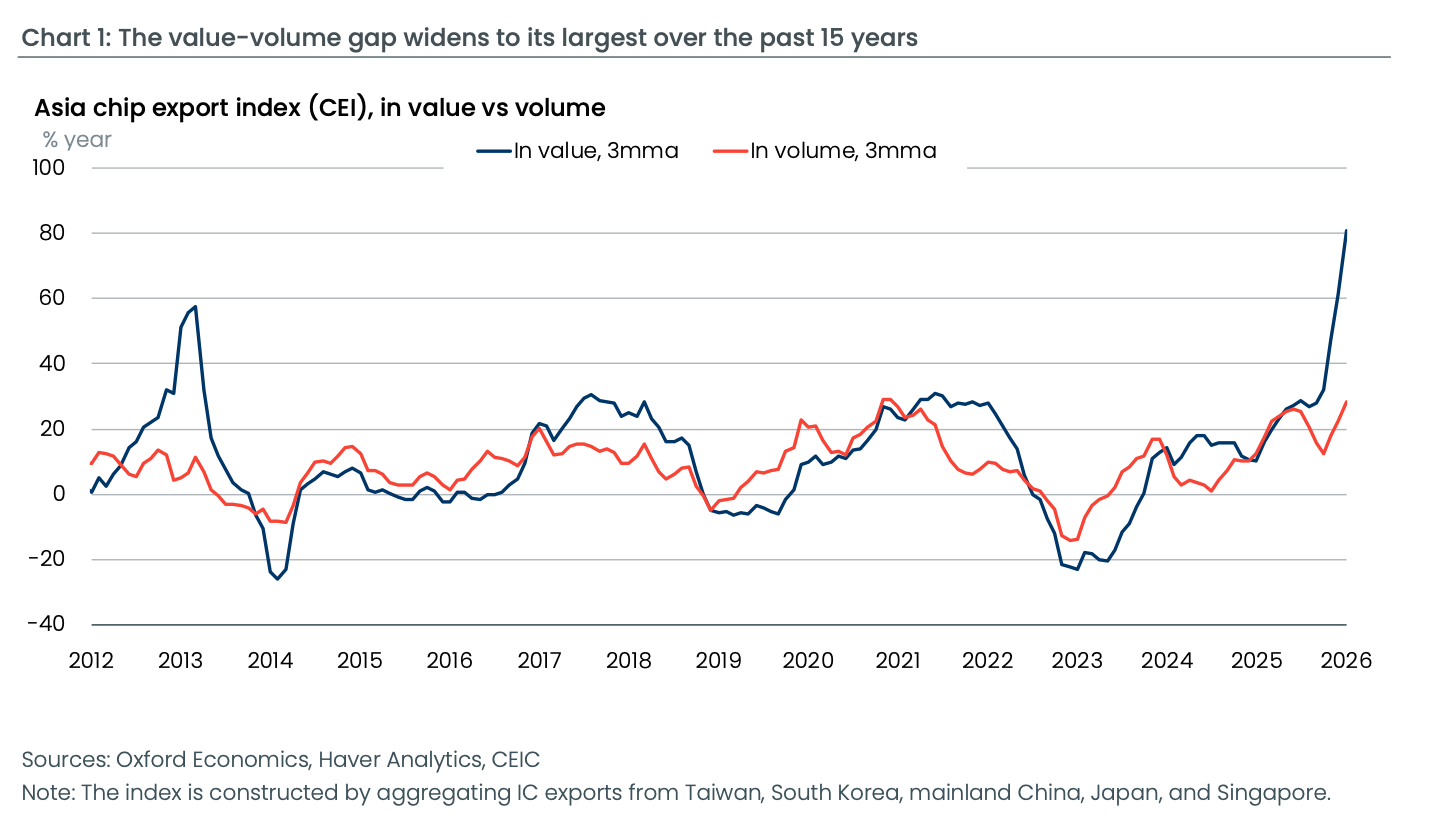
Oxford Economics’ Asia chip export index surged in March, the most recent data available, by more than 80% year-on-year in value and by more than 28% in volume.
Of note is the widening gap between the continent’s chip exports in value and volume, which reached historical highs earlier this year. OE’s Betty Wang, lead economist, and Jia Yu Lee, assistant economist, wrote that this means the region exercises “significant pricing power” for advanced chips.
Additionally, the uptick comes at a time of heightened geopolitical uncertainty, highlighting trade performance in the region is less vulnerable to external supply shocks.
NUMBER OF THE DAY
77%
Bank of America writes that 77% of Americans are planning a vacation this year, surpassing both 2025 (74%) and 2024 (72%).
That said, with tensions in the Middle East still affecting oil prices, some may change their plans. BofA’s 2026 summer travel outlook found 23% of people are planning to reduce the number of trips they take, and 1 in 10 said they’d cancel their trip altogether if increased prices persist.
THE FRONT PAGES TODAY
Xi Jinping told Donald Trump that Putin might ‘regret’ invasion of Ukraine – FT
Google DeepMind’s Demis Hassabis emerges as early Anthropic investor – FT
In Closed-Door Talks, U.S. Demands a Major Role in Greenland – NYT
See How the Global Government Debt Binge Is Rippling Through Markets – WSJ
ONE MORE THING
Let the hawks loose
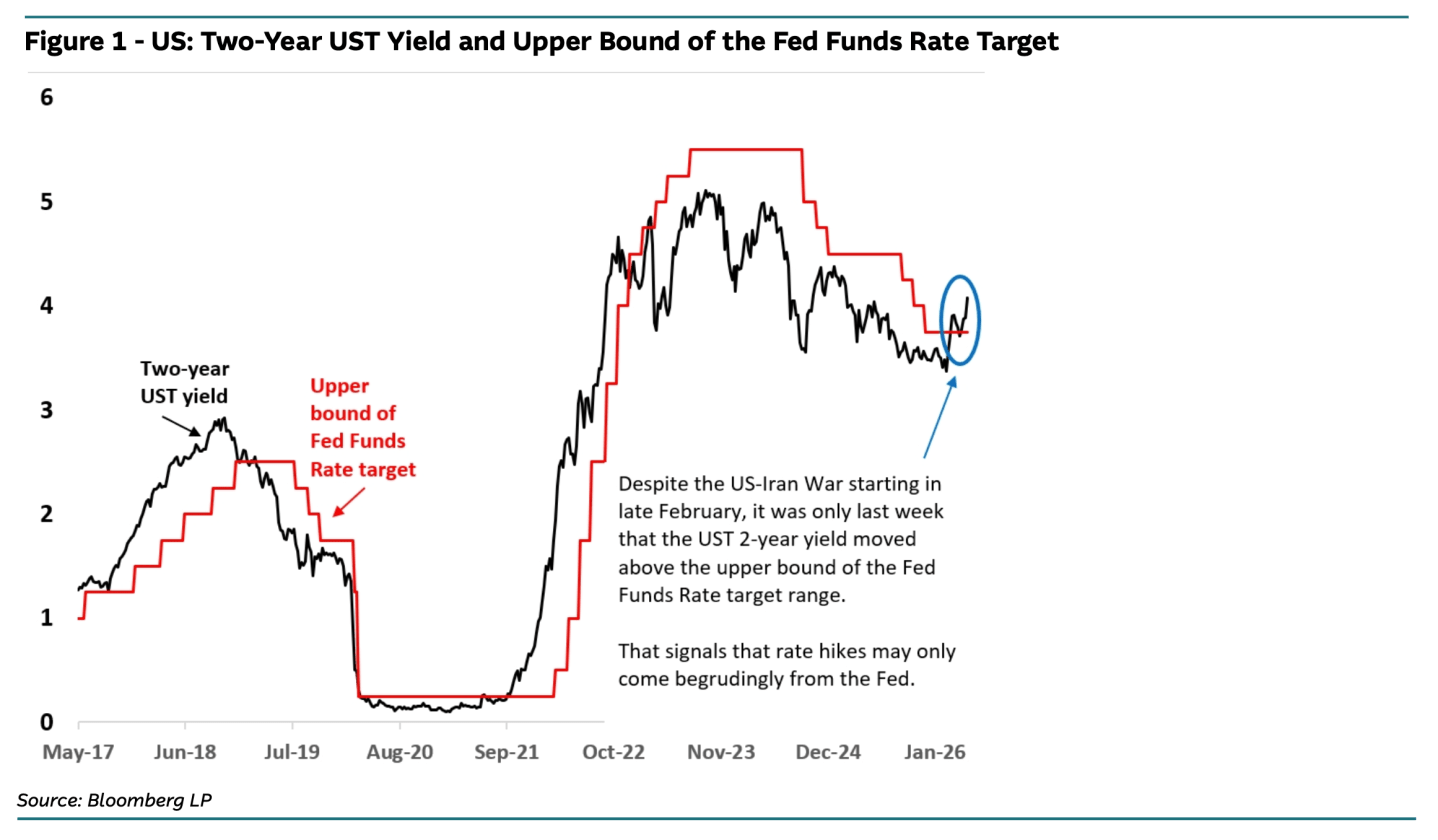
If the 2-year Treasury yield is anything to go by, the Fed has some serious work to do to reassure bond markets it’s not falling behind on inflation expectations.
In light of 2-year Treasuries tipping above the upper bound of the Fed Funds Rate, Macquarie’s Thierry Wizman writes that for the Fed to quell inflation concerns, it must become more hawkish. That sentiment can’t come from the expected crowd, he adds. Rather, “to convince bond traders that the Fed is ‘serious,’ the ‘hawkish’ lead may have to come from the voting ‘doves’—e.g., Chris Waller and Anna Paulson,” he added.
“If that doesn’t happen, traders will conclude that the Fed is falling behind, and a further rise in U.S. inflation risk premiums and a new steepening of the yield curve may ensue.”