As entry-level hiring grows tougher, young Koreans are turning to intensive, government-backed coding programs to gain workplace-ready skills.
The classroom is a five-minute drive down a two-lane road past rice paddies in Anseong, Gyeonggi — the kind of remote spot you’d almost expect for a military training ground, not a coding class. But inside, 30 job seekers are debating how to program a car’s gear-shift logic, one week into an intensive program built to make them hire-ready.
“Should the shift parameter be a string or a number?” one participant asked. “Could we change the field values instead?” another responded.
The exchange could pass for a product development meeting at an auto company, but it instead took place at the LS Jump-Up Bootcamp, an AI workforce-training program that cable and power conglomerate LS Group runs with the Ministry of Employment and Labor at the LS Future Center in Anseong. It operates under the government’s K-New Deal Academy initiative, which pays for intensive job training in digital and AI skills.
Related Article
All 30 participants had started learning to code just a week earlier. They refer to themselves as “job-training recruits.”
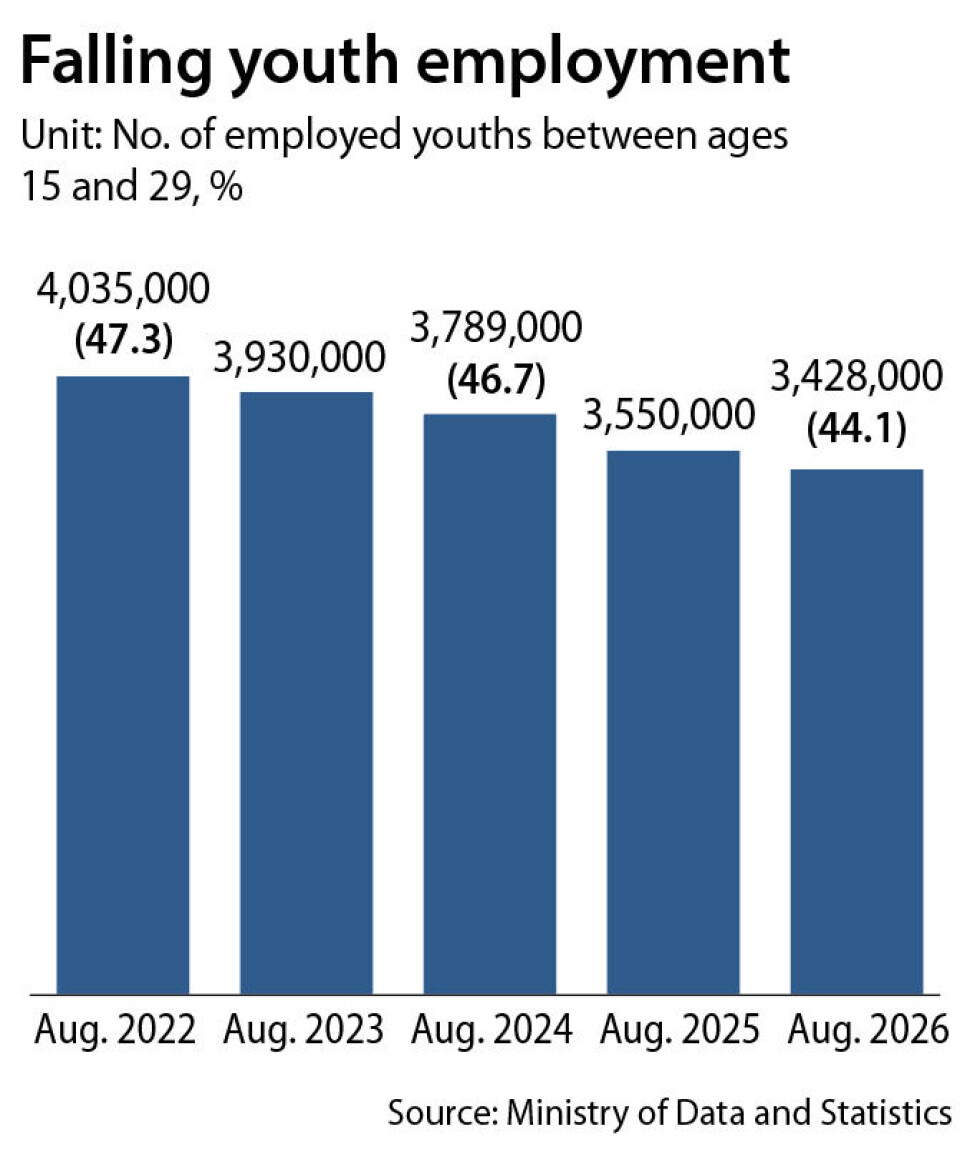
Programs like this one are becoming more common as young Koreans turn to AI and programming boot camps to cope with a tougher hiring market, essentially an intensive push to get participants job-ready. Those who enrolled at the LS Future Center last month will live and train together for roughly three months, with classes running from 9 a.m. to 9 p.m. daily.
“Our goal is to train people who can be put straight to work on what companies actually need,” said Eun Ji-won, chief executive of Robotics Valid, who serves as an instructor at the camp.
“Companies are cutting back on open recruitment and shifting to rolling, as-needed hiring, so job hunting has turned into a long war,” said 27-year-old Yoon Ga-eun, a biotechnology major, who enrolled in the program. “It’s a burden to keep writing new cover letters and preparing all over again every time a company posts an opening.”
As more companies hire for specific roles instead of running mass recruitment drives, they’ve also raised the bar for how much expertise they expect from entry-level hires. “At final interviews, it’s not unusual to see candidates who already worked at another company applying as if they were fresh graduates,” said Kim Seong-woo, 27. “I applied to about 50 production-management jobs over six months after graduating without landing one, so I chose a boot camp instead — and it feels like I’m back in the military, every day packed tight.” Kim has since landed a job at a major company and graduated from the program.
Job boot camps offer the advantage of hands-on training based on curricula designed by companies themselves. Most run full-time for three to six months and are largely free for participants because the government covers most or all of the tuition costs. Some programs, including the LS Jump-Up Bootcamp, even pay participants a monthly stipend of 300,000 won ($216).
The government plans to fund job training for 10,000 people this year through the K-New Deal Academy.
At the Future Mobility School, a boot camp Hyundai AutoEver runs with the Korea Radio Promotion Association, roughly 140 trainees are pushing through 1,000 hours of training over six months. “These days, job prep centers more on the specific role than the specific company, so I wanted to learn my field in depth,” said 25-year-old trainee Jin Soo-hyeon. “It’s great to learn the tools and real-world cases that people already working in the field use.”
A Hyundai AutoEver official described the program as “a kind of corporate social contribution — using our company’s capabilities to develop talent.”
But a boot camp doesn’t guarantee a job. The long, full-time schedule, often combined with living on-site, makes it hard to juggle anything else. “Even after class ends at 9 p.m., my roommate and I stay up late debating coursework, and on weekends the team studies two or three more hours together,” said Lee Seo-yoon, aged 33.
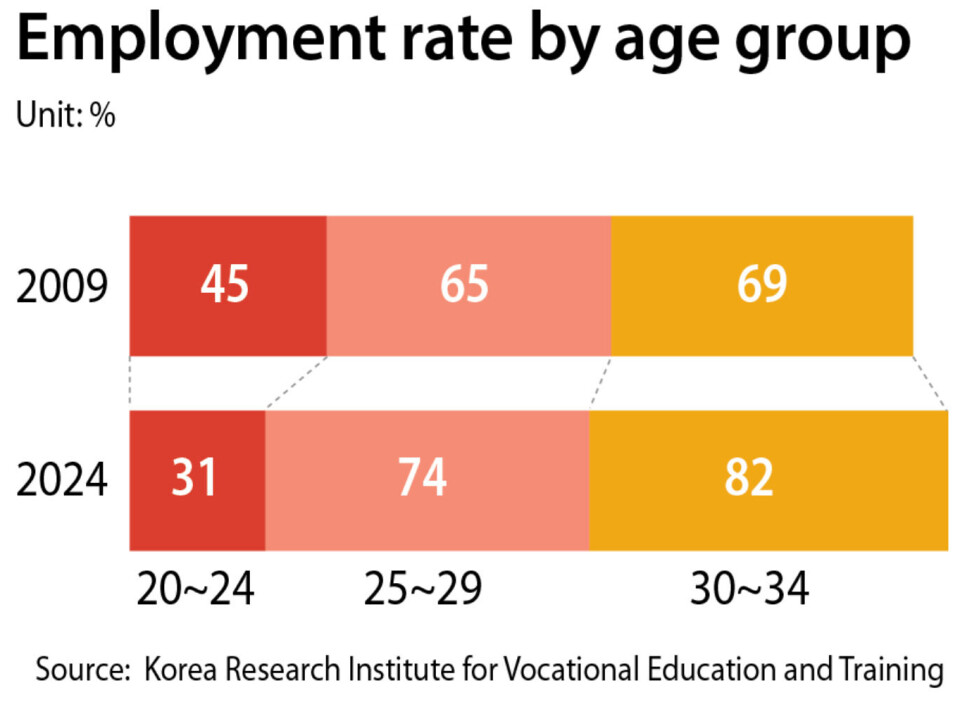
As job seekers stretch out their preparation to meet employers’ demands, the age at which Koreans land their first job is climbing. According to the Korea Research Institute for Vocational Education and Training, the share of people who got their first job in their early 20s fell from 45 percent in 2009 to 31 percent last year. Over the same period, the share of first-time hires in their late 20s and early 30s rose by about 10 percentage points combined — a sign that settling into the labor market has increasingly been pushed back into people’s 30s.
Some critics argue this dynamic is trapping young Koreans in an endless cycle of resume-building just to meet employers’ demand for hires who can start working immediately. “Hands-on training like boot camps has real value, but it risks keeping job seekers stuck in a loop of building up their resumes without ever actually entering the job market — a kind of ‘postponed youth,'” said Hong Dae-soon, a professor at Kwangwoon University’s Graduate School of Business Administration. “Fundamentally, the government needs to improve regulations and institutions so companies can hire more, and widen the playing field for jobs.”
BY KO SUK-HYUN, NAM YOON-SEO, SUK GYEONG MIN [lee.jian@joongang.co.kr]