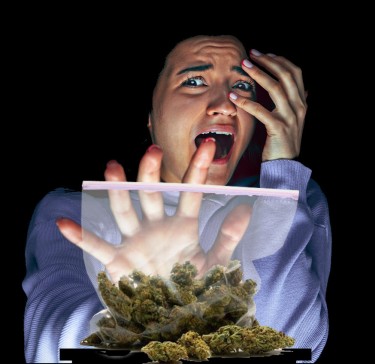
Strong Weed Is No Reason for Prohibition
There’s a new study out of JAMA Psychiatry that’s got prohibitionists reaching for their old talking points again, and I want to get ahead of it before the reefer madness reboot gains steam.
The study, led by National Institute on Drug Abuse Director Nora Volkow, found that the share of American men reporting at least two symptoms of cannabis use disorder rose from about 7.3 percent in 2021 to 9.3 percent in 2024. Among women, it went from 4.5 percent to 5.6 percent. Moderate-to-severe CUD ticked up too, from 3.1 to 4.1 percent among men and 1.7 to 2.5 percent among women. The products people are buying today are stronger than what your uncle smoked at Woodstock, and Volkow told Reason magazine that “cannabis products available today have significant addiction potential.”
Fair enough. I’m not here to tell you that ripping a 90 percent THC dab cart is the same experience as passing around a joint of Mexican brick weed in 1974. It isn’t. Potency matters, dependence is real, and anyone who tells you cannabis carries zero risk is selling you something, possibly literally.
But here’s where I get off the train with the people trying to turn this data into a rallying cry for re-prohibition: the entire argument runs backward.
The Logic Prohibition Always Gets Wrong
Think about the actual claim being made. Weed is stronger than it used to be, therefore we need less research, less regulation, and more of the black market that got us into this mess in the first place. That’s not a policy. That’s a superstition dressed up in a lab coat.
Here’s the thing about dangerous substances: the more potent something is, the more urgently we need to study it, standardize it, and put guardrails on it, not less. We don’t respond to fentanyl’s lethality by banning all opioids from hospitals. We respond by tracking dosage, requiring prescriptions, and funding addiction research. We don’t respond to alcohol’s liver toxicity by pretending Prohibition worked. We regulate proof content, tax it, card people at the door, and fund treatment for the minority who can’t handle it.
Cannabis prohibition never followed that logic, and that’s exactly why we’re having this conversation seventy years late. For most of the twentieth century, marijuana sat in Schedule I alongside heroin, legally classified as having “no currently accepted medical use” and a “high potential for abuse.” That classification didn’t make the plant safer to study. It did the opposite. It choked off federally funded research into dosing, interactions, and long-term effects for generations, which is precisely why Volkow herself is now admitting that “we lack comprehensive data on the types of cannabis that people are using—including the concentrations of delta-9-THC and other cannabinoids—and how those relate to addiction potential.”
Read that again. The nation’s top addiction scientist is telling you, in 2026, that we still don’t have solid data connecting THC potency to addiction risk. Why? Because prohibition spent decades treating the drug as too dangerous to touch scientifically while simultaneously ensuring it was freely available on every street corner in America. We got the worst of both worlds: an unstudied product and an uncontrolled supply chain.
Same Mistake, Different Molecule
This is the exact same failure that kept psychedelics locked in a research deep freeze from the 1970s until roughly a decade ago. LSD and psilocybin were criminalized not because the evidence showed they were more dangerous than legal substances, but because they became culturally and politically inconvenient. Once Schedule I closed the door on federally sanctioned research, we lost fifty years during which psilocybin could have been developed as a treatment for treatment-resistant depression and MDMA could have been studied for PTSD. Only now, with regulatory walls finally cracking, are we seeing the wave of clinical trials showing genuine therapeutic promise. Imagine where that science would be if it hadn’t been buried for half a century out of moral panic.
Prohibition doesn’t eliminate danger. It just moves the danger somewhere you can’t see it, regulate it, or study it. Put a substance under a bucket, hope nobody finds it, and if someone does, arrest them or worse. That’s the entire model. It never asks what’s actually in the product, never verifies potency, never checks for contaminants, never funds a clinical trial. It just criminalizes curiosity and calls it a health policy.
What the Data Actually Supports
Here’s what I find almost darkly funny about the current moment: the same NSDUH data driving this CUD panic also shows that marijuana use declined among Americans 25 and under between 2021 and 2025, even as legal markets expanded, while use rose among older adults. That’s not the profile of a drug flooding into vulnerable teenage hands because of legalization. It’s a legal, regulated market maturing among adults who are making informed adult choices, some of them clearly still risky, but informed nonetheless.
And the debate happening right now in Massachusetts is instructive. Voters there will decide this fall whether to repeal recreational legalization entirely, a measure bankrolled in part by Smart Approaches to Marijuana, which is using the JAMA study as ammunition. But even people alarmed by rising CUD rates aren’t uniformly calling for a return to prohibition. Jonathan Caulkins, a drug policy researcher at Carnegie Mellon, frames it as a legitimate question about how much a free society should restrict adult choices to protect a self-harming minority. That’s a real conversation worth having. It is not, however, an argument for handing the entire market back to unlicensed dealers who don’t test for pesticides, don’t verify THC content, and don’t care how old their customers are.
Jeffrey Singer, a Cato Institute health policy scholar and practicing surgeon, put it plainly in response to the same study: cannabis use disorder “shouldn’t become the basis for a new moral panic.” His prescription isn’t a ban, it’s education, paired with the same live-and-let-live principle we already apply to alcohol. “We don’t ban alcohol because some people use it unwisely or develop alcohol use disorder,” he notes. “Autonomous adults should remain free to make choices others consider unwise so long as they don’t violate the rights of others.”
Even Jodi Gilman, director of neuroscience at Massachusetts General Hospital’s Center for Addiction Medicine, agrees that rising CUD rates track with a market getting “flooded with highly potent products,” not with legalization itself being the problem. Her prescription for people struggling with cannabis use disorder isn’t jail. It’s motivational interviewing and cognitive behavioral therapy, the same evidence-based treatments we’d use for any other substance use disorder.
Regulate the Thing You’re Worried About
So yes, today’s cannabis is stronger, and yes, a meaningful minority of frequent users are developing a real use disorder. That’s a serious finding and it deserves serious attention: better product labeling, potency caps or graduated taxation on high-THC products, funded research into dosing thresholds, and expanded access to treatment for people who develop problems. None of that requires prohibition. All of it requires the opposite of prohibition, which is transparency.
A black market doesn’t card minors, doesn’t list THC percentage accurately, and definitely doesn’t fund a longitudinal study on addiction risk. A regulated market can do all three, badly at first, better over time, the same way every regulated industry improves through iteration and oversight rather than through a ban that just pushes the whole enterprise into the shadows.
If pot is more potent than it used to be, the honest response is to study it harder, regulate it smarter, and stop pretending that ignorance enforced by a police baton has ever once made a substance safer. It hasn’t. It never does. The war on drugs has run this experiment for over a hundred years, and the results are in: prohibition doesn’t shrink the danger, it just makes sure nobody’s watching when it shows up.
THE IRRATIONAL FEAR OF THC, READ ON…