Paul Krugman is the greatest econ writer in the world, and also a legendary economist. But I sometimes feel that he has a blind spot when it comes to the value of new technologies. In 1998 he famously wrote:
The growth of the Internet will slow drastically, as the flaw in ‘Metcalfe’s law’—which states that the number of potential connections in a network is proportional to the square of the number of participants—becomes apparent: most people have nothing to say to each other! By 2005 or so, it will become clear that the Internet’s impact on the economy has been no greater than the fax machine’s.
By the time he wrote that, America was already well into an IT-driven productivity boom that would temporarily interrupt the stagnation that had begun in the 1970s. The internet was surely part of that story; it allowed companies to reshuffle and optimize their supply chains for greater efficiency, find customers, suppliers, and workers more easily, conduct business communications cheaply and in greater depth, and so on. Dolfen et al. (2023) estimate large consumer gains from the rise of e-commerce, Barrero, Bloom, and Davis (2021) find large economic gains to households from high-quality internet access, and so on. The internet is a lot more than just people yelling at each other on forums and social media. (Krugman later argued that the internet’s economic impact had been disappointing, but I suppose that depends on your expectations.)
In 2011, Krugman wrote that American kitchens hadn’t changed much since 1957. I can forgive him for not being an early adopter of the air fryer or the Instant Pot, which came out in 2010, but he really should have given more consideration to countertop microwaves, food processors, Keurig-type coffee machines, crock pots, and induction stoves, all of which became available between 1957 and when he wrote the post.
So although it’s always dangerous to disagree with Paul, I am going to go ahead and push back on his argument that AI technology “does nothing” for most Americans:
He writes:
There is also, however, a more prosaic reasons for the public’s dislike of AI: This is a technology of, by and for oligarchs, with hardly any of the benefits trickling down to regular Americans…Or to put it a different way, never before in history have corporations spent so much money — playing a major role in soaring interest rates — to create so few jobs.
I think that this is basically wrong. Although we don’t know the long-term effects of AI on the distribution of income and wealth, right now we can see a substantial amount of economic benefit flowing — I wouldn’t say “trickling down” — to regular Americans.
This is not to say that regular Americans couldn’t stand to benefit more from the AI boom. I think they could. I like some (though not all) of Jared Bernstein’s ideas for spreading the benefits of the data center boom more broadly. But I think Krugman has underestimated the benefits of the data center buildout in terms of direct employment, and has basically ignored the fiscal, macroeconomic, and consumer benefits of the current AI boom.
Building data centers takes a lot of labor. But Krugman argues that data centers aren’t doing much in the way of providing construction jobs:
Given this spending surge, one should expect a sharp rise in nonresidential construction spending — basically construction for businesses rather than housing…But that’s not what we actually see. Nonresidential construction…has basically flatlined under Trump, despite the immense AI investment boom…[E]ven the physical construction of a data center involves relatively little construction.
He quotes Van Nieuwerburgh (2026), who shows that only about a third of the cost of a data center involves construction work.
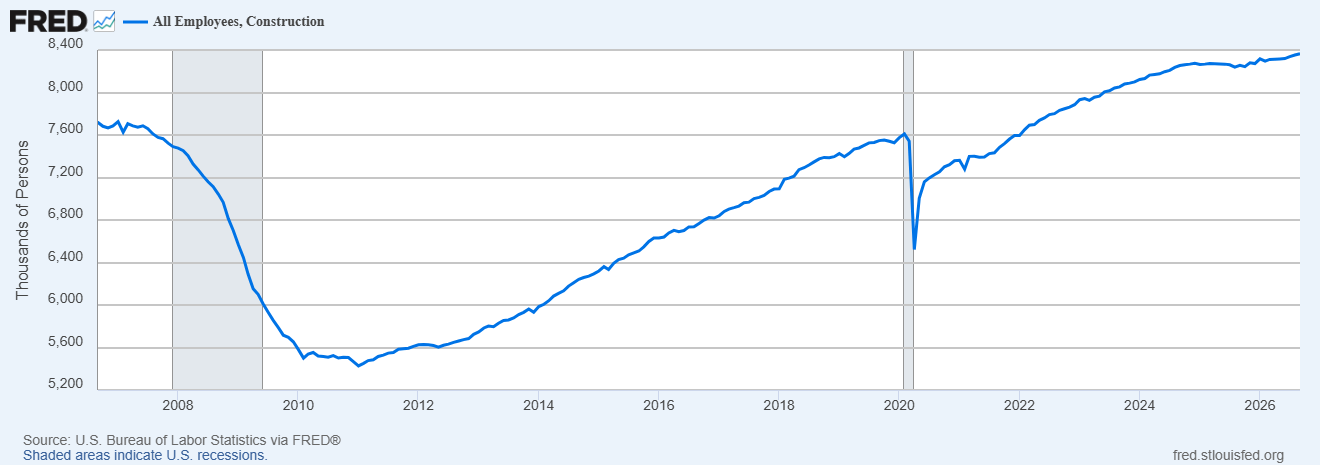
But I don’t think Krugman proves his case here. First of all, if we’re talking about construction jobs, we should look at employment levels, not spending. And here we see an increase in construction jobs since the AI boom began in late 2022:
Construction has also increased as a percentage of the workforce:
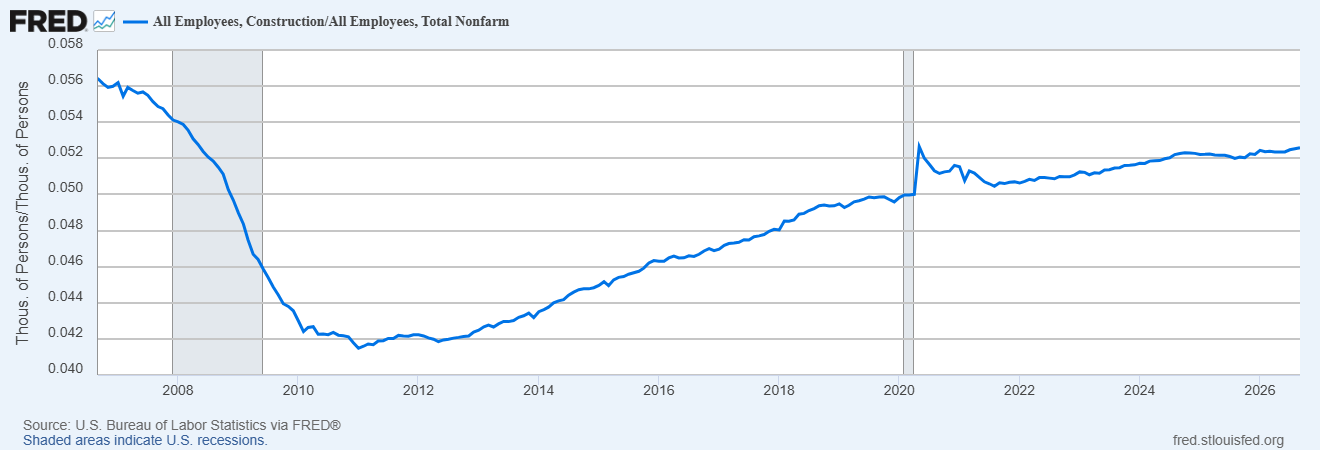
And remember, this was at a time when Trump was deporting construction workers en masse — 13% of the construction workforce is undocumented, and deportations also have knock-on negative effects on the industry that result in the firing of native-born workers as well. This probably explains the pause in the increase of construction employment in 2025. But even that couldn’t stop construction’s rise.
And it’s exactly the type of construction workers who are required for building data centers who are seeing the biggest job gains:
Construction workers’ real wages have also risen since the middle of 2022:
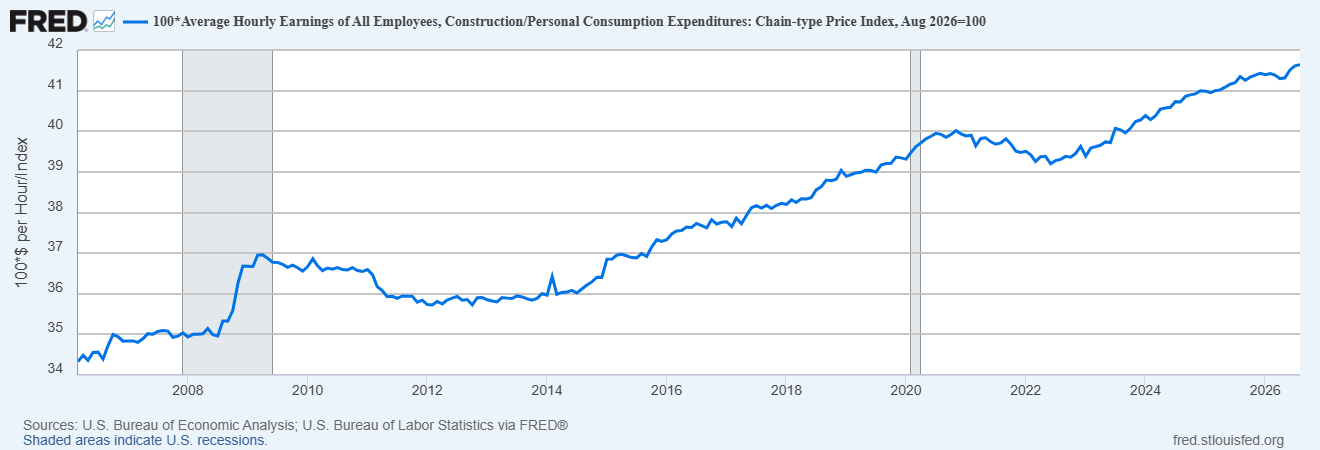
You might be tempted to think that this is a composition effect from Trump deporting the lowest-paid construction workers in 2025. But in fact, there has been a big jump in construction workers’ wages relative to national average wages just this year:
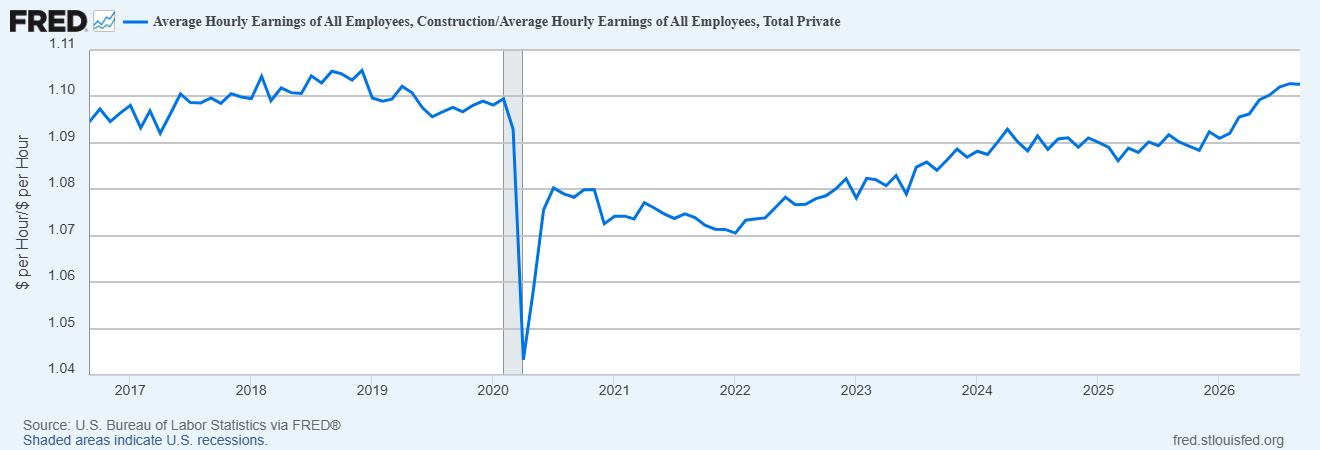
These are all signs of healthy labor demand.
In fact, although estimates of the effect of the data center buildout on construction employment produce very different numbers, they all agree that it’s a significant positive impact. The state of Virginia, for example, produced the following numbers:
And of course these are just the numbers so far; the data center buildout is accelerating, and Goldman estimates that 500,000 new construction and trades jobs will have to be added by 2030 in order to sustain it.
So while you can argue that this boost to labor demand isn’t worth the costs of AI (whatever you think those are), we need to count it on the positive side of the ledger here.
Jobs aren’t the only way that the economic benefits of data centers get spread to ordinary Americans. There’s also the tax system. Data centers pay property taxes, sales taxes, corporate taxes, various fees, and so on — here’s a good explainer from the Tax Foundation. All in all, depending on their policies, local and state governments can reap large windfalls from data centers:
Those taxes go to pay for local public goods, like roads, public transit, and parks. They go to pay for public services like education and health care. Those expenditures all tend to benefit regular people. This is from a story in the New York Times about Loudoun County in Virginia:
A convergence of early fiber internet access and fast-track zoning has made Loudoun the data center hub of the world…Two decades into its experiment, Loudoun has become a case study for the rest of the nation on how to make data centers pay off. Thanks to the proliferation of the warehouses, the quiet bedroom community 30 minutes outside Washington, D.C., has transformed into a tech destination with trophy schools and libraries, and freshly tarred roads.
Now that doesn’t mean data centers are necessarily good for a city or state on net. There are real costs, too — electric power demands that put strain on the grid, nuisance noise, and so on. But the benefits are real, and they don’t come in the form of job creation.
And crucially, state and local governments can demand even more benefits whenever they want! They can raise taxes and fees — in fact, they can even raise them after a data center is already up and running, so that relocation to avoid higher taxes becomes less attractive of an option.
And before construction, they can demand “community benefit” agreements that are actually just additional taxes. Here’s what Jared Bernstein suggests:
Such agreements should include reduced electric and water rates for the surrounding community, funding for the local infrastructure upgrades (roads, substations, water systems) these facilities require anyway, and substantial investment in the schools, parks, and public goods that make a host community better off for having said yes.
Bernstein wants much more of this, of course, and better enforceability. But note that even as things stand, taxes and fees are substantial, and community benefits agreements are common.
I spent my early blogging years supporting Paul Krugman in his epic quest to remind people that aggregate demand is a real and important thing. But for whatever reason, Paul doesn’t mention the demand-side benefits of AI investment in his post.
When Donald Trump came into office, he did a bunch of things that should have clobbered the economy. He announced high tariffs on nearly all of America’s trading partners, then created massive uncertainty by walking some of these back, periodically announcing new ones, granting tons of exceptions, and striking opaque and confusing “deals”. On top of that, he deported large swaths of America’s workforce, visibly weakened the U.S. international alliance system, ran enormous deficits, and behaved in a lawless and corrupt manner that caused people around the world to question the long-term stability of the U.S. government.
All of this created huge amounts of policy uncertainty:
Uncertainty on this scale usually causes big economic problems. Businesses can’t invest if they don’t know if the president of the United States is going to destroy their business model with an executive order tomorrow. All of this Trumpian chaos and meddling should have caused a visible negative demand shock.
But it didn’t, because just as Trump was trying his best to hit the American economy over the head with a stick, the AI boom came along and pushed in the opposite direction. AI technology itself is a positive supply shock, of course, but the data center buildout is a positive demand shock.
How big of a shock? It’s hard to say, because causal estimates of aggregate demand are inherently difficult. But it’s clear that the data center boom has made up a large percent of economic growth for Trump’s entire second term so far:

Jason Furman@jasonfurman
Investment in information processing equipment & software is 4% of GDP.
But it was responsible for 92% of GDP growth in the first half of this year.
GDP excluding these categories grew at a 0.1% annual rate in H1.

5:48 PM · Sep 27, 2025 · 122K Views
37 Replies · 190 Reposts · 760 Likes
Now as I mentioned, it’s hard to know whether we’d just be building something else instead if this boom wasn’t happening. Data center construction certainly crowds out some other forms of economic activity, by sucking up scarce labor, and by raising interest rates (which makes it harder to finance other projects).
But to believe that the AI boom isn’t having a big effect on aggregate demand would require some heroic assumptions. You’d have to assume very strong crowd-out. You’d have to assume that Trump’s tariffs and other irresponsible policies are having basically no effect on demand, so that there isn’t any negative shock in need of canceling out. You’d have to assume that “animal spirits” — i.e. corporate bullishness — basically don’t affect the business cycle. And so on.
I don’t think those assumptions are realistic. I think if you see one industry contributing a very large percentage to U.S. economic growth, your prior should be that it’s causing a positive demand shock.
And if so, that means that the AI boom is the only thing standing between countless regular Americans and Trump’s self-destructive chaos. According to Okun’s Law, shaving just 1 percentage point off of economic growth would throw almost a million Americans out of work. That would be bad for regular people.
This macroeconomic benefit is hidden; it’s the proverbial dog that didn’t bark. But it’s pretty significant.
So far, I’ve been talking about the benefits of the data center construction boom. But I should also mention the impact that AI technology is already having on consumers. Krugman’s post seems to treat AI and the data center buildout as synonymous, and jobs as the main (or only) way by which regular Americans might benefit from the new technology. But the truth is that AI is also something that lots of Americans already use, and seem to derive a lot of utility from.
By every measure I can find, AI has seen more rapid household adoption than any other consumer technology in recorded history. And what do Americans use AI for? Everything. This poll is from over a year ago, but already it showed the incredible diversity of use cases for consumer AI:
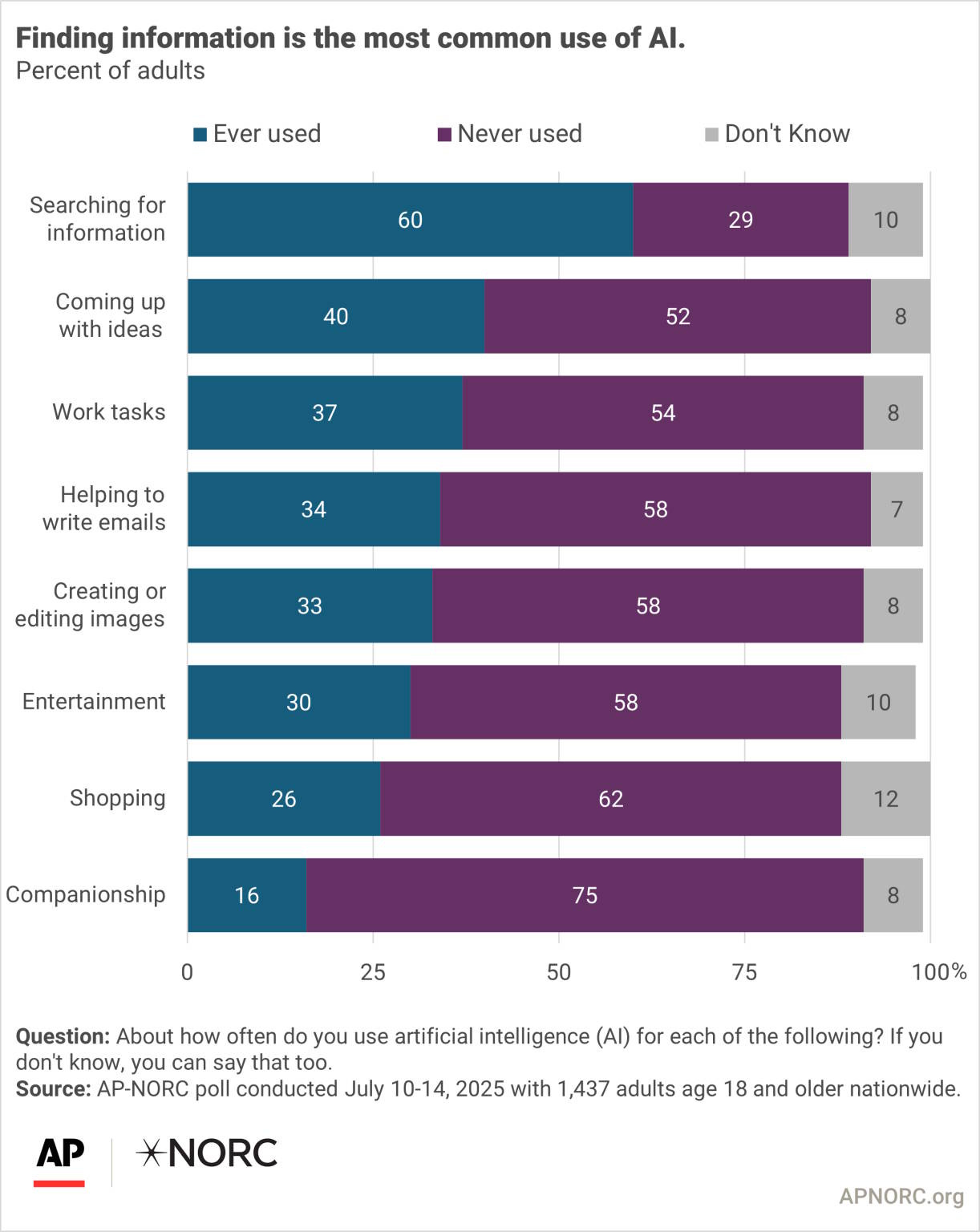
Here’s a more recent poll, asking what people regularly use AI for, rather than what they’ve ever used it for:
Medical advice and diagnosis has emerged as a particularly important consumer use case. But in general, Americans say chatbots make them more productive, informed, and creative:
This does not mean Americans like AI overall; in fact, they’re overwhelmingly negative on the technology. They’re afraid it’ll take their jobs, and increasingly afraid it’ll kill them. But there are real, substantial consumer benefits from AI that we shouldn’t ignore.
How substantial? In April of this year, Brynjolfsson et al. used surveys to estimate a total annual consumer surplus of $172 billion in the United States. That’s more than the run rate revenue of Anthropic and OpenAI combined, and certainly much much more than their combined profits would be even if they stopped spending anything on fixed costs right now. It’s about half of the annual profits of Nvidia.
So when Krugman says that “this is a technology of, by and for oligarchs, with hardly any of the benefits trickling down to regular Americans,” he’s just wrong. Just the consumer surplus alone is substantial. On top of that the data center boom is creating a significant amount of jobs, generating a significant amount of local and state tax revenue, and propping up the macroeconomy and the job market as a whole.
There are plenty of big problems with AI. Malicious use or accidents might wipe out our whole species in the not-too-distant future. Job loss hasn’t been a big deal so far, but it might eventually be huge. Cognitive weakness from overreliance on AI could affect our society in strange and negative ways that we have yet to even comprehend, much less reckon with. When you ask Americans why they hate AI, these are the things they’ll tell you. Anger at “oligarchs” monopolizing the wealth from AI doesn’t typically make the list, and I don’t think it’s a great way of framing the AI issue.