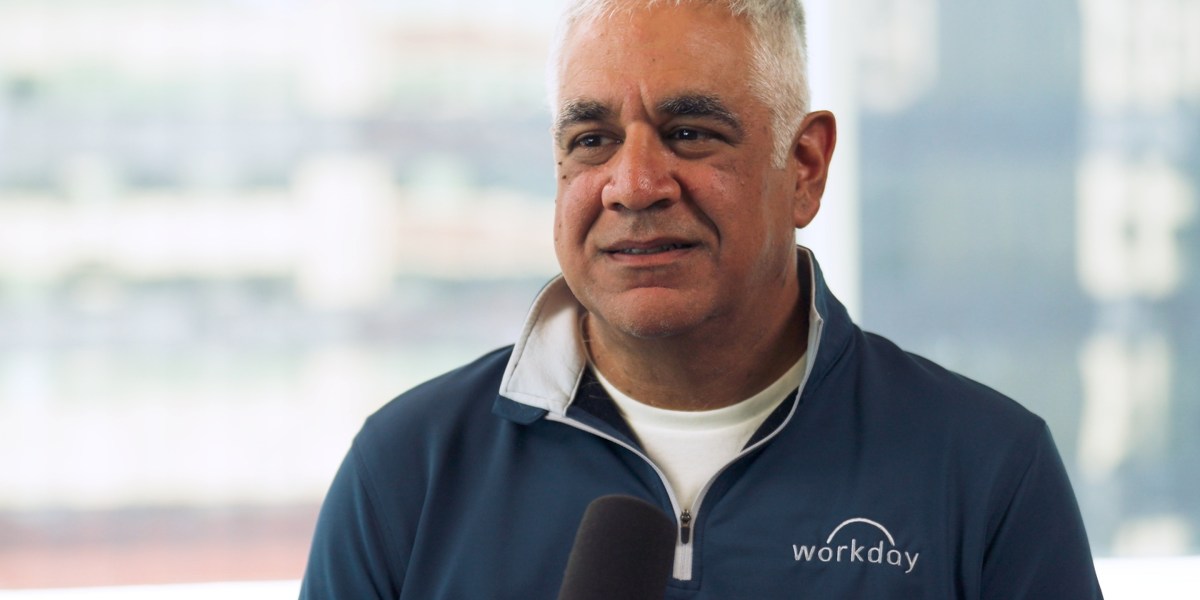
If you don’t know what Workday does, chances are your head of HR or your head of finance does. Aneel Bhusri cofounded the company with his friend Dave Duffield in 2005. Now he’s back in the CEO seat in 2026, reinventing Workday for the age of AI.
In a new episode of Fortune 500: Titans and Disruptors of Industry, Fortune’s Editor-in-Chief Alyson Shontell talks to Bhusri about where the workforce stands in this moment, what the workforce of the future will look like, and his candid thoughts about AI’s threat to jobs.
On job displacement
- Why Bhusri expects AI to displace a lot of jobs within five years, starting with rote work like payroll processing and junior auditing
- Why he says tech companies that profit from AI have a responsibility to retrain the workers it displaces, and how Workday is doing that through RAISE US
On refounding Workday
- Why Bhusri, who calls himself an entrepreneur rather than an operator, came back as CEO for what he calls Workday’s “refounding moment”
- How studying Steve Jobs’ return to Apple led him to cut Workday’s agents in development from 50 to 20 and give each AI effort a single owner
On putting AI agents to work
- How Workday’s customers are getting measurable returns from agents in recruiting, contracts, and employee self-service
- Why Bhusri thinks agents that automate audits and closing the books could spark a renaissance in finance
On managing agents like employees
- How AI agents are letting Workday flatten its own org chart by taking on low-level management work
- Why Bhusri says companies will manage agents the way they manage employees, with credentials, permissions, and a human always in charge
On protecting customer data
- How Workday trains AI models on aggregated data without letting any customer’s data or intellectual property leave its systems
Read more: Aneel Bhusri is back as Workday’s CEO—and betting he can reinvent the company for the AI era. Go inside his second act.
Read the transcript, which has been lightly edited for length and clarity, below.
Aneel Bhusri, thank you for joining me today for our podcast. I’m sitting here across from Fortune 500 CEO of Workday, which is now No. 430 on the ranking, 21,000 employees, about $10 billion in annual revenue. So a lot has changed since you were 39, in 2005, starting this company.
Sure has. It’s been a great ride.
Incredible. And you recently came back into the CEO seat after a brief hiatus of a couple years. But first, I want to get your big-picture thoughts. I don’t think there’s anyone more credible we could be speaking to about what the future of work looks like. About 60% of the Fortune 500 are your clients, using software and even now agents to help figure out efficiencies within their orgs. So I’m curious, what do you see the future of work looking like in 2030, from an employee standpoint and an employer standpoint?
I don’t think anybody has a crystal ball. We actually have a project called HR 2030 to try to figure out what organizations are going to look like. But there’s never been a more profound change in technology than AI. I’ve never seen anything like it, and I’m old enough that I’ve seen the mainframe, client-server, web, cloud. But AI is different. AI has the promise of replacing how humans think and act. So it’s pretty profound. We’re going to live in a world of humans and agents, and they’re going to have to coexist. I’m optimistic we’re going to find a path where it’s mutually beneficial, as opposed to just agentic technology replacing humans, but it’s still to be determined.
On the future of work
A lot of this is still playing out, but based on what you’re seeing and how companies are adopting the agents you’re putting out, do you think organizations will be as big? Do you think job functions will change drastically?
I do think job functions are going to change. Agents are effectively rule-based technologies where you can look at a specific job and say the agent can do that equally as well as a human. And that to me is both exciting and a little bit scary. The more rote, repeatable work that doesn’t require a lot of human judgment will be replaced by agents, and I think that’s already happening across the board. The ability to analyze an amazing amount of data in a short amount of time and come up with predictions at a much faster pace than humans—that’s what AI is really good at. The question is how far it goes.
What I see from startups is that they’re designing their business models around AI. Companies are trying to figure out how to put AI into their existing business model. And I think there’s a lot to learn from the startups in what an organization in the future looks like. To me, a lot of the great talent going forward, from the human perspective, will be people that really know how to use AI. As opposed to being replaced by it, figure out how to use it. I see that in our own company. The best coders are not just great coders, they’re great at using the coding tools. And I think that’s across the board: whatever profession you’re in, become proficient in using the AI tools.
It’s always hard for an incumbent to adopt new technology and really seep it into its core. I know you advise a lot of startups, so you have a very good viewpoint of working with the incumbents, being one yourself and trying to transform it, and seeing the startup scene. There are predictions of more turmoil in the Fortune 500 over the next decade than ever before. I interviewed Vinod Khosla earlier this year, the venture capitalist who has very famously said this. Do you feel the same? Do you think the clients you work with will change drastically over the next few years?
I don’t know if they’ll change drastically, but they’re going to have to change. There’s always going to be an upstart that has a brand-new model using AI, and they’re going to have to counter that. But at the same time, companies have great brands, they have great products, and that’s not going to go away overnight. I do believe in this hybrid world going forward.
At the same time, I think every large company needs to think about what they would look like if they were a startup. How would you approach it with a clean sheet of paper? That’s how we’re doing it at Workday. We call it a refounding moment—thinking about if we were a startup today, how would we run the company? We’re applying a lot of startup principles and thinking about AI as a native technology, not adding it on to the product we’ve built.
On coming back to refound Workday
So talk to me about the refounding moment. You’ve been back in the CEO seat officially since February 10 of this year. There were two years where you were executive chair of the board, still working closely with the company and advising Carl [Eschenbach], who had been your co-CEO. But now you’re back fully in the saddle. What drove that decision? Because when I hear you talk about the transformation that has to happen—my goodness, it’s daunting. And not only that, you said you were having fun doing it on your last earnings call. That’s not something I hear a lot of CEOs saying right now.
At the core, I’ll be the first to say I’m not a great operating executive. I’m an entrepreneur, and I love products and technology. For the 25th version of cloud, there are better people to run Workday than me. When AI showed up, it was a refounding moment, in that all bets are off. It’s a brand-new world.
AI is so different from any technology you’ve ever seen. It’s a reasoning engine. It’s more about probabilistic work than a deterministic business process platform. It’s a fundamentally different way to approach the applications you build. AI applications are iterative—they’re changing almost on a daily basis, as opposed to a business application that you might change every six months. So you have to reinvent yourself. For me, that was something I’d be excited about, being an entrepreneur and a product person.
Part of it is, when you look at the history of technology, great tech companies are not built on one generation of technology. They pass the test of time. Microsoft went from desktop to client-server to cloud and now to AI. Google the same, Apple the same. I really wanted Workday to be one of those companies that was not just great in cloud, but also great in this next generation of technology. And I felt that I had a role to play in getting us to be a leader in this new world. So that’s why I came back.
It’s really exciting. The pace of change is like nothing I’ve ever seen in my life. The models seem to change on a weekly basis. And I’m 60 now, so I’m fortunate I have this great partner in Gerrit Kazmaier, who’s in his early 40s and is really driving the products. I’m working with him to set the vision and, more importantly, set the tone for the culture. But it’s an environment I’ve never seen before. It’s exhilarating, it’s fun, and it’s scary at the same time.
In 2005, you and Dave Duffield decided to start Workday. And we’re walking by a diner in the middle of the office. It’s called Truckee Diner, and I was wondering how this pertains to the founding story of you and Dave and Workday.
We had just come off the hostile takeover of PeopleSoft by Oracle, and honestly, I was trying to convince him to start one more. We both like diners and dives—I’m a big Guy Fieri fan—so we would meet at a diner in Truckee, which is actually called Jax at the Tracks. I think we met four or five times, and we would talk and think about whether we really wanted to do it. And then we started building our plans for starting Workday.
As you’re thinking about setting the culture, I understand you studied Steve Jobs’ return to Apple when he came back as CEO. What did you take away from those learnings, and what are you doing to put your mark on this company for a second time around?
In coming back, there are just not a lot of examples of founders leaving and then coming back several years later. I was trying to think, well, what should I do when I come back? And I’m a huge Steve Jobs disciple as it relates to his product and market thinking. So I watched video after video, interview after interview about him. I drove my management team crazy because I’d send them these Instagram clips.
There was one AllThingsD interview he did where he talked about making Apple the biggest startup in the world: getting back to ownership, accountability, speed, and reducing the number of products to the ones that really mattered. When I came back, we had 50 agents under development. Now we have 20. There were a lot of other projects that were not core to the future. We just had to end those projects and really get focused on what mattered. And the best lens on that is what matters for the customer. Some of the agents just weren’t that impactful. Some were features that got rolled into other agents. We’ve just got a lot more focus, and I learned that watching countless hours of his videos. He wasn’t just a product genius, he was a management genius too, in the way he organized Apple for success. And then Tim Cook took it to greater heights.
So I’m trying to bring that same mentality of recreating that startup mindset, with clear accountability. When I came back, there were multiple owners of AI on the agent side, multiple owners on the API side, multiple owners on the platform side. And I thought, well, I don’t know who owns it. So now we have one owner for building our agents, one owner for building our AI platform, one owner for building the tools, and we’re moving at breakneck speed. That’s part of the set of lessons I learned from watching his videos.
So it sounds like your first six months have been spent getting the leadership team settled, everyone aligned on the mission and the goals, and having ownership so they feel committed and accountable to what they’re doing. And refocusing from 50 agents down to 20 sounds purposeful and smart. You want to be great at a few, not overwhelming at many. Is there anything else in the first six months that you feel you’ve done to set the stage for growth? You’ve now had two really nice quarters in a row.
My co-founder Dave had this great expression: The best product doesn’t always win, but it sure wins a lot. So getting back to that best-product mindset has been a big part of the last six months. Getting people to take risks in products—not with customer data, but take risks in terms of innovating and seeing what’s possible. And if it doesn’t work, that’s fine. Move on to the next thing.
And getting the company very focused on really three things: Build our AI future with our customers, get close to our customers again, and live our values. Those three things are really simple, but it’s not 20 different initiatives. It gets everybody centered on what’s right, and so far it’s working. The salespeople are really excited because they’ve got exciting new products to sell, and the first wave of these products is doing quite well.
You mentioned a little bit ago that you are not a great operator, but you are an innovator. A few years ago we heard this term “founder mode” emerge. It was started by Brian Chesky, the founder of Airbnb, and it sort of lit a fire in the business community. And I think we’re seeing that more and more now. The operator COO was good leadership for maybe a particular period of time, but I’m seeing more companies—even Apple, just this last week, with Tim Cook going into a chairman position and John Ternus, the product guy, trying to drive innovation in this era. I think that’s a leadership change a lot of companies are making.
Tech companies, like any company, go through cycles. There’s a period of time when innovation is front and center and the most important thing. I think innovation always matters. But then there’s a period of time, once the innovation’s been brought to market, when scaling the company matters. We’re back to a point in time where it’s all about innovation again. So I definitely think Workday’s in founder mode right now. I didn’t come back to run the company better. Carl’s a very good operator. I came back to make sure that we are super innovative with the AI products, and that we do it responsibly. It’s an incredibly powerful technology, and we have to do it the right way, especially in our worlds of HR and finance. It’s a daunting but exciting task.
I definitely want to get into security and the AI agent moment that we’re in. First, though, I want to talk about February. Around when you came back was also the SaaSpocalypse.
Yeah.
Not just you, but your competitive set took a dive in the markets. I think Anthropic released something that made people feel like, oh my gosh, all of the enterprise companies that are pay-per-seat or are servicing enterprise clients with software had been a great business model before, but now with one product release, Anthropic or OpenAI can eat their lunch. Was there reality in that SaaSpocalypse? Was it just market jitters? How did you make sense of that moment?
There’s always some truth to it. I honestly don’t think it applied to Workday, unless we stand still for the next five years. The coding tools that came out of OpenAI and Anthropic and Cursor are incredibly powerful. Could they be used to build something that’s competitive with Workday? Absolutely. But we’re using those same tools too, and I think that was lost on the market. We’re big users of all three of those platforms. I think half of our development now is being driven by those tools.
I think the part that people miss is that AI is a really amazing reasoning engine, but at the end of the day, the technology is trying to predict the next token, right? It’s probabilistic. It’s creating a 90% probability that’s the next thing to happen. Deeply embedded business processes like Workday are deterministic. You start a payroll process, you end a payroll process. It can’t be 90% right 90% of the time—especially if that 90% changes between two payroll runs. We’ve got to be 100% right, 100% of the time. That’s the way payroll works. That’s the way HR works. That’s the way finance works. You can’t get the audit partially right. You’ve got to get it completely right. So the real power is combining the two technologies.
Now, are there some SaaS companies that were much more about content generation versus business process, or more about workflow orchestration versus a system of record? Yeah, they might be more exposed. But what we do—and I call it the swamp—all three major AI companies run Workday. Google runs Workday, Anthropic runs Workday, and so does OpenAI. So I think there’s some sensibility in there that the market lost. I always worry when investors who are not fully informed make these huge, gross generalizations. They don’t always have the right incentives, and they drive stocks up or down without really knowing the underlying fundamentals. I’ve been back for seven months. I’ve yet to meet a single customer that’s thinking about replacing Workday with anything that’s vibe coded or built by a model.
I’m not surprised to hear you say Workday sounds like it’s safe. And some of the competitors, like the Oracles and SAPs, are probably in the same category.
Pains me to say that, but Oracle and SAP are safe.
On job displacement
But it sounds like there are some things that are not—maybe some companies that are more consumer-facing, but also employees. I pulled a quote from an interview you did in May. You were pretty honest about where you think the jobs market is headed: “The cold, hard reality is AI is replacing labor. I think there’ll be a lot of job displacement because of AI.” I’m curious if you can expand on what makes you say that when a lot of people won’t, at least publicly—and I commend you for saying it publicly. And on what timeline do you think this will play out?
Timeline, I think it’s within the next five years. But I look at what we’re doing with some of our agentic technology. Say, a financial audit agent—it’s going to replace the work of junior auditors. I look at what we’re doing with our contract intelligence agent. It does replace the work of lawyers, or at least a subset of lawyers. I think we just have to be honest about it. It’s why Workday is involved with RAISE US. We’ve got to figure out how to retrain the people who get displaced.
The first wave of AI will be low-level business process automation that didn’t get done by cloud. Taking you step by step through the payroll process is a pretty rote process. Can an agent do that and replace a human at a lower cost? Yes. Will companies want to do that? Yes. Am I worried about the job displacement? Absolutely. So we have to figure out what we’re going to retrain these folks who get displaced into, or we’re going to have a set of social issues. Dario [Amodei] has been pretty open about these issues coming, and I think we just need to have a plan. That’s why we joined RAISE US as an early investor. And we’re also doing our own learning and education programs to help people get through this transition.
Can you explain what RAISE US does, what the initiative is, and some of the solutions? I think a lot of people hear, oh my gosh, my job is being taken and there is no plan.
It was started by Gina Raimondo and Eric Holcomb, two former governors, and they see the same issue about job displacement. They’re really focused on retraining—first of all, exposing what the set of issues is, so we actually have an understanding of where jobs are getting displaced, and then coming up with a plan to retrain the folks who are being displaced. There’s a whole bunch of companies involved. We’re involved, I know Cisco’s involved, Microsoft’s involved, OpenAI’s involved, Anthropic. We’re all involved to try to figure out a plan to retrain the folks who get displaced.
Another thing you’ve said is that tech leaders need to be part of the solution for job displacement and not just profit from the disruption. It sounds like that’s what you’re really leaning into.
Absolutely believe that. We’re making our own investments. We made a very sizable commitment to RAISE US, but we’re also doing our own programs as part of the Workday Foundation. And I think it’s incumbent on the tech companies that are going to thrive in this world to help everyone that’s not going to thrive in this world.
You’re the leader of an organization with 21,000 people, and a lot of your Fortune 500 peers have that many or more. How are you thinking about the org structure of the future, and getting to the place where, in five years, things might look very different in who you employ, whether it’s a person or an agent or both?
There’s the Workday perspective of how we’re running internally, and then there’s the product perspective, which we offer to our customers, since we are the HR system of record for so many companies. I’ll start with the first.
On the internal side, we’re flattening the organization. There’s just no way around it. You don’t need as many management layers as we’ve had historically, because the agents can do so much of that low-level management work. I think that’s actually a positive, especially for the individual contributors who are building products, selling products, supporting customers. They’re going to have a clear line of decision-making and a simpler way of doing their work. You’re going to see that across all large organizations: a kind of flattening of layers to make work more efficient and, actually, probably just better.
On the product side, we’re very focused on providing our customers with the tools. We are that HR system of record for employees. Several years ago, we came up with the idea of the agent system of record, which is basically an HR system for agents, and now the two are together as one product. Longer term, you’re going to think about an agent the way you think about an employee. What work do you want it to do? What credentials does it have from a security perspective? What business processes can it work on? Authenticate them, add them to the workforce, take them away from the workforce. Managing an agent is going to be very similar to managing an employee. And you have to have those guardrails, or you get the issues of rogue agents doing things they’re not supposed to do.
So it sounds like the future is going to be centered around doers versus delegators. But then who’s going to be managing the agents?
There’ll always be a level of delegation and management. I just think that’s going to be less required, in terms of humans versus the systems. If you’re a doer, an individual contributor, you’re going to be fine. I really believe that, because you’re doing real work on the front lines. I think in the long run, everyone’s going to be fine. It’s just this short period of disruption, where the technology is moving faster than we can figure out what to do with the people who get displaced. And that’s what I worry about most, is this—
In-between period.
In-between period. Just like it happened in the Industrial Revolution. This one’s just moving at a much faster clip. We just have to recognize that. It’s that period of time where jobs are going to get displaced, and we might not be set up to handle what we should be doing with the folks who get displaced.
On putting AI agents to work
You have your employee base that you’re considering, of course, and you want their well-being as their leader. And you also have these agents that you’re working with and offering. I’m curious to look at the here and now. Where are we with agentic AI? It seems ever more powerful. There are definitely ever more security concerns. But I’m curious about the adoption rate. From your recent earnings, it seems like they’re being adopted relatively quickly—each quarter, it’s growing with your customer base.
Yeah.
I’m curious how they’re using it. And the ROI question continues to kind of plague the industry. It’s like, I know I’m supposed to be using these agents, but are they actually returning value for me and my company?
The perspective we’ve taken from day one, since I came back—and hopefully before I came back—is that the ROI for anything done with agents has to be real. It can’t be a soft ROI. Real value for our customers, which is why we took those 50 agents and got down to 20. They had to be really valuable to our customers. A very pragmatic approach tied to very aggressive innovation.
The enterprise is a little different in terms of hallucinations and rogue agents. Agents are pretty constrained by the security model, by the data they’re allowed to work on. And in all cases with the agents being used, there’s a human managing those agents. I think that’s an important part we need to focus on going forward: Humans should be managing the agents.
So when I look at where customers are adopting it, they’re looking at solving specific problems, whether it’s in recruiting, frontline workforce management, or contracts. Our killer agent is going to be the self-service agent. That’s effectively your employee concierge, really driven by Sana, the company we acquired a little over a year ago, based in Sweden and run by an incredible entrepreneur, Joel Hellermark. It’s basically our new front end to everything Workday: a prompt-based AI interface that lets you orchestrate work, and an employee can ask it any question. It’s basically an employee help desk. I see that as being hugely valuable to customers. We’re rolling it out to a lot of our largest customers. I think it’s going to be our first big one, the self-service agent.
We’ve also come out with the deployment agent, which dramatically reduces the time and cost to implement software. Someone chooses Workday HR or Workday Finance, and there’s typically a one-year project and a lot of consultants required to implement that software. Well, that’s going to go away with things like the deployment agent. And then the developer agent gives customers the ability to build their own apps really quickly on top of the Workday platform.
So those seem to be the ways customers are getting real value up front. Number one, specific business problems they’re trying to solve. Number two, faster, more cost-effective deployments. And number three, building custom apps on Workday using that developer agent. That’s where all the growth is coming from.
I’m not surprised to hear your customers say they’re not eager to rip out Workday anytime soon, because I think they trust you, and they’re trusting you with their most precious data and information. There have been questions about whether, if you use ChatGPT or Anthropic, you’re giving all your IP away. Satya Nadella has been vocal about this: Don’t give away everything it can be trained on. How are you thinking about that for your customers—protecting their financial information, their employee information, really their most secure assets? And can you guarantee that’s safe in a way those other companies can’t?
We can guarantee that they’re safe in the way we use the models. We treat the customer data as their data. We aggregate the data to allow it to train the models, but we’re not exposing any of their intellectual property. It might be employee data to drive career paths—well, that’s not something that’s unique to a company. That’s where they want to learn from each other. Or you want to understand wage data across a certain sector and a certain profile, where we can aggregate the data and educate our customers. So we’re doing it in a very careful way. Everything we do, we run by our customers. It’s all done in a secure way. The data does not leave Workday. We call it zero copy. And the AI companies have worked with us to do it in a way that’s both secure and private. I think that is the future of AI: not letting your IP seep out your doors.
As customers implement your agents, are they really seeing an ROI lift? Is it helping them generate more revenue? Is it lowering their costs? Are there proof points you can point to and say, because of this Workday agent, or because of agent adoption, they’re really seeing this pickup?
On the recruiting agents, absolutely. Dramatic improvement. Better than 50% ROI, a much faster recruiting process, better hires.
They’re doing interviews and—
Scheduling interviews, sifting through massive amounts of résumés, basically orchestrating the process. On the contract intelligence agent, it’s going through a massive amount of contracts in a short amount of time. On the procurement side, they’re saving millions of dollars—we have some use cases of that—by going through all the procurement contracts and finding places where they were overspending. It would take humans a year to do what you can do in seconds with AI. On the self-service front, it’s HR case deflection. Right now, we think we’re deflecting 25% to 30% of cases, but as that self-service agent gets better and better, we’ll get to 80% or 90% of cases, and that’s massive cost savings. So every agent has a very specific ROI attached to it. And if it didn’t, I wouldn’t want to offer it to our customers.
If you were speaking to a room full of CHROs who are planning to help their workforces, how would you advise them to think about AI and AI agents to help their cause?
I would think about using HR agents where you need to improve your process or improve your ROI, and it tends to be around the specific areas of learning, recruiting, and payroll. We have agents that line up with where we think customers have pain points. Look at your business and see where you have the pain points.
I think in some ways the more interesting area is actually in finance. CFOs have forever talked about lights-out finance, or true financial automation, and cloud only took us so far with business process automation. With a financial audit agent, with a financial test suite agent, you can automate a lot of the really heavy lifting on a financial audit, or running the controls to close the books. You could be closing the books continuously, and by the time you’re closing the books, it’s all done. That’s just not something we could have done in the past without agentic technology. So what I’m seeing is almost a renaissance in the finance world because of AI.
That sounds to me like maybe you still need a CFO, but the financial department can pretty soon be done with agentic AI.
I think you’ll still have the financial department—again, people driving the agents. Companies spend a lot of money on financial audits. Over time, I think they can spend less and less if they leverage the financial audit agents we’re building, and probably our peers are building as well, or the financial test suite, or the financial planning agent. These are really powerful agents that replace a lot of work that’s actually being done by third parties for these companies. So they can bring it in-house and let the agents do it for them.
On what’s next for Workday
As you look at the next six months for Workday and for you as a leader, what are you really excited about? What’s next on your to-tackle list?
What’s really important to me is that the culture continues to thrive, that we continue to hire the best folks—and we’ve been really focused on doing that—and that we keep driving innovation. I hope that as we go into next year, we have all the right products, that the products have actually been battle-tested, that they’re adding real value to customers, and that we go into next year as a very different company. I think of this year, my year coming back, as a transitional and transformational year where we’re changing a lot of things. We’re organizing the company, focusing on new products, trying to become that AI-native company. And next year we go into it with everything humming.
A big part of it is the reps we get on these agents. We put them in customers’ hands, they use them, the agents get better, and we learn from that. Most of the agents we have now that are doing well have been around for a year, a year and a half. The newer ones need hardening—six months, nine months, 12 months, I don’t know. So going into next year, I just hope we’re really launching that agentic future for our customers.
As the agentic future takes off, do you think the SaaS business model has to change? Historically, it’s been pay-per-seat. But if people are going to be using agentic AI much more, and perhaps employees less, what does that do to the business model, and how are you thinking about that transition?
We’re definitely embracing a hybrid model. We’re going to continue to have an employee-based model for HR, where it’s based on the number of employees you have. But as workloads and the workforce change to being more agentic, that second piece is going to be very much consumption-based. That’s the way AWS and Google Cloud and Azure have charged customers for the last decade, so there’s a proven model for consumption. As we sell all of our agentic technology, it’s really consumption-based to go along with the seat-based pricing. We’re never going to get away from seat-based pricing for human employees, but as some of that workload transitions to agents, we’ll move that part to consumption-based. So yeah, I think that’s the future.
One of the things you did last year, which you mentioned earlier, is acquire Sana for $1.1 billion, which I have to admit sounded low to me for an AI company. It’s like, he found something for $1.1 billion—that’s great. I’m curious how you’re thinking about adding on to Workday, and what you need to add to the team by finding startups that are already doing the work you need here and now.
Sana was a transformational acquisition for Workday. I’m not going to comment on the price. I felt it was pretty expensive at the time, and Joel feels it was pretty cheap, so I think we got to a good place. Joel, who is now our chief AI officer, is a generational talent and is really driving us in the right direction AI-wise.
I feel really good about where we are from an AI perspective. We’ve got the right platform, from the agents we’re building, the agent system of record, and the APIs we’re building. Going forward, I’m always interested in acquisitions of companies that are super innovative—typically small companies, like Sana—that might move us into new areas. There are areas on the roadmap that would open up more market opportunity for us, and we’re exploring those. I’m not a fan of huge acquisitions from a people or revenue perspective. I’m more focused on really powerful innovation like Sana. I would do 10 Sanas if I could find companies of that nature that are super innovative and run by great founders.
I assume also that you did not come back to then get acquired. There have been some rumors about Silver Lake being in the mix, looking at Workday. I’m sure you probably can’t comment much on that, if at all, but I’m curious how you think about going the course alone versus—I think a lot of CEOs are going to have to think about whether they’re better off docking to someone else’s boat.
As you probably guessed, I can’t comment on those rumors. But I came back to Workday for the long run. I’ll just leave it there.
On carrying Workday into the AI era
OK. Well, more to come. I have two final questions. We’ve talked a lot about the changing workforce, and I was wondering if you could give some advice to employees who are about to see their worlds potentially rocked. What would you say not just to your employees, but to all the employees out there watching AI happen and trying to get ahead?
That’s a tough question to answer, but I would say the genie’s out of the bottle. AI’s here. Do I wish it would slow down a little bit so people could catch up? I do. But whether or not that happens, it’s here. I would do my best as an employee to embrace it and figure out how it can make you better, whether it’s in your work or your personal life, or retraining to do something different. Embrace it, because it’s not going to go away, and fighting it is not going to work.
If you’re in the finance world, learn how these tools help with planning and audit. If you’re in HR, learn how you can leverage them for recruiting or running a payroll system. Be expert in using these tools in the workplace. And make yourself smarter. One of the great things about AI is you can learn any topic you want right now. It’s amazing. The world is your oyster in terms of learning. You just ask to get smarter on a certain topic, and you will be in a short amount of time. I would take advantage of that.
My last question is for you personally. You don’t need to be doing this. You could be riding off into the sunset, hanging out with your daughters, doing philanthropy, enjoying life, and not have the stress of transitioning your company to the next era. So what’s driving you, and what does winning look like?
I ask myself this question pretty often. I love Workday. Dave and I set out to build a special company in 2005, to do it the right way, to take care of our customers, to be innovative, and to have fun along the way. And I just need to see Workday thrive. When it’s clear that we’re set up for this next chapter, I can go back to philanthropy and my daughters. But I feel like I need to get the company through this phase, which is super exciting, challenging, and changing every day.
And I’m enjoying myself. It’s a lot of work. I’m not a spring chicken anymore, but I’m having a lot of fun with it. I see the path for us to be successful, not just as the cloud company of the last 20 years, but as an AI company of the next 20 years. When I feel like we’re there, I can fade back into the sunset again. But right now, there’s a lot of work still in front of us.
Well, Aneel, thank you so much for sharing all this with us. I really appreciate your time.
Thank you.