The United States government just published a list of who it considers the “worst of the worst” — the most dangerous immigrants currently being deported under the Trump administration’s mass deportation campaign. The headline was dramatic. The implication was cartel members, traffickers, violent offenders.
The reality, on inspection, was something else entirely.
A review of the Department of Homeland Security’s own public database found at least 77 people on that list whose sole listed offense was marijuana possession. Not trafficking. Not distribution. Not violence of any kind. Sitting with weed. [1]
DHS built a shareable social media tool around these profiles — essentially a digital perp walk — under the banner: “Under DHS leadership, the hardworking men and women of DHS and ICE are fulfilling President Trump’s promise and carrying out mass deportations—starting with the worst of the worst.” [1]
The worst of the worst. People with a bag of weed.
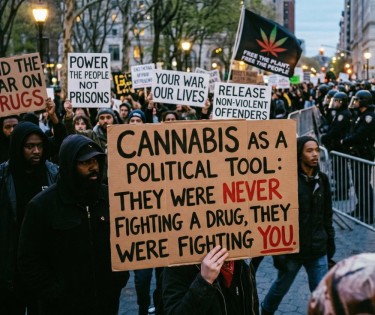
If you find this surprising, you haven’t been paying close enough attention to what cannabis has always been in this country. It has never been about public health. It has never been about safety. It has been a political lever, pulled by whoever is in power, against whoever they need to target.
The System Runs on “Crime”
To understand what’s happening now, you have to understand where the architecture came from.
In 1986, then-Senator Joe Biden authored the Anti-Drug Abuse Act, which created a sentencing structure so lopsided it became its own scandal: a five-year mandatory minimum for five grams of crack cocaine, while powder cocaine — chemically identical, favored by wealthier and whiter users — required 500 grams to trigger the same sentence. [2] Biden stood on the Senate floor holding up a quarter to explain the logic. He was not horrified by it. He was bragging. [3]
In 1988, he co-sponsored legislation extending mandatory minimums to people under 21 caught selling marijuana. [4] In 1994, he wrote and shepherded the Violent Crime Control and Law Enforcement Act — what he called, proudly, “the 1994 Biden Crime Bill” — which funded 100,000 new police officers, accelerated prison construction, and gave states financial incentives to impose harsher sentences. After it passed, he boasted to colleagues about “70 enhanced penalties,” “60 new death penalties,” and “125,000 new state prison cells.” [3]
This is the man who ran in 2020 on cannabis decriminalization.
The audacity isn’t even the point. The point is that it worked. Biden built a national political identity — “tough on crime Democrat,” the reasonable alternative to Republican excess — on the back of laws that put hundreds of thousands of people in cages for nonviolent drug offenses, disproportionately Black and brown Americans. Cannabis wasn’t the enemy. Cannabis was the tool.
Trump is doing the same thing, more crudely. His administration openly acknowledges that cannabis remains federally illegal, has re-empowered federal prosecutors to charge simple possession cases on federal land [5], and is now using possession records to justify deporting people it wants the public to perceive as dangerous. The drug didn’t change. The political calculus did.
This Is the Oldest Play in the Book
None of this is new, and it’s worth being precise about that rather than acting shocked.
Harry Anslinger built his entire career and the DEA’s institutional predecessor on cannabis prohibition in the 1930s — and he was explicit, at least in private correspondence, that the racial targeting was the point. Nixon’s domestic policy adviser John Ehrlichman later admitted on the record that the War on Drugs was designed to criminalize and disrupt Black communities and anti-war activists. “Did we know we were lying about the drugs?” Ehrlichman said. “Of course we did.” [6]
The pattern is consistent across administrations, parties, and decades: find a substance that the population you want to control uses, make it illegal or keep it illegal, then use enforcement as a justification for doing what you wanted to do anyway. Cannabis has been that substance more than any other in American history because it crosses every demographic. It gave the state a tool that fit almost any target.
What DHS is doing right now with that deportation list is the 2026 version of the same move. Call them criminals. Show their photos. Let the public fill in the narrative. The fact that the underlying offense is a plant that half the country can legally buy at a strip mall is a detail they’re counting on most people not noticing.
What You Do With This Information
Timothy Leary was once called by Richard Nixon “the most dangerous man in America.” Not because he was violent. Not because he had an army or a weapon or a billion dollars. Because he told people to stop believing the system’s version of reality — to think for themselves, to question the structures they’d been handed, to opt out of the consensus.
The establishment doesn’t fear the plant. It fears the state of mind the plant can produce: a person who looks at the machinery of control and says, “I don’t consent to this.”
The practical version of that, stripped of all the cosmic vocabulary, is straightforward. Every dollar you spend at a locally owned business instead of a corporation is a dollar that doesn’t fund the lobbying that keeps cannabis illegal. Every community you build that trades directly, supports its own, and creates alternatives to systems that extract and discard — that’s a network they can’t easily criminalize its way through. Every person who reads a deportation list, checks the actual offenses, and tells their neighbors what they found is doing more counter-programming than a hundred think pieces.
They need your participation to maintain the illusion. The list only works if people don’t look closely at it. The “worst of the worst” framing only holds if nobody checks whether the worst of the worst was holding a gram.
The most dangerous thing you can do is pay attention. The second most dangerous thing is build something they don’t control.
The plant keeps coming back no matter how many times they pull it out of the ground. That’s not a metaphor. That’s just the way it is.
Citations: [1] Marijuana Moment — “Trump Admin’s ‘Worst Of The Worst’ Deportation List Includes Nearly 100 Immigrants Accused Of Marijuana Possession Alone,” March 26, 2026. https://www.marijuanamoment.net/trump-admins-worst-of-the-worst-deportation-list-includes-nearly-100-immigrants-accused-of-marijuana-possession-alone/ [2] CLASP — “Rectifying Past Wrongs: the Biden Administration’s Limited Progress in Drug Decriminalization,” 2023. https://www.clasp.org/blog/rectifying-past-wrongs-the-biden-administrations-limited-progress-in-drug-decriminalization/ [3] Reason — “Biden Tries To Gloss Over His Long History of Supporting the Drug War,” October 2020. https://reason.com/2020/10/16/biden-tries-to-gloss-over-his-long-history-of-supporting-the-drug-war-and-draconian-criminal-penalties/ [4] Rolling Stone — “From ‘Drug War Joe’ to ‘Dank Brandon’: A Timeline of Biden and Weed,” 2023. https://www.rollingstone.com/politics/politics-features/biden-pardon-weed-offenders-timeline-1234606962/ [5] NORML — “Military Eases Enlistment Rules for Those With Prior Marijuana Convictions,” March 2026. https://norml.org/blog/2026/03/31/military-eases-enlistment-rules-for-those-with-prior-marijuana-convictions/ [6] Dan Baum, Harper’s Magazine — John Ehrlichman interview, published 2016.
STONED POLITICS, READ ON…