Want more ways to catch up on the latest in Bay Area sports? Sign up for the Section 415 email newsletter here and subscribe to the “Section 415” podcastwherever you listen.
If you walk into Oracle Park for a Giants game …
If you make a purchase at the team’s Dugout Store …
If you visit the market behind home plate on the Promenade level …
If you check out the scoreboard for launch angle and exit velocity readings …
Chances are, you’re using artificial intelligence.
The Giants have integrated AI in a major way at Third and King, and it’s deployed from the fan experience to the everyday practices of the business, marketing, communications, and baseball departments.
“People will ask, ‘Well, how are the Giants using AI?’” said the team’s chief information officer, Bill Schlough. “Honestly, it’s easier to answer how are we not using it? We’re using it everywhere. It touches everything that we do.”
AI is increasingly used throughout Major League Baseball, including with the automated ball-strike, or ABS, challenge system that was introduced this season. Schlough, 56, who joined the Giants in 1999, oversees all things AI throughout the organization and makes sure club employees are equipped with knowledge and skills to use generative AI tools such as ChatGPT, Gemini, and CoPilot to perform their jobs more effectively.
He makes available AI methods to enhance a fan’s day at the ballpark and gain a competitive edge in the front office and on the field.
“Obviously, AI wasn’t something we thought about for the first 20 years of my time with the Giants,” Schlough said. “It’s really exploded. Our use of generative AI, the ChatGPT world, started for us in 2024, and we spent 2025 leaning into training everyone across the organization. It cuts across all departments, all roles, because everyone can leverage AI to do their job better.”
While the technological advancements are a work in progress, the baseball department can use forms of predictive AI to compile and manage data, scout and research talent, forecast player development, and even try to reduce injuries.
“It’s an area that’s obviously growing around the world,” said assistant GM Paul Bien, who runs the team’s analytics department. “For us, it’s a tool to help us in our day-to-day workflows, and also we’re trying to learn more from the past and apply that information to the present and the future.”
GM Zack Minasian, who’s Buster Posey’s right-hand man, said the baseball department is open to using AI as a way to gain an edge. On the other hand, it’s not an end-all for determining daily decisions, such as where struggling Rafael Devers should bat in the lineup or how long starter Logan Webb should remain in a game.
Just like some teams have relied heavily on advanced analytics for data-driven decisions while lacking a human element, there’s a hesitation to go overboard using AI, because it wouldn’t necessarily take into consideration the pulse of the players and the game.
“Every form of evaluation has its strengths and weaknesses,” Minasian said, “and I’m sure there’s going to be some strengths with using artificial intelligence that we can use, and there’s going to be some other things that maybe it’s not as good for. If there’s a tool that we think can help, obviously you want to try and exhaust it to see where it can be more useful and then try and leverage it.
“You want to be extremely efficient, and chasing down everything new just to chase it down may not make sense either. There’s a balance there, and I think we’re probably at the stage of still learning where we think it can be with coaching, machine learning, on the medical side. … It’s uncharted territory, and we’ll definitely continue to look into it.”
Minasian cited an example of how AI could be deployed: In spring training, out of curiosity, he asked an AI tool about setting up a two-man pitching coach group versus three-man and four-man groups to see how it would divide up responsibilities for everyone involved. The results were mixed.
“You could tell there were some things that AI didn’t have a great sense of,” he said, “so it’s not necessarily something you’re going to go with. But as a way to kind of organize your thoughts, it’s an interesting starting point.
2 readers have shared their thoughts on this story
“Now, if you go on AI and ask, ‘Is this guy going to have a better season?,’ it’ll give you an opinion based on the data. I’m a believer that AI can be very helpful, and anything that can help us, we need to take very seriously, but also it’s great to have boots on the ground and have a sense of who these players are as people.”
The Giants are among the MLB teams at the forefront of implementing AI in the workplace, Schlough said, and why not? San Francisco is the AI capital of the world, just a few relay throws from Silicon Valley, where tech companies are transforming workforces and reshaping lifestyles while ramping up research and development.
“AI has to be part of our language and part of our tool kit for everyone in our organization,” Schlough said. “I just talked to marketing about this the other day, and they gave me all these bullets about how every different division of marketing is using AI in different ways, whether it’s in-game entertainment and how we create our content, whether it’s how we capture insights into fan sentiments and fan behavior, whether it’s how we optimize our ticket pricing or how we distribute our tickets.”
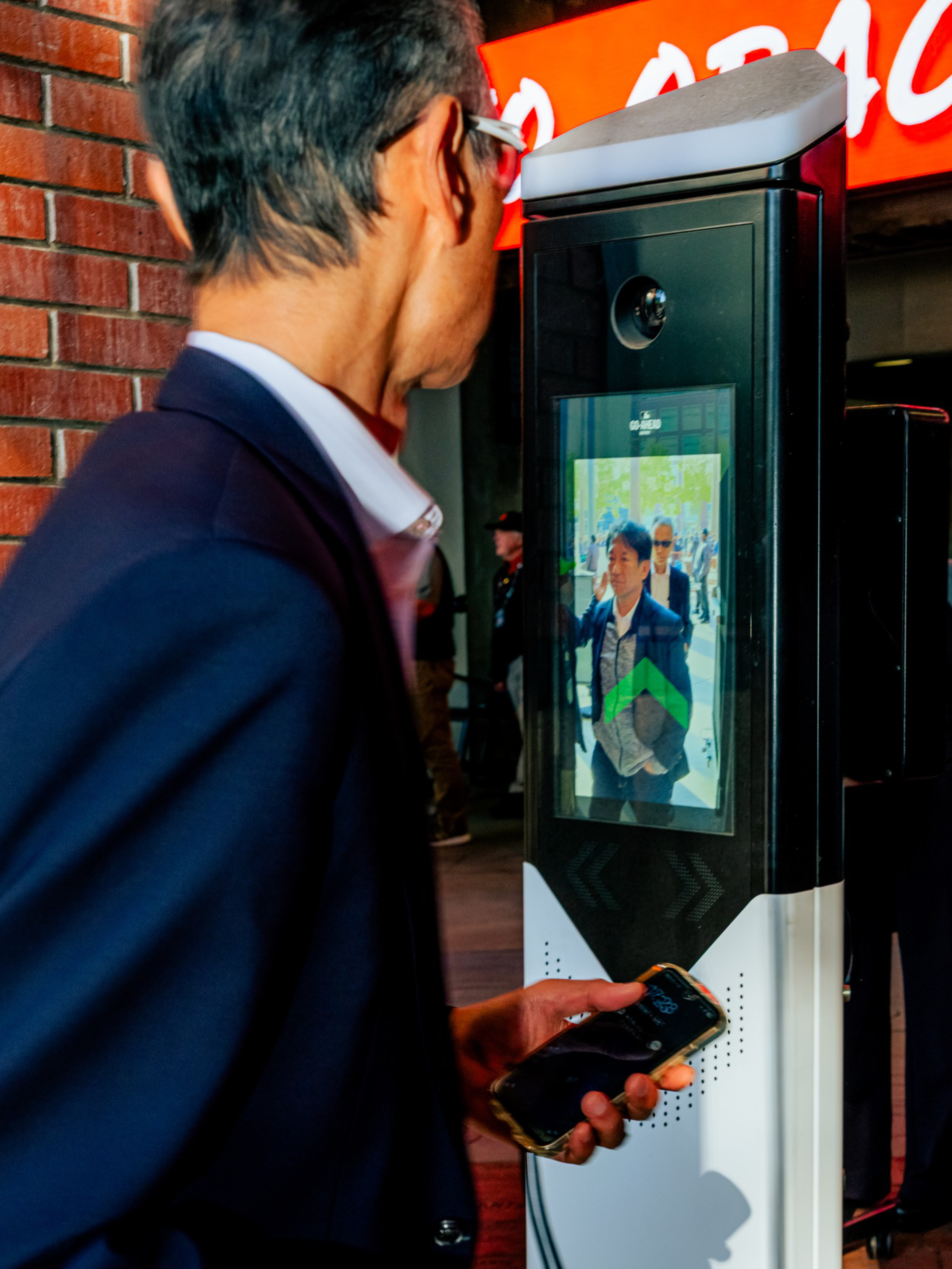

Here are examples of how the Giants have incorporated AI into the fan experience at Oracle Park:
- Go-Ahead Entry is a facial authentication process that’s located at all four main gates and gives fans the opportunity to expedite entering the stadium, a far cry from the magnetometers that detect only metal. No need to stop and scan tickets so long as fans register and purchase tickets in advance on the MLB Ballpark app.
- In the Dugout Store, fans can buy jerseys, caps, and other merchandise through the RFID (radio frequency identification) system by placing all items in a bin to be identified and charged. Again, no checkout person, no one scanning the goods.
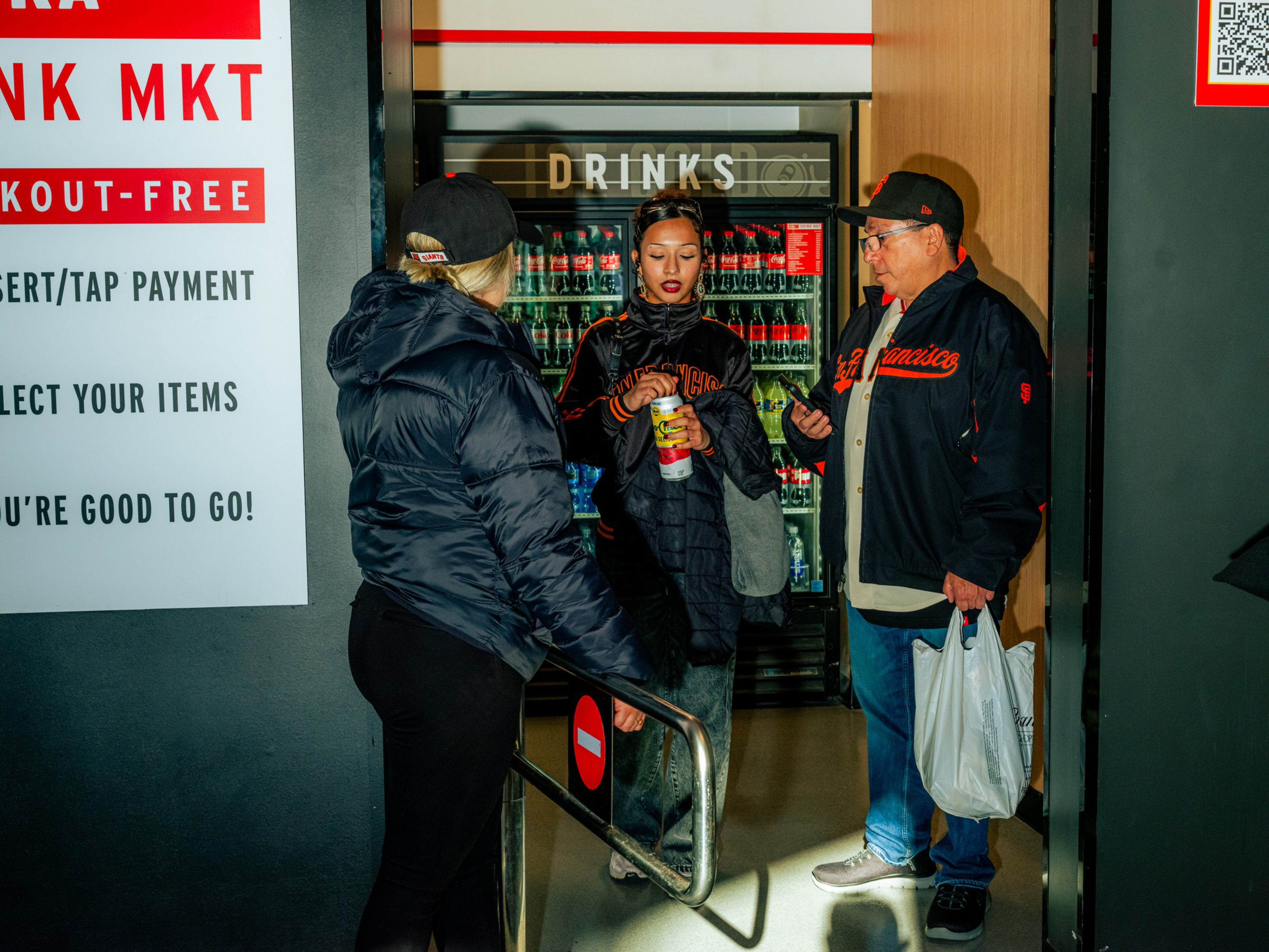
- ExtraMile is a beverage marketplace behind the plate on the lower level where fans can tap a credit card upon entry, grab whatever they desire, then walk out, thanks to an AiFI camera technology that provides an autonomous, frictionless experience. No reason to wait in a checkout line, because there is none.
- Real-time intel is flashed on the scoreboards to update a player’s advanced metrics — the days of showing just batting average, homers, and RBIs are over — along with how a pitch is thrown (type, velocity, movement) and how a ball is hit (exit velocity, launch angle, distance).
Schlough’s fingerprints are over all Giants departments, including baseball operations. In the days that Brian Sabean and Bobby Evans were in charge, when the Giants were winning World Series championships, Schlough introduced tools to beef up the use of analytics and hired a number of software engineers onto his IT team, some of whom transitioned to the baseball side. One was Bien, who later got promoted under Farhan Zaidi to run the analytics department and then again by Posey to assistant GM.
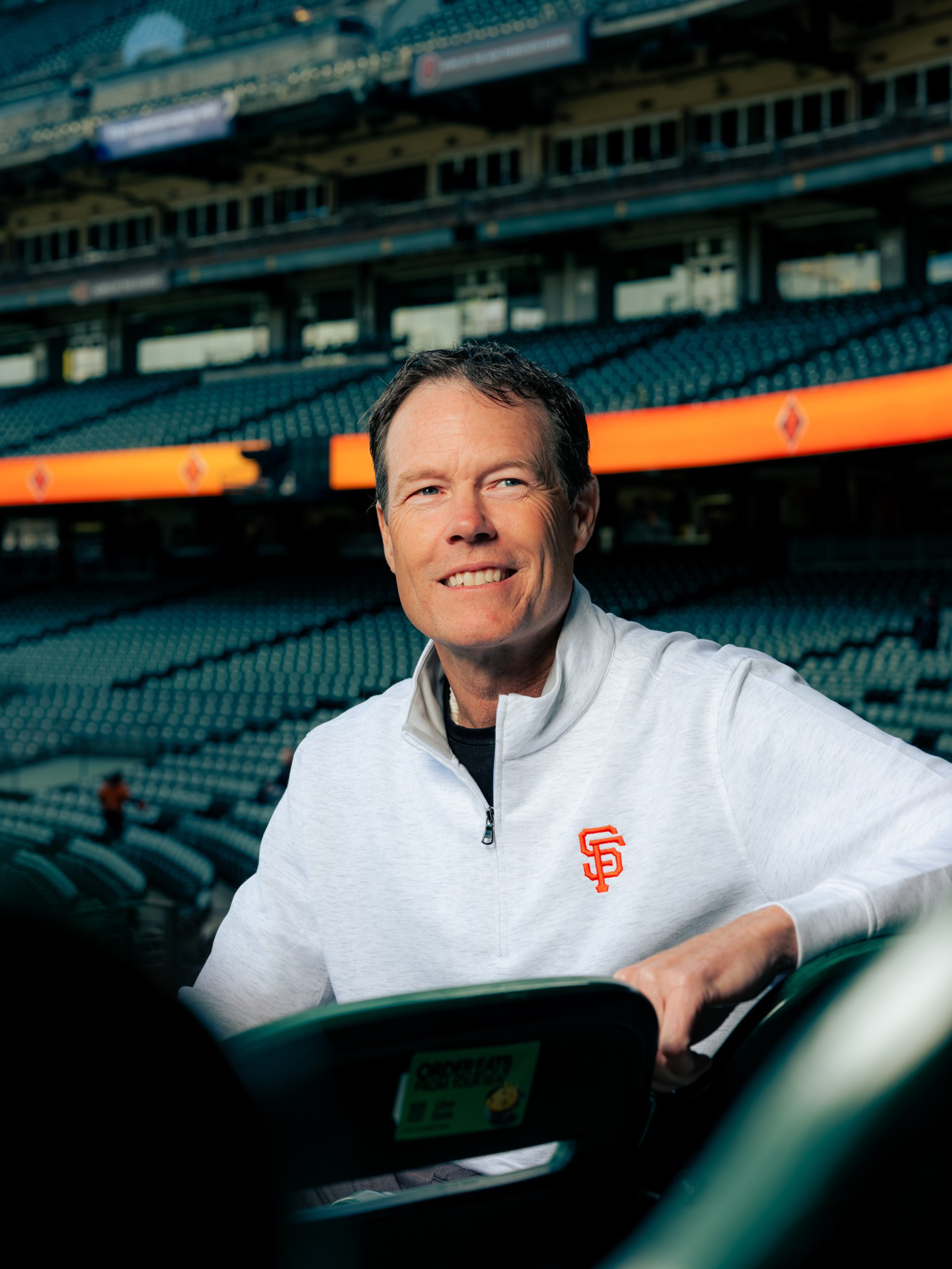
Schlough served as president of the Class A San Jose Giants in 2011 and 2012 and chairman of the farm team through 2022. He lent his technological expertise to various Olympic Games, most recently in Milan Cortina, and was involved in San Francisco’s bids to host the Summer Olympics in 2012, 2016, and 2024.
Through it all, he said, he has mixed in next-gen technology he absorbed at the Games into what the Giants do.
In April, the Giants announced a partnership through 2028 with the AI company ElevenLabs. Schlough said a focus is “translating and localizing our content to better support our international fan base.” That includes Spanish speakers and fans in South Korea, where the Giants’ marketers have made a push because of the popularity of right fielder Jung Hoo Lee.
One of the biggest complaints in any AI setting is the potential loss of jobs, but Schlough said, “We’re not reducing head count in any area of our operation as a result of AI. I can honestly say that.” And if fans want to avoid AI services at the ballpark via the Go-Ahead Entry, Dugout Store, and ExtraMile, traditional alternatives are readily available.
Meanwhile, the baseball department will continue seeking an edge through AI and any other means.
“I think it’s all part of the process behind the scenes that we think through,” Bien said. “Ultimately, we have to distill it down into what’s most meaningful.”