-
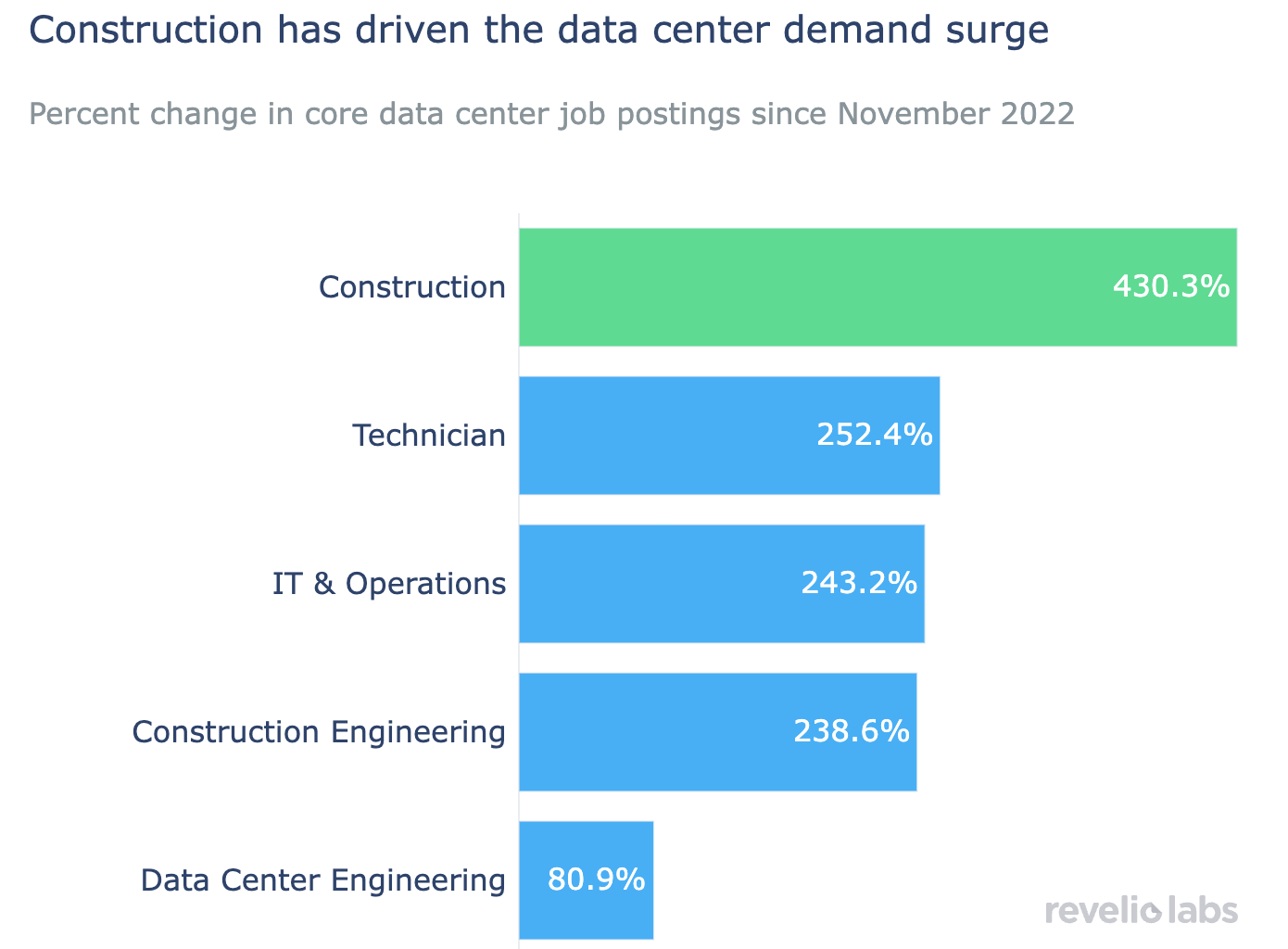
Demand for core data center-related jobs has grown substantially, resisting the downward trend in demand across the broader economy. Since the launch of ChatGPT, demand for construction workers tied to data center buildouts has grown over 430%, serving as a key leading indicator of the accelerating AI boom.
-
AI’s unique infrastructure requirements are catalyzing the expansion of data centers beyond the traditional US tech hubs, spreading economic benefits to middle America and working class communities.
-
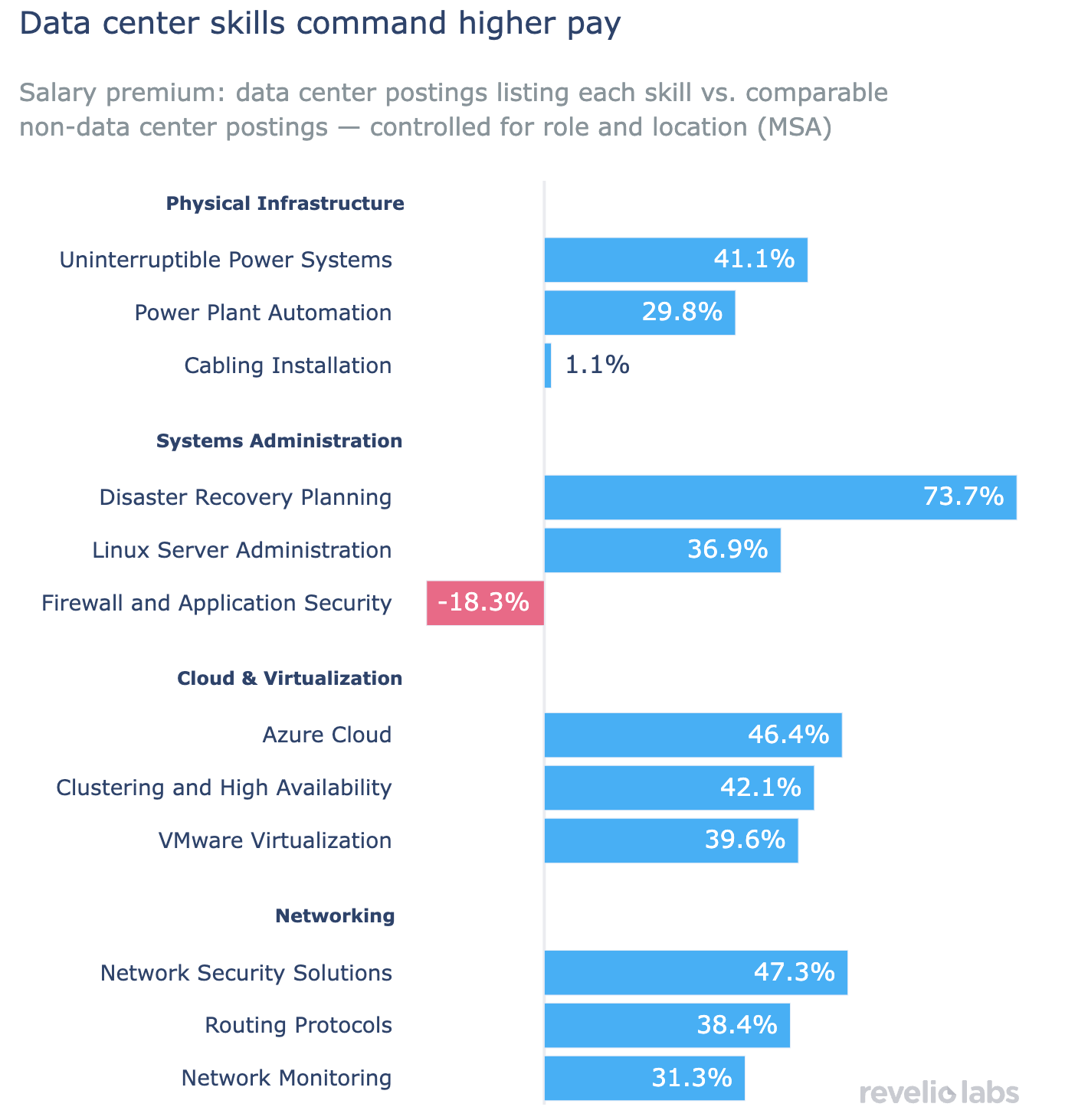
Data center-related skills are associated with 20-40% wage premiums, with operators even offering on-the-job training to quickly acquire the skilled workers they need.
Sign up for our newsletter
Our weekly data driven newsletter provides in-depth analysis of workforce trends and news, delivered straight to your inbox!
Advancements in artificial intelligence are reshaping both the economy and everyday life. With 17% of the past year’s real GDP growth coming from investments in the equipment and infrastructure to build and operate artificial intelligence systems, the economy is evolving rapidly to meet AI’s accelerating demand for computing power. Front and center in this trend, the US has seen an explosion of data center construction nationwide.
According to Revelio Labs data, this astounding trend is equally apparent within the US labor market. Since the launch of ChatGPT in November 2022, demand for “core” jobs needed to build and run a data center has grown by 175%, even as overall hiring demand across the broader economy has declined.

However, unlike other tech-driven economic expansions, artificial intelligence technologies’ unique infrastructure requirements are spreading the benefits of the AI boom beyond the traditional tech hubs.
In the US, Texas and Virginia have historically been the nation’s data-center capitals as they offer proximity to major population centers and can facilitate fast, or “low-latency,” data transfer as a result. Training the large language models used for AI, however, does not require such low-latency since these processes occur in isolation without significant data transfer. This distinction allows operators to locate AI-focused infrastructure in regions with lower land and energy costs. As a result, a number of states—from Alabama to Wyoming—are experiencing significant growth in their emerging local data center clusters. Our data center growth map demonstrates how the AI boom has not just driven growth in demand for computing power but also spread the opportunity to meet those needs to new parts of the country.
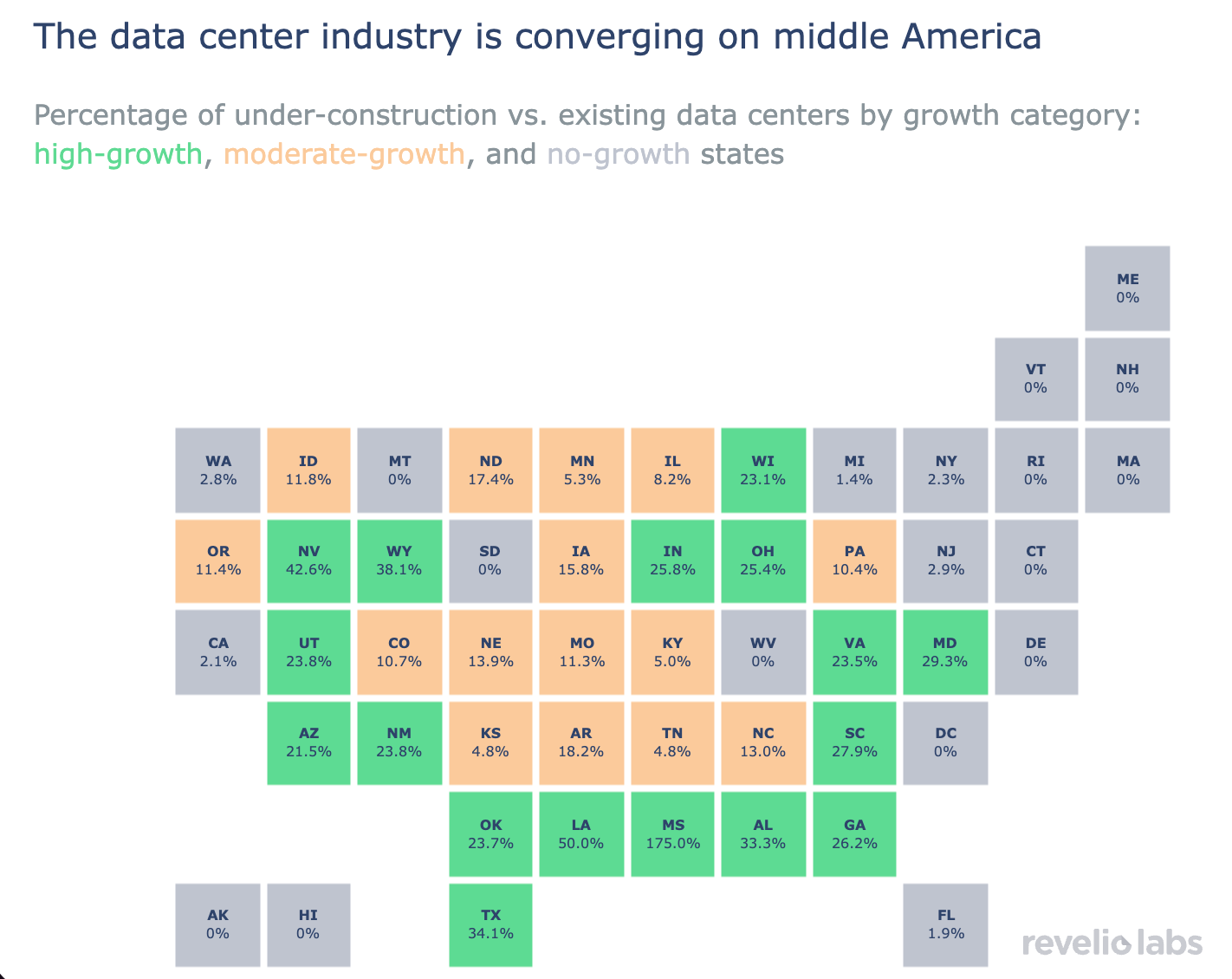
Local communities considering data center-development projects face complex trade-offs, weighing factors such as strained energy grids and ecosystems against employment and investment opportunities. With this backdrop, companies such as Meta have invested millions in marketing campaigns highlighting the local economic benefits these projects can bring. To understand how local communities can expect to benefit from a data center operator moving to town, we analyze the labor market dynamics using Revelio Labs data.
A new data center represents a significant development project: constructing buildings ranging in size from two to 200 football fields, ingesting and distributing 100-200 megawatts of power (roughly enough for 50,000-100,000 homes), and heating and cooling servers efficiently 24/7.
With over 700 such projects currently in development (a nearly 20% increase in total data centers nationwide), construction work has been the primary driver of the rise in data-center labor demand. Since the launch of ChatGPT, the demand for data center construction workers has jumped by over 430%, making it one of the clearest leading indicators of the data center industry’s rapid expansion. Crucially, demand for construction labor is one that local workforces are prepared to supply—particularly those in emerging data-center markets such as Alabama or Wyoming, which have relatively larger blue collar workforces.
Nevertheless, while construction projects can provide a boost to local labor markets, the benefit is ultimately temporary. The main question for communities considering hosting data centers is whether these projects generate sustained employment, that is, permanent jobs that remain once construction is complete.
Permanent data center jobs can be classified as either off- or on-premises. Off-premises roles can range from sales and finance to engineering, which can be done from anywhere and, therefore, do not inherently provide local labor opportunities. On the other hand, on-premises jobs are those that must be physically conducted at a data center. Like construction, these roles such as data center operations, maintenance, and security tend to align well with the labor pool of the communities receiving new development projects. Indeed, as shown earlier, demand for both technician and IT and operations roles—which comprises the bulk of permanent on-premises jobs—has more than tripled, suggesting that the data center buildout is still in an early phase and that longer-term labor demand is continuing to scale.
While these on-premises jobs favor blue collar workforces, they require a unique set of industry-specific skills. Analyzing the Revelio Labs job postings data, we identify some of the leading industry skills that data center operators currently seek and estimate associated wage premiums. The results show that having the skills data center operators need pays off; workers with expertise in physical infrastructure, systems administration, cloud platforms, and network security command meaningful pay premiums.
For both individuals and communities looking for data center opportunities, there are accessible resources to acquire the proper skills. Many industry groups and companies offer certification programs in a number of different data center-related fields. Remarkably, many data center operators currently offer on-the-job training too, demonstrating just how motivated they may be to not just hire but do so quickly as well.
As local communities weigh the pros and cons of welcoming a data center to town, there are multiple factors they must consider, from environmental to economic impacts. From an economic perspective, the data suggests that demand is large and growing and that real labor market benefits are attainable. Facilitating access to effective workforce training—especially for blue collar roles—can help tip the balance and ensure that the AI boom spreads lasting benefits across the country.