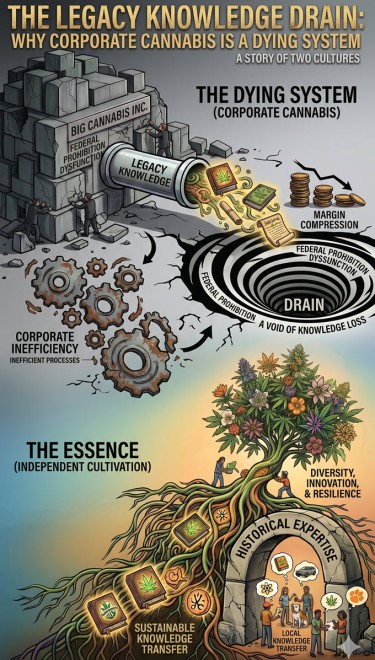
There’s a dispensary near me that sells pre-packaged eighths under fluorescent lighting, where the budtender—who looks like he just finished a retail shift at the Gap—can tell you the THC percentage and which terpenes the lab detected. What he cannot tell you is who grew it, what the lineage is, how the plant was stressed, or why it hits completely differently from the same strain you bought last month. That information is gone. Not forgotten. Erased.
This is the legacy knowledge drain, and it is the quiet catastrophe nobody in the cannabis industry wants to talk about openly—because acknowledging it means acknowledging that the “professionalization” of weed has, in many respects, destroyed the thing that made it worth professionalizing.
Let me be precise about what I mean by legacy knowledge. I’m not talking about nostalgia. I’m talking about the accumulated expertise of cultivators who spent decades—in many cases under threat of federal prosecution—developing a working relationship with Cannabis sativa at the genetic level. These growers understood phenotypic expression, stress responses, soil chemistry, harvest timing by trichome color, and cure techniques that affected the final experience in ways no certificate of analysis can capture. They kept genetics alive through clones and seeds passed hand to hand across generations of growers. That body of knowledge took roughly 50 years to develop in the American underground market, beginning with the first imports from Colombia, Thailand, and Afghanistan, moving through the Skunk era, through the Northern California outdoor scene, through the indoor revolution.
The mechanism is straightforward. When states like California, Colorado, and Washington built their legal frameworks, they imposed compliance costs—licensing fees, mandatory testing, packaging requirements, track-and-trace systems, seed-to-sale software—that effectively filtered out small operators.
In California, estimates have consistently placed compliance costs for a small craft cultivator between $50,000 and $250,000 before a single plant goes in the ground. (MJBizDaily has covered this regulatory burden extensively in its annual licensing cost reports.)
The operators who survived were the ones with capital. Capital comes from investors. Investors want standardization, scalability, and consistent returns. None of those priorities align with the careful, idiosyncratic, small-batch cultivation that produced the most interesting genetics and the deepest grower expertise.
What scaled instead was the monoculture.
A handful of commercially viable strains—reliably high in testable THC, easy to grow at volume, visually appealing for packaging—came to dominate the legal shelf. The names changed constantly; the underlying genetics often did not.
A study published in PLOS ONE in 2023 analyzed the cannabinoid profiles of over 90,000 cannabis samples from legal dispensaries and found the chemical diversity between strains labeled as different cultivars was frequently indistinguishable. The researchers concluded the naming system in commercial cannabis is largely marketing, not taxonomy. (McPartland & Small, “A classification of endangered high-THC Cannabis (Cannabis sativa subsp. indica) domesticates and their wild relatives,” Phytologia, along with the PLOS ONE genomic data, corroborate this.) You are paying premium prices for branded sameness.
Meanwhile, the legacy growers—the people who held the actual knowledge—faced a binary choice: absorb the compliance costs and enter the legal market on corporate terms, or keep operating outside it. Most of those who went legal found their product undercut by MSOs (multi-state operators) with industrial scale.
Many of those who stayed underground saw their operations swept up in enforcement actions, because the legal framework was never designed to absorb them; it was designed to replace them. Some simply retired. Their knowledge left with them.
The irradiation issue makes this concrete. Mandatory gamma irradiation of cannabis products—required by some state programs to address microbial contamination—is a symptom of what happens when you move from skilled, small-scale cultivation in controlled environments to factory-scale grows where contamination is an industrial risk rather than a craft failure. Irradiation extends shelf life and kills pathogens, but it also degrades terpenes and potentially alters minor cannabinoid profiles.
A grower who understood cure humidity, jar timing, and post-harvest handling would not produce product that required gamma treatment. The irradiation mandate reflects an industry that has traded craft quality for industrial volume, then used regulation to paper over the degradation.
The craft vs. corporate cannabis debate appears regularly on Reddit’s r/microgrowery and r/trees, and the sentiment in those communities is not subtle. Users with decades of growing experience describe legal dispensary weed as “homogenized,” “lacking depth,” and “hitting flat.” This is not mere snobbery. The endocannabinoid system responds to the full spectrum of a plant’s chemistry—the entourage effect, documented in Russo’s 2011 paper in the British Journal of Pharmacology, suggests that terpenes and minor cannabinoids modulate the effects of THC in ways that a single-variable THC percentage cannot predict. When you standardize for THC and flatten everything else, you lose the pharmacological complexity that made diverse genetics medically and experientially valuable.
There is an argument that the market will self-correct—that consumer demand for quality will eventually reward craft producers. It’s the argument Colorado boosters made after the state’s market crashed between 2021 and 2023, when wholesale flower prices dropped below the cost of production for smaller operators.
The invisible hand did appear: it wiped out several hundred small businesses. Veritas Fine Cannabis went from 144 employees to 21. Hundreds of small operators shuttered. The survivors who emerged weren’t primarily the craft growers with superior genetics; they were the businesses with enough capital to absorb the price collapse. The market self-corrected toward consolidation, not craft.
None of this is accidental. The regulatory architecture of legal cannabis was built in consultation with lobbying interests that had a stake in high barriers to entry. Large operators benefit from compliance costs that their smaller competitors cannot absorb. The result is a legal market structurally designed to produce and reward mediocrity at scale—precisely the outcome that benefits the “Epstein class” of cannabis investors who entered the space not because they love the plant, but because they recognized it as a commodity play.
The fix, if one exists at this point, is not primarily legislative. Legislation built this problem. The fix is practical and personal: find legacy genetics, maintain them, grow them, and trade them within trust networks. Seed banks that preserve pre-prohibition landraces—Ace Seeds, Bodhi Seeds, Swami Select—are doing archival work as important as any cultural preservation effort. Supporting them matters. Growing your own, where legal, matters more. The home cultivation provisions in adult-use states exist precisely because some legislators understood that consumer access to the plant should not be mediated entirely by a licensed commercial system.
Corporate cannabis will not reform itself out of this problem.
It will keep optimizing for what it can measure: THC percentages, unit costs, shelf velocity, brand recognition. The legacy knowledge that built this culture was never theirs to hold, and they have no incentive to preserve it.
Stop funding the circus. The genetics they’re selling you are a pale copy of what this plant can be. The people who knew that are largely gone. The ones who remain deserve your attention and your dollars more than any MSO with a slick logo and a loyalty app.
CANNABIS CORPORATE CULTURE, READ ON…