From Philly and the Pa. suburbs to South Jersey and Delaware, what would you like WHYY News to cover? Let us know!
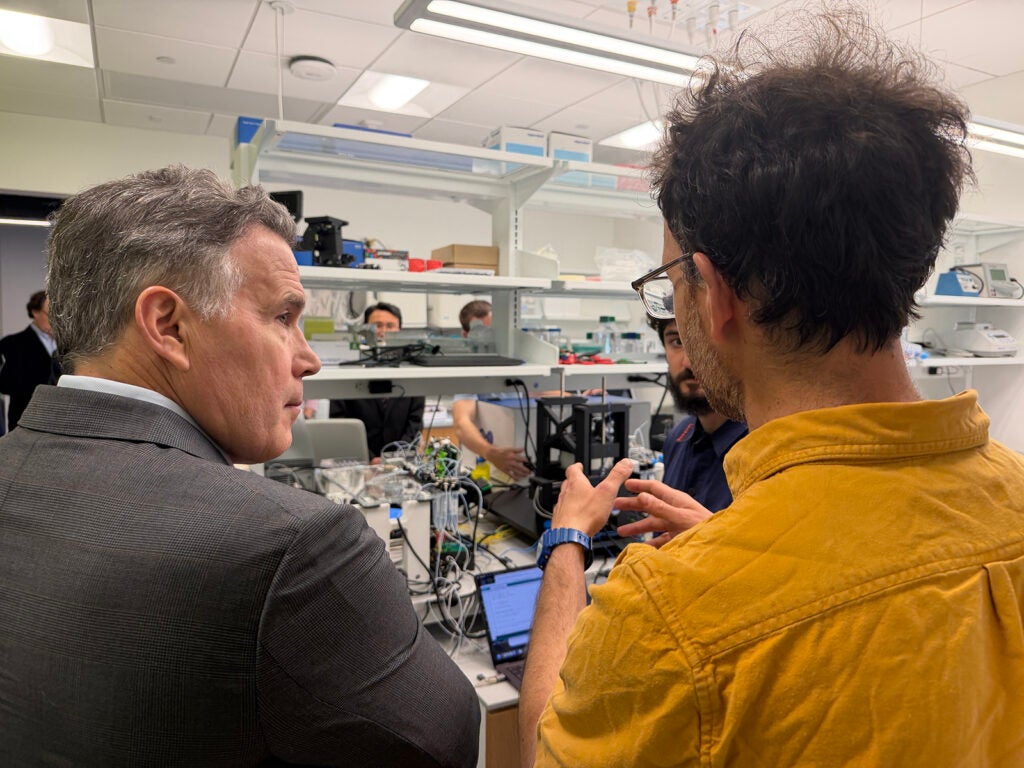
U.S. Sen. Dave McCormick, R-Pa., toured a University of Pennsylvania research laboratory Friday to highlight how artificial intelligence can supercharge advances in biomedical and drug development.
“Every time I come here for a visit, I leave just inspired by all the wonderful, incredible discoveries and progress,” McCorkmick told researchers.
AIRFoundry, an AI-driven research lab funded by the National Science Foundation, is located at One uCity Square near Penn’s campus. The lab uses AI, robotics and automation to speed the development of RNA-based medicines, drug delivery systems and other biotechnology applications.
Years become weeks
Researchers at the incubator said AI is changing biomedical research by helping scientists process large datasets, predict successful drug formulations and automate parts of the discovery process.
That has meant a highly accelerated development process, bringing ideas to production in a much shorter time.
“Years of work become weeks of work, and that’s sort of the compression that you see when you use AI to do these things,” Jake Gardner, an assistant professor of computer science who works at the lab, told McCormick.
The technology has the potential to reduce the drug discovery timeline and associated costs, and may benefit fields beyond medicine, such as agriculture and veterinary science.
Right now, “a company has to search for 10 years and spend hundreds of millions to billions of dollars just looking for a potential candidate that they’ll then take through the clinical pipeline,” said Andrew Hanna, a bioengineering doctoral student working at the lab. “The goal is to turn that from like a 10-year process to like a six-month process.”
The visit also highlighted the commercialization efforts tied to Penn’s research ecosystem. Several researchers described how startup companies have emerged from university labs.
One of those, InfiniFluidics, created a prototype system that uses robotics and AI-processing to speed up the creation of RNA-based drug treatments. Co-founder Daeyeon Lee said hospitals, research labs and pharmaceutical companies could eventually use the technology.
“This is a unique project even for Penn, which is known for interdisciplinarity,” said Lee, who is also a professor of chemical and biomolecular engineering at Penn. “We have computer scientists that are building AI platforms so that we can design experiments for people, but then we have people working in molecular biology. We have people like me or engineers that come together to build these facilities and help researchers.”
The AI talent pipeline
Penn boasts of being the first Ivy League university to offer an undergraduate degree in AI, from which the first six students graduated this weekend.
The curriculum includes fundamental courses, as well as “AI for health” and “AI for robotics.”
George Pappas, Penn’s AI program director, told McCormick they expect the program to grow to 250 students next year.
“It’s not just advancing AI, but how to impact other disciplines and other sectors of the economy through AI,” Pappas said.
In addition to Penn, Carnegie Mellon University in Pittsburgh also offers an AI major, making Pennsylvania the only state with two universities offering the curriculum.
AI is expected to disrupt many professional and creative industries, taking jobs from writers, creators and lawyers, but is also expected to create millions of technical jobs worldwide in the next decade.
Industry leaders say they hope the U.S. will hold its lead in the field, ensuring many of those jobs stay in the country. McCormick also emphasized the importance of maintaining U.S. leadership in AI as a geopolitical necessity, particularly as China increases its investment.
“We’re in this existential race with China, in my opinion, for leadership in AI,” he said.
Some estimates put China six months to a year behind the U.S., but some note that China is catching up. Former Google CEO Eric Schmidt said China is “within striking distance.”
The funding and energy conundrums
The AIRFoundry was launched in April through an $18 million NSF grant and brings together researchers from Penn, Children’s Hospital of Philadelphia, Drexel University and others.
McCormick said AIRFoundry reflects the value of federal funding that can boost medical research, and create jobs.
“I’m so glad to see that the funding’s being put to good use,” he said. “I’ve been somebody who’s tried to be a really strong voice increasing NSF, [National Institutes of Health] funding. I think we need to make sure it’s really used in local ways.
The Trump administration planned to cut NSF funding by nearly $5 billion in its preliminary budget proposal last year. That funding was largely restored, but scientists have expressed concern over Trump’s firing of the NSF board last month.
Another challenge for the rise of AI: energy use. The processing power required to train AI models demands unprecedented levels of energy and water for cooling. Critics say the expanded use of natural gas for data centers will increase greenhouse gases and further impact the climate.
There are now 52 AI-based data centers in Pennsylvania, about half in and around Philadelphia, with dozens more in planning stages. They have driven up energy demand and led to recent increases in consumer electricity rates. The state utility commission has proposed a tariff plan to reduce that impact, but state legislators may need to intervene as demand increases.
Asked about concerns over the power needed by data centers, McCormick said data centers should be required to produce the energy they need themselves, and used Homer City as an example. A planned development in the Indiana County town includes on-site natural gas generators that are intended to generate 4,500 megawatts to help power the data center. However, the local utility is still expected to provide a significant amount of additional energy.
“You can’t really say AI revolution without saying energy revolution, because you have to have enormous power to power the compute,” McCormick said. “Pennsylvania is uniquely blessed. We have incredible energy resources, [the] fourth-largest natural gas reserves in the world, second-largest energy producer in America.”
WHYY is your source for fact-based, in-depth journalism and information. As a nonprofit organization, we rely on financial support from readers like you. Please give today.