Rest of World visited workers across Asia and Africa who are using AI to solve daily problems, make a living, and create new possibilities in their everyday lives.
These profiles reveal how people choose to leverage artificial intelligence — what they are willing to delegate, which tasks they insist on handling themselves — and how access to cheap, powerful AI can expand the limits of what one person can accomplish.
It’s proof the economic impact of AI is taking shape on a personal, local level as forces in Silicon Valley and China battle to command the global AI ecosystem.
🇳🇬 “I have invested my time but not my money”

Damilare Dosunmu
When Nureeyah Ogunmuyiwa decided to hire her first employee earlier this year, she faced an unexpected problem.
The 24-year-old makeup artist, who caters to brides and bridal parties among others in Lagos, had never hired anyone before. With her business growing and Ogunmuyiwa stepping into content creation to promote her services, she knew she needed to hire help. But she didn’t know how to write a job description, what questions to ask in an interview, or what qualities to look for in candidates.
Ogunmuyiwa asked ChatGPT.
Within minutes, the chatbot produced a complete hiring plan, including interview questions and a checklist to evaluate candidates.
“ChatGPT was my hiring manager that made the process less of a hassle,” Ogunmuyiwa told Rest of World. “I told her that I needed someone reliable, and to let me know what to do and what to look out for. She gave me everything that helped me hire my amazing assistant.”
That assistant now works alongside the AI one.
Ogunmuyiwa first encountered ChatGPT a couple of years ago while working as a customer support officer at a Lagos logistics startup after graduating from university. She used it to rewrite emails so they sounded more empathetic to customers and professional to colleagues. When she left her job in 2024 to focus full time on the makeup business she had been building on the side since 2018, AI came with her.
As a bootstrapped entrepreneur with a small budget, she said ChatGPT has become her “most reliable business partner.” Today, it plays multiple roles.
It’s her social media manager, writing captions, suggesting suitable hashtags, and recommending content ideas that have helped attract new customers. It’s her sales coach, helping her refine client pitches so they sound “bold but not too salesy.”
It also handles the math. Whenever she restocks beauty products, ChatGPT helps her calculate prices based on costs and profit margins, saving hours of manual calculations.
“It saves me from punching each product in the calculator and then trying to do the mental work of arriving at a profitable price point,” Ogunmuyiwa said.
Nearly half of Nigeria’s population now has internet access, with the majority connecting through smartphones. Ogunmuyiwa finds the convenience of access to AI bots on her phone very useful.
ChatGPT has become one of her most visited apps, alongside WhatsApp Business and Instagram. She prompts it for the simplest tasks like setting reminders. She has organized her conversations with different labels: “Glam by Ree,” named after her business; “return to corporate” for her professional plans; and “my studio project” for creative planning.
When Ogunmuyiwa recently moved her business from her dining room to a rented studio, she used AI to generate mood boards, which she shared with carpenters and electricians as they worked on the new space.
As new AI tools appeared, she began experimenting beyond ChatGPT. After a friend recommended Anthropic’s Claude earlier this year, she reluctantly gave it a try, worried she’d have to teach another chatbot everything about her business from scratch. Eventually, she settled into using both but highly favors ChatGPT.
-
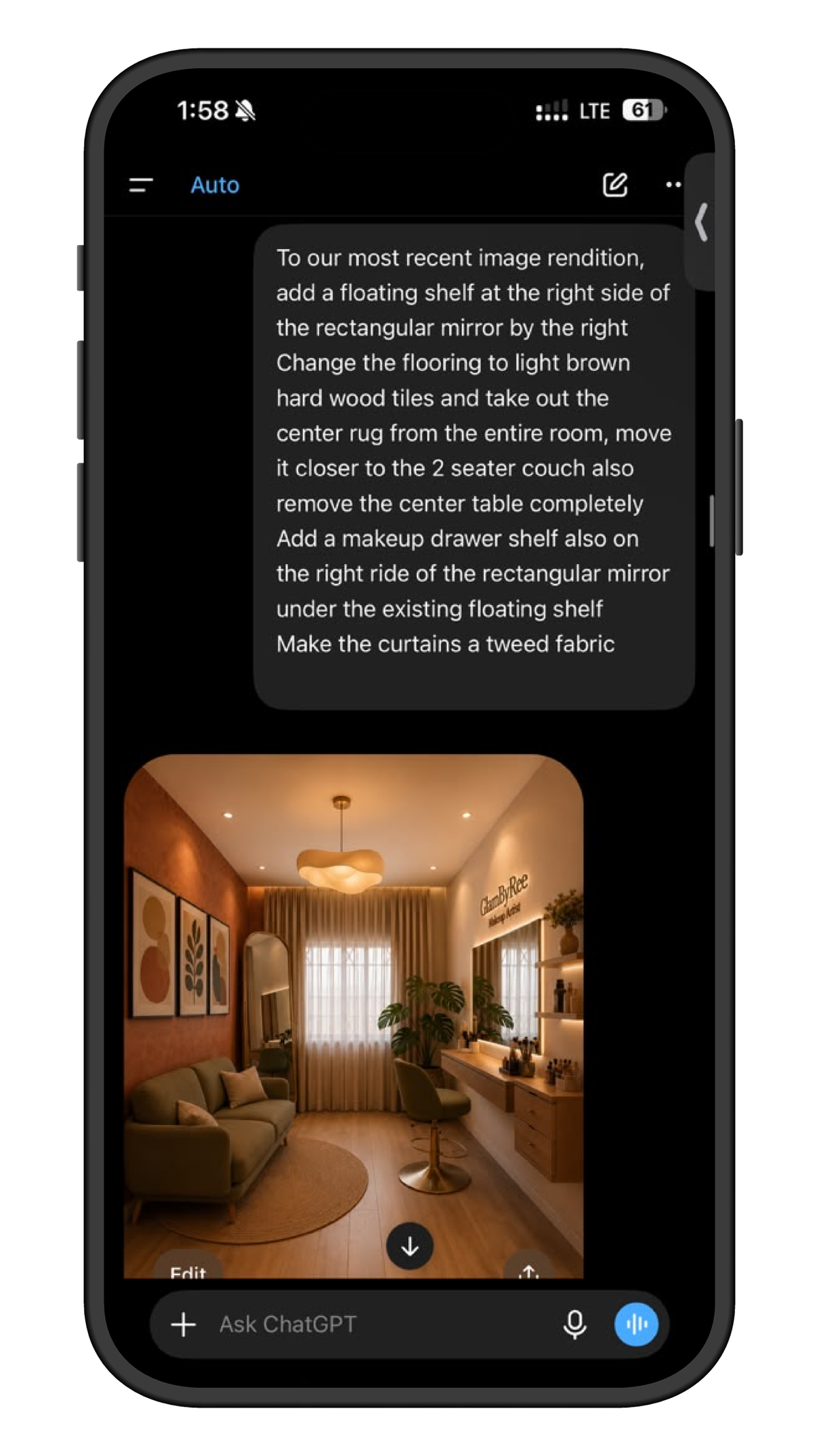
Ogunmuyiwa recently moved her business into a rented studio and used AI to generate mood boards. -

Ogunmuyiwa shared AI-generated reference images with carpenters and electricians to design her new studio.
Damilare Dosunmu
Despite relying on AI throughout her business, Ogunmuyiwa hasn’t paid for either service because she feels the free version serves her purpose.
“I have invested my time but not my money,” she said. “And I’m getting a great return.”
She is open to a paid version in the future if needed, especially to generate images and mood boards.
AI contributes roughly 5% to her business growth. “I can’t give all the credit to AI for giving my business structure because I made a personal decision,” Ogunmuyiwa said. “AI has really helped me to implement that structure in the best way possible. I spent less time on things I trust ChatGPT to handle.”
That growing dependence sometimes worries her.
At one point, she deliberately stopped using AI because she felt she was consulting it before making every decision. She tried using Google search instead.
“But Google, too, now has AI it’s promoting you to use,” she said. “It’s quite difficult to look anywhere these days without seeing AI.”
🇮🇳 “Let humans do that”

Itika Sharma Punit
When Chinmayee Mishra opened Patta Chai, a neighborhood tea cafe on the outskirts of Bengaluru, she wasn’t trying to build a technology business.
Her husband, Ajay Anbalagan, had left his corporate career, and the couple wanted to create something deliberately slower: a cafe where people linger over chai, conversations, and freshly baked cookies. Their four-person staff knows regular customers by name. Every dish is plated by hand.
“If AI ever completely replaces the people cooking,” Mishra told Rest of World, “that’s the day I’ll shut down my cafe.”
Yet behind the handmade food and warm hospitality, Patta Chai has quietly become an unexpected experiment in grassroots AI adoption.
It began earlier this year with ChatGPT.
Like many small businesses, Mishra initially used it for marketing. Social media captions, which once required endless back-and-forth with an intern, now take minutes. She trained ChatGPT on her previous writing, asking it to mimic the reflective, long-form tone that has become part of the cafe’s identity.
Canva and Adobe Express, both equipped with AI features, helped her design labels, posters, and promotional material without hiring a designer.
The real transformation happened when she realized AI could do far more.
Although Mishra has spent years working in marketing at enterprise software company Zoho, she has no engineering background. Curious rather than technical, she began experimenting with AI tools by asking them questions, watching tutorials, and building one workflow at a time.
Soon, Mishra was building AI agents using Zoho’s Zia Agents platform — tools to automate tasks she currently handles through spreadsheets.
For instance, one of the agents she is testing analyzes daily sales and customer feedback. Another calculates recipe costs by combining ingredient prices, labor, electricity, and overheads before recommending a selling price. It even compares her prices with those of cafes within a 10-kilometre (6-mile) radius and makes suggestions based on similar menu items.
“The calculations were always possible,” Mishra said. “What AI adds is memory.”
-

Mishra, along with her husband Anbalagan, has created a deliberately slower business focused on handmade food and warm hospitality.
Itika Sharma Punit
-

A live sales dashboard, built with Claude and hosted on Zoho Catalyst, pulls data directly from Patta Chai’s restaurant management software to show what’s selling and what’s not.
Instead of Mishra having to remember how she priced dozens of cakes or whether a new cookie resembles an older product, the AI assistant recalls previous decisions, compares ingredients, and offers pricing and menu recommendations in seconds.
It has also changed how the cafe communicates internally.
Mishra writes instructions for her staff in English and asks AI to translate them into Hindi or Bengali, allowing recipes and kitchen notes to move more easily across a multilingual team.
Every month, she pays around 2,000 rupees ($26) for ChatGPT Plus and 500 rupees for Canva Pro. Adobe Express costs her 2,500 rupees a year. The expenditure initially felt extravagant. Today, Mishra considers it one of her best business investments.
“It seems a little pricey if you are not doing anything with it,” Mishra said. “But I feel it is just brilliant because we get so much work done. You get a lot of value for that money.”
Not every AI suggestion makes it into the business. She trusts it with mathematics far more than judgment.
“If it’s a calculation based on my data, I trust it,” she said. “If it’s subjective — market positioning or emotions — that still has to be my intelligence.”
The cafe’s launch of samosas illustrates that balance. AI helped validate pricing and gave Mishra confidence that the margins worked. But the decision to introduce the dish — and the recipe itself — came entirely from the team.
Technology has also changed how she spends her workday. Hours once spent writing captions, updating spreadsheets, and calculating margins are now devoted to developing new menu items, organizing community events, and improving the customer experience.
Mishra remains cautious about letting AI reshape the cafe’s character. She rejected proposals for QR code menus, automated ordering screens, and AI-driven customer profiling. Her manager already remembers which regular likes less sugar in their coffee, she said.
“Let humans do that.”
Privacy and the environmental costs of AI rarely influence her day-to-day decisions, largely because she doesn’t believe her small business holds particularly sensitive information. Her concern lies elsewhere: ensuring technology stays behind the scenes.
For Patta Chai, AI isn’t replacing hospitality. It’s quietly taking over the paperwork so the team can focus on making tea.
🇨🇳 “Changed everyone at the bottom of the industry”

Courtesy of Wendi Ma
When Wendi Ma graduated from film school in New York in 2018, he imagined a career spent on bustling film sets, directing actors and working alongside cinematographers and lighting crews.
A decade later, the Chinese director spends much of his day writing AI prompts.
His production studio in Zhengzhou, central China, has no actors or camera operators. Instead, it employs people whose job is to generate thousands of AI video clips until one precisely fits the requirements of the scene.
Ma began directing minidramas just as the vertical, mobile-first format started taking off in China. His early titles, No Escape from My Ruthless Alpha and Twin’s Love Trap for Billionaire Dad, attracted tens of millions of views. By late 2023, Chinese-funded streaming apps such as ReelShort and DramaBox had brought the format to the U.S., creating a global audience for the bite-sized soap operas.
Minidramas were considered low-budget, but it still took about $200,000, a crew of 50 people, and two months to make an entire series. Ma frequently traveled between New York and Los Angeles, directing live-action shoots with actors and full production crews.
Then AI video generation arrived.
By 2026, models such as ByteDanceByteDanceByteDance is a Chinese internet technology company that owns TikTok and Douyin, a Chinese version of TikTok with a successful e-commerce arm.READ MORE’s Seedance had become good enough for studios to produce entire dramas without hiring actors. Production companies rapidly shifted their investments toward AI-generated series, forcing directors like Ma to reinvent how they worked. Prompt writers, video generators, and editors have largely replaced traditional camera crews and lighting teams.
Today, Ma’s studio creates minidramas entirely with AI. He has rented an office space and bought laptops. To generate each second of video, Seedance charges about 0.8 to 1 yuan (12 to 15 cents). For the minidrama industry, the economics are impossible to ignore. It takes just 10 people, around $20,000, and less than a month to make a series.
“The transformation may not have reached the biggest productions yet,” Ma told Rest of World. “But it has already changed everyone at the bottom of the industry.”
A typical prompt might specify everything from the setting and camera angle to the emotions on each character’s face:
Medium close-up inside a hospital room. The baby starts crying. Asher picks her up and gently comforts her. Victoria watches him with a soft smile.
-

Prompt writers, video generators, and editors have largely replaced traditional camera crews and lighting teams in minidrama production.
Courtesy of Wendi Ma
-

On each attempt, AI generates a different version of a scene, even with the same prompt. Finding the right shot often comes down to luck.
Prompts often include instructions like “realistic cinematic texture” or “handheld camera with a slight shake” to mimic live-action filmmaking. “Mostly it comes from imagination and experience,” Ma said of the art of writing prompts. “Or, the easiest way, you generate a clip and see if it works.”
Even then, there are no guarantees.
Every time the same prompt is submitted, the AI produces a different version of the scene. Finding the right shot often comes down to luck. That’s why the people generating videos have earned an unusual nickname: lottery masters.
To produce a 90-minute series, they may generate between four-and-a-half and six hours of footage before finding enough usable clips. Ma misses filmmaking the way he first learned it.
At a human shoot, the actors, cinematographers, and lighting crews brought their own artistic contributions, he said. “It felt like a chemical reaction was happening. It sparked subtle, accidental creativity.” Most of his old crew members have left the industry as jobs vanished.
🇮🇳 “It all depends on the content”

Shenvi School of Dance
For years, Trishika Udyawar taught young children to dance using a library of existing songs. There was no shortage of music, but much of it felt outdated and generic.
Children’s dance songs often told students exactly what to do: Clap your hands, jump up, turn around. Udyawar’s employer, Rhythmus Happy Feet, wanted music that encouraged children to imagine rather than simply imitate.
The Mumbai-based dance education company develops curricula and trains teachers to conduct dance classes in more than 65 schools across India, and runs after-school dance programs.
Since January, Udyawar, 27, has been creating songs herself with help from AI.
She asks ChatGPT to draft lyrics that are aligned with classroom lessons. She then feeds the lyrics into AI music-creation app Suno, tweaking prompts repeatedly until the rhythm, language, and melody work for preschoolers.
In one of her AI-generated songs about the life cycle of a tree, children become seeds, then grow into big, sturdy trees. In another, they mimic insects moving through the monsoon.
“If I try to generate lyrics of one song, I probably have to do it 10 times before I get the exact output I need, and even then, I might have to make a few changes,” Udwayar, who works as a teacher and curriculum planner at Rhythmus Happy Feet, told Rest of World.
Before AI, Rhythmus relied on YouTube videos and licensed educational music. But licensing became expensive as the company’s curriculum expanded. “You have to buy rights for one class application, and to multiply by each class, the cost increases a lot,” Swara Patel, founder of Rhythmus Happy Feet, told Rest of World.
A music production company had quoted 60,000 rupees ($629) per song, and three months to create 10 original songs for Rhythmus.
With Suno, the dance company has made 60 songs in the same amount of time. Their annual subscription for the app costs around $90.
But Suno has recently come under fire for allegedly scraping millions of songs, including potentially copyrighted music, to train its AI model. It faces several lawsuits, including from Sony Music and Universal Music Group, because some of the AI-generated tracks bear a strong resemblance to existing hits. The company has admitted to using “essentially all music files of reasonable quality that are accessible on the open internet,” but claims it is fair use.
That hasn’t affected Rhythmus. Parents rarely ask where the songs come from, Udyawar said. “It all depends on the content of the song. If it’s nice, the lyrics are clean, the concept is great, the music is amazing, and it is appropriate, that’s all that matters.”
-

Before AI, Rhythmus relied on YouTube videos and licensed educational music. A music production company had quoted $629 per song to create 10 original songs.
Ananya Bhattacharya
-

AI music-creation app Suno creates songs using lyrics provided to it. Making a rhythm and melody that would work for preschoolers requires several prompts.
Eventually, Rhythmus Happy Feet hopes to publish its growing catalogue of AI-generated music on streaming platforms like Spotify and Apple Music, and monetize it.
The company is also using AI to build a social media footprint.
In May, it started making AI-generated cartoon videos for Instagram to reach its intended audience — parents of young children. Some of these videos feature original songs created by Rhythmus. The videos are made using video-generation app Kling, for which the company spends around $130 per year. The Instagram page, called Easy Kids’ Dance, has amassed more than 33,000 followers.
Udyawar believes AI songs still require plenty of human work for now. She spends a lot of time refining prompts and rewriting lyrics.
The hard work is paying off, with schools appreciating the original songs and even making special requests. The principal of one school, impressed by a song for kids aged 3–6 years called “No More Screen,” asked for a tweaked version for older kids.
🇹🇼 “Enabled me to build things of my own”

Kinling Lo
On his way to meet a client, personal trainer Philip Yeh usually glances at his phone. Within minutes, he can see their workout history, where they struggled, and what to focus on that day.
A few months ago, those notes were scattered across different apps on his phone. It would take him at least 30 minutes to organize them each time. So Yeh, a 27-year-old from northern Taiwan with no coding experience, asked Anthropic’s Claude to help him build a better system.
The result is an AI-powered app called LinkOS that tracks clients’ workouts, summarizes their progress, and suggests what Yeh should focus on before every session. For him, the app is about much more than becoming a better trainer.
“AI has enabled me to build a life where I’m not just selling my labor hours, but to take back some control, and let me be a creator and build things of my own,” Yeh told Rest of World. “For a personal trainer, it is really important to have a clear record of the student’s progress to be able to make targeted judgments on how we assist them to achieve their goals. But sometimes, when there are more students, it is easy to lose track.”
Yeh began gravitating toward personal training while studying for a master’s degree in marketing management. He found teaching rewarding as he could help people attain their ideal physique and see them accomplish something their body could not previously do.
His goal is to build a career that gives him more control over his time and choices. For now, he describes himself as a “slasher” — someone who builds multiple careers instead of relying on a single full-time job.
By day, Yeh works in university administration. After work and on weekends, he trains six private clients across northern Taiwan, sometimes traveling an hour by train between sessions.
LinkOS, which he began building with Claude in June, stores each client’s workout history, goals, physical condition, and coaching notes. Claude is the only AI Yeh pays for — 600 New Taiwan dollars ($20) a month. He upgraded to the paid version because the free one repeatedly ran into token usage limits.
He eventually hopes to make LinkOS available to other trainers. After about a month of building its trial version, Yeh tested it with around 15 other personal trainers he met through social media. He is now incorporating their feedback before a second round of testing.
The app has improved Yeh’s efficiency. He estimates he can now accommodate three more clients. He emphasized that AI is not the only factor that has created this capacity.
-

Yeh, who had no prior coding experience, now hopes to make the app he built with Claude available to other trainers.
Kinling Lo
-

LinkOS, built using Claude, stores the workout history, goals, physical conditions, and coaching notes of Yeh’s clients.
“My main consideration of whether or not I can take on more students is about whether or not I can afford the time,” Yeh said. “What AI helps me do is make sure that, within that time, I can still provide each student with quality training.”
Yeh uses AI to keep up with the science behind his training. He asks Claude to summarize the research he regularly receives from the U.S.-based National Strength and Conditioning Association, where he earned his trainer certification. AI also helps him consider how the research could apply to his training.
Still, there are parts of his job he would never hand over to AI.
“If a student tells me, ‘Coach, I can’t really feel the muscle strength used on this move on my left side,’ am I going to immediately open AI and ask it? Of course not,” Yeh said.
AI cannot tell whether someone has arrived exhausted after a stressful day at work, if the correct muscles are activating during an exercise, or if an injury requires changing a workout in real time. Those judgments, he said, still come from experience.
“I would still need to be doing my job.”
🇸🇬 “Helping compress the timeline by several years”

Courtesy of Shoumo Mitra
Every day, Shoumo Mitra helps decide what ends up on dinner plates around the world.
As a scientist at Corteva, a U.S. agricultural science company that develops seeds and crop protection products, Mitra studies whether new pesticides and treatments actually work on crops grown across Asia, Europe, and Africa. Farmers rely on those products to protect harvests from pests and disease, and his job is to make sure they deliver.
In recent years, artificial intelligence has become one of his most important research assistants.
Developing a new crop protection product can take seven to 10 years, generating thousands of pages of scientific reports, field trial results, and regulatory documents along the way. Rather than reading every document, Mitra now uses Copilot, ChatGPT, and Claude to help him navigate years of accumulated work.
“AI is helping compress that timeline by several years,” 56-year-old Mitra, who is based in Singapore, told Rest of World. “It allows chemists to visualize and design candidate molecules more quickly, enables biologists to begin testing new compounds much earlier in the pipeline, and reduces the number of field trials needed.”
The technology has also changed where those trials happen.
To test a pest-fighting product, scientists need fields where the pest actually shows up, and pests rarely announce where they will strike. A trial planted in the wrong place can sit through a whole season without enough infestation to prove anything, forcing a second year of testing.
Mitra’s team now runs years of weather, soil, and harvest records through AI models that predict where a pest is most likely to hit, so trials land in the right fields the first time.
“By applying AI-based weather analysis and predictive modeling, we were able to pinpoint sites with a high likelihood of significant pest incidence,” said Mitra, Corteva’s Asia-Pacific head of strategic projects. “This not only improved trial site selection but also eliminated the need for a second year of trials.”
-

Developing a new crop protection product can take up to 10 years, but AI is helping shorten that timeline.
Courtesy of Shoumo Mitra
-

Mitra often uses AI to compress thousands of pages of scientific reports, field trial results, and regulatory documents.
His trust in AI grew after Corteva signed a companywide agreement with Microsoft and rolled out its Copilot to 8,000 employees.
Its biggest impact, however, has been on the less glamorous parts of his job.
As a manager overseeing 16 people, Mitra used to spend nearly three weeks every year writing detailed performance reviews. Now he feeds Copilot notes about each employee, edits the draft it produces, and finishes the process in about a week.
“That’s a time savings of roughly 66%,” he said.
He uses AI throughout the workday. Copilot summarizes long email threads, drafts routine responses, and organizes reports. Even small courtesies run through the machine. When a team member recently completed five years with the company, Mitra fed ChatGPT a rough congratulatory line, asking it to make the draft warmer, then longer, until it sounded like him.
The trick, he said, lies in the asking.
“I spend more time crafting a detailed, well-thought-out prompt upfront than I do fine-tuning the response afterward,” he said.
Still, Copilot has its off days. Often, when its presentation slides leave him underwhelmed, Mitra hands the job to Claude, which has proved useful enough for him to personally pay for a subscription costing $200 a month.
His enthusiasm stops where company secrets begin.
Mitra keeps confidential material away from public tools, sticking to his company’s firewalled system for anything sensitive.