Advertised pay is rising fastest in occupations most exposed to AI.
Key points:
- Advertised salaries in the most AI-exposed occupations are growing more quickly than in the least-exposed occupations.
- The gap built slowly but has widened notably since 2024.
- High-exposure occupations include software development, IT support, data and analytics, marketing, and finance. Low-exposure work includes nursing, caregiving, food service, cleaning, and manufacturing.
- The pay premium appears to widen with seniority – large for senior roles, moderate at mid-level, and negligible at entry level.
One of the most common AI-fueled worries is that the technology will hollow out knowledge work and drag down pay for those jobs that remain. But almost four years after the public release of ChatGPT in late 2022, US job postings data tell a different story. Advertised wages in the occupations most exposed to AI aren’t falling behind. Instead, they’re growing faster than in less-exposed jobs.
Analyzing millions of US job postings with an advertised salary, Indeed Hiring Lab sorted occupations by their AI exposure. Highly exposed occupations are those in which generative AI tools could perform or substantially reshape a higher share of skills the job requires, opening these roles to greater potential transformation. Our AI exposure score is the share of a role’s skills judged open to “hybrid” or “full” GenAI transformation.
High-exposure occupations include Software Development, IT Systems & Support, Data & Analytics, Marketing, and Banking & Finance. Low-exposure work includes Nursing, Personal Care & Home Health, Food Preparation & Service, Cleaning & Sanitation, and Production & Manufacturing. We tracked the changes in advertised salaries in each group before and after the launch of ChatGPT — a marker for the start of the GenAI era.
AI-exposed roles have pulled ahead on pay
Since 2021, advertised pay in the most AI-exposed occupations has climbed by about 46% (versus 25% in the least-exposed). Pay in more- and less-exposed occupations tracked closely for the first year after ChatGPT launched. But the gap began to widen noticeably around 2024 and has continued to grow since (coincidentally, around the same time we began to see postings for more-exposed occupations bounce back). That’s consistent with employers gradually reorganizing work and competing for AI-adjacent skills.
The trend holds even when we account for the changing mix of occupations (the balance between, say, Software Development and Driving). Controlling for occupation mix, we find a post-ChatGPT pay premium of 5.7%.
The advertised pay advantage for AI-exposed jobs persists under our most granular control. Comparing each job title against its own past – data engineers against data engineers, truck drivers against truck drivers – the premium survives at 4.7%.
A third specification holds the seniority mix (see next section) constant within each occupation. On that basis, the premium narrows to 2.4%. Yet since AI task reshaping is plausibly one factor behind the seniority tilt, it could be argued that this control may tend to over-correct, removing some of what AI is doing rather than a distortion in the data.
How do the trends differ by seniority?
Splitting the same index by the seniority level stated in the posting shows the premium widens as you move up the job hierarchy. At the senior level, the gap is largest and opens earliest: More-exposed pay grew 45% from its 2021 level by mid-2026, compared with 28% for less-exposed pay, a gap of about 17 points. Mid-level roles show a clear but smaller gap of about 12 points, opening from around 2024. Finally, at the entry level, there is only a modest 2-point gap. The pattern is clear on the index, though the regression terms behind it are mostly not statistically significant, so we treat the seniority split as suggestive.
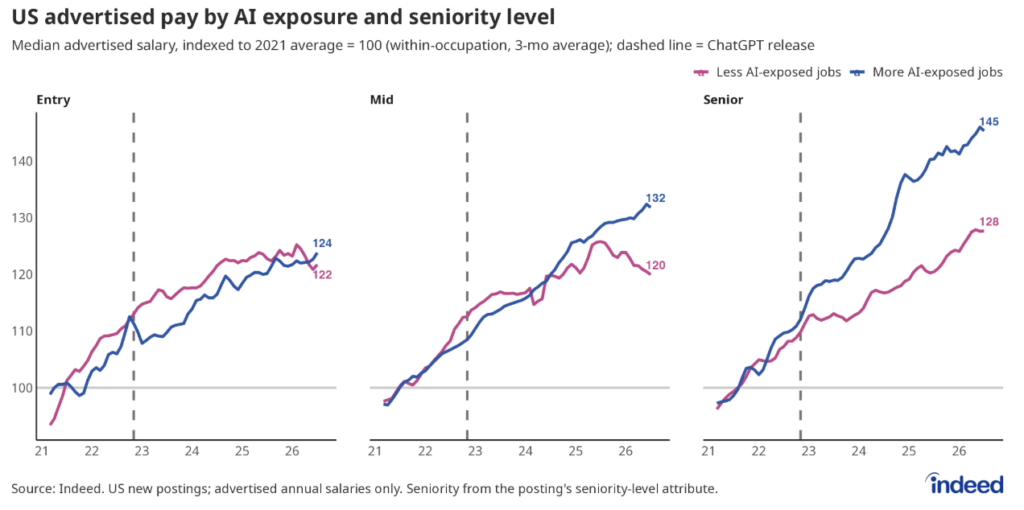
It’s worth separating the two questions here, because they give different answers. On the cumulative level — how far pay has increased since 2021 — the premium rises with seniority. But specifically on the post-ChatGPT change, measured against a 2022 baseline, the gap is far more even across levels — roughly 5 points at entry, 6 at mid, and 7 at senior.
What might be driving this?
The most-exposed occupations are concentrated in knowledge-work sectors, while the least-exposed are largely in-person jobs that require greater physical engagement. Part of the gap may reflect differing sectoral dynamics across these segments of the labor market. Interestingly, these dynamics have changed recently. Job postings for more AI-exposed occupations, including software development, generally fell the most between 2022 and 2026. But over the past year, they have generally seen the largest rebound in postings. Solid growth in postings over the past year, alongside rising pay, is consistent with the skills in these roles becoming more valuable.
It’s important to note that because we measure advertised pay in posted jobs, some of the rise reflects a shift toward fewer, more senior postings. That shift is larger in more AI-exposed work. In the most-exposed occupations, the entry-level share of postings fell from 29% to 10% between 2021 and 2026, while the senior share rose from 22% to 47%. In the least-exposed, the tilt was around a third as large.
Overall, it appears that AI has been acting more as a complement to skilled workers than a replacement. It’s reshaping which skills the market pays for. The takeaway for employers is to keep pay benchmarks up to date in AI-adjacent industries such as tech, marketing, and finance. And since AI skills appear to command a premium, highlighting them in job postings could be a useful attraction lever.
Appendix: The model
We estimate a difference-in-differences: the extra advertised pay growth in more-AI-exposed occupations after ChatGPT, over and above what less-exposed occupations and the wider market would predict. Fixed effects controls are applied — occupation (or job-title) effects remove permanent pay differences between jobs, while month effects remove economy-wide swings such as inflation or a hot labor market. What’s left is the exposure-specific, post-ChatGPT movement in advertised wages. We show three specifications below, ordered by how much of the seniority shift each removes.
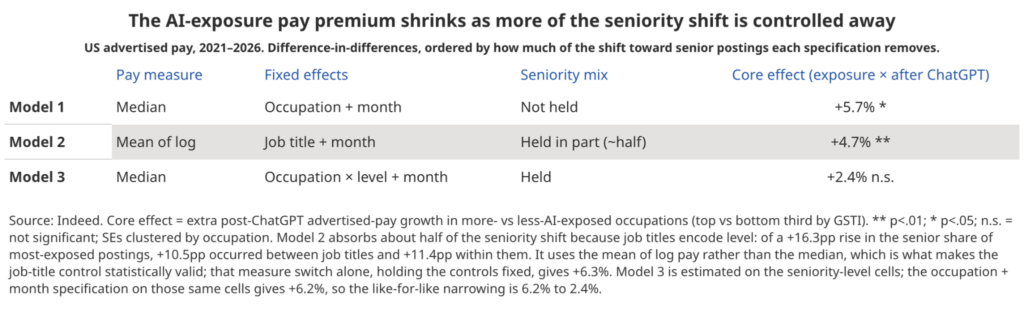
The core premium is positive in all three, but smaller the more of the seniority shift the specification removes: 5.7% under occupation fixed effects (median pay), 4.7% comparing postings within the same job title, and 2.4% when the seniority mix is held constant within occupations. The first two are statistically significant; the third is not at the 5% level. These are alternative specifications rather than a nested sequence — the job-title and seniority-level controls are different cuts, not cumulative.
Methodology
We used our Indeed GenAI Skill Transformation Index (GSTI) scores to classify high/mid/low AI exposed occupations, based on our 2025 AI at Work report. The GSTI measures how much GenAI could change the way different skills or jobs are done. Instead of measuring if GenAI is capable of fully replacing a human worker, it examines how skills may be applied going forward and how human involvement with those skills and tasks may change. GenAI models evaluated both the cognitive and physical demands required across almost 2,900 work skills and GenAI’s capacity to perform them. Based on this evaluation, skills were grouped into four distinct categories based on their potential to be transformed by GenAI: Minimal transformation, assisted transformation, hybrid transformation, and full transformation.
Occupations were sorted by exposure score and cut into equal-count terciles over the occupations present in our data; the headline compares the top and bottom third. Because exposure is continuous, occupations close to a boundary are near-identical in score.
Only job postings specifying annual salaries were included in the analysis.
Seniority comes from the entry/mid/senior level attribute extracted from each US posting – see more detail here. About 99.5% of salaried postings carry exactly one level tag in every year of the period. The headline pay comparison uses all salaried postings and does not depend on seniority.
Seniority shares in this analysis are not comparable with Hiring Lab’s published seniority shares for all US postings. Our population is restricted to postings advertising an annual salary, which skew considerably more senior: the senior share reaches about 37% here by 2026, against about 14% across all US postings.
Occupation shares were fixed at 2021 averages to control for shifting jobs mix.
The number of job postings on Indeed.com, whether related to paid or unpaid job solicitations, is not indicative of potential revenue or earnings of Indeed, which comprises a significant percentage of the HR Technology segment of its parent company, Recruit Holdings Co., Ltd. Job posting numbers are provided for information purposes only and should not be viewed as an indicator of performance of Indeed or Recruit. Please refer to the Recruit Holdings investor relations website and regulatory filings in Japan for more detailed information on revenue generation by Recruit’s HR Technology segment.