Thanks for reading! If you haven’t subscribed, please click the button below:
By subscribing, you’ll join over 80,000 people who read Apricitas!
America has lost more than 200k jobs in “creative” industries over the last four years, with roughly 50k lost within the last year alone. That makes for one of the worst stretches for media employment in modern US history, with similar job loss intensity and duration occurring only during the major economic recessions of 2001 and 2008. Yet there’s no generalized recession today—instead, this period of job loss coincides with the rise of AI systems that can compose wholesale novels, photorealistic images, soundalike music, and practically every other form of digital art, en masse and at extremely low costs. Is this the fall of the Creative Class?
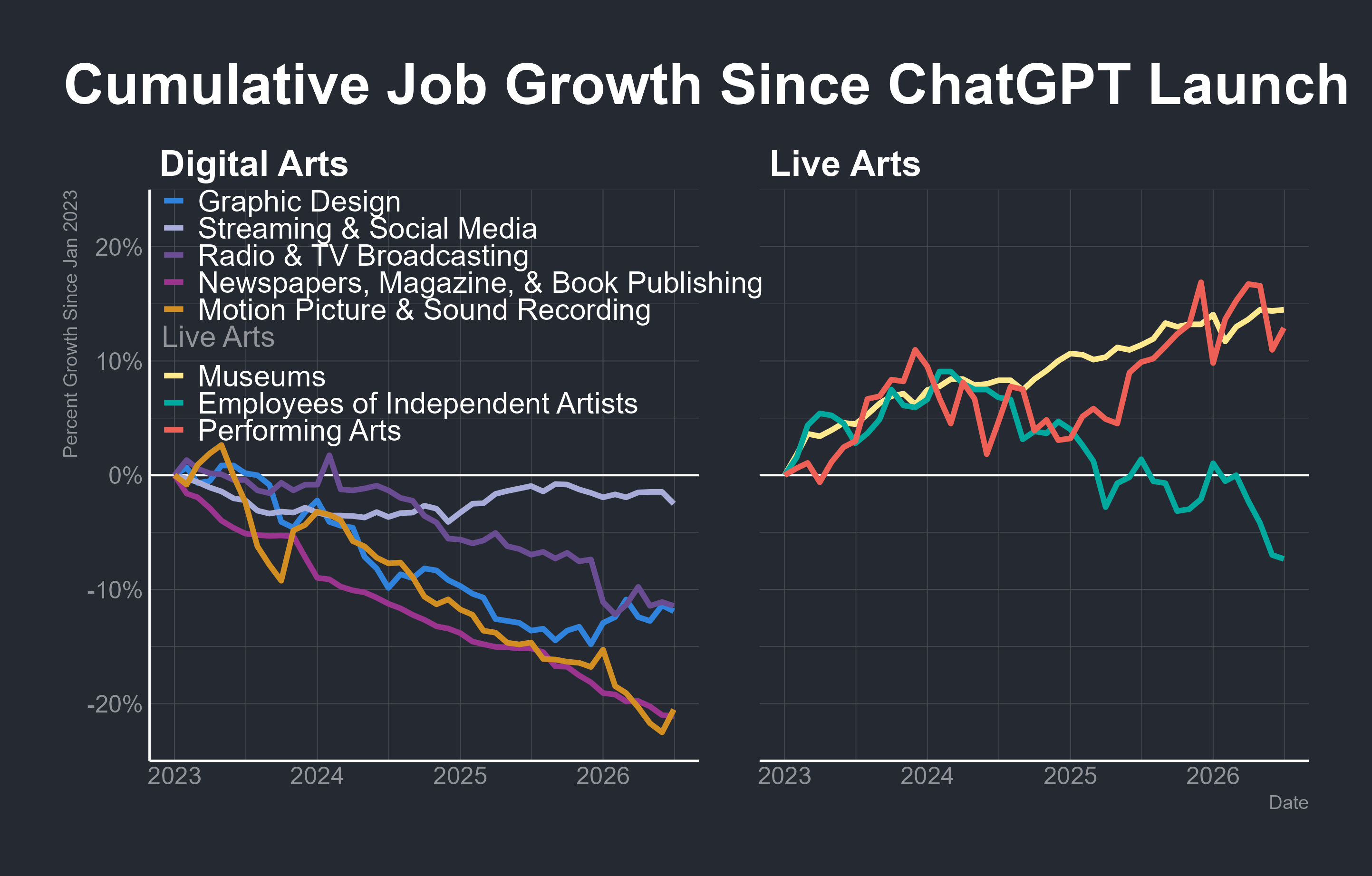
Proving the exact amount of AI-driven job loss in the arts is extremely difficult. Media firms are decidedly coy about their AI use, both to protect against public backlash and, more financially important, to preserve the legal basis for their copyrights. The effects of AI are also hard to disentangle from other factors currently affecting arts businesses, like consolidation in Hollywood, offshoring of content production, or the continued displacement of traditional media providers in favor of social media creators. Yet perhaps the clearest evidence of AI’s influence is just that all subsectors of the digital arts industry are losing jobs, while in-person entertainment is still growing at a healthy pace.
Some of those digital job losses are just a continuation of prior trends, like in the publishing industry where technological change has been continually grinding away newspaper and magazine jobs for decades. Yet for sectors like live broadcasting, streaming, or graphic design, recent experience is an unusual downturn compared to the tranquility of years prior. Then there’s the worst-hit sector, movie & sound recording, which has been bleeding jobs at a nearly unprecedented pace over the last three years.
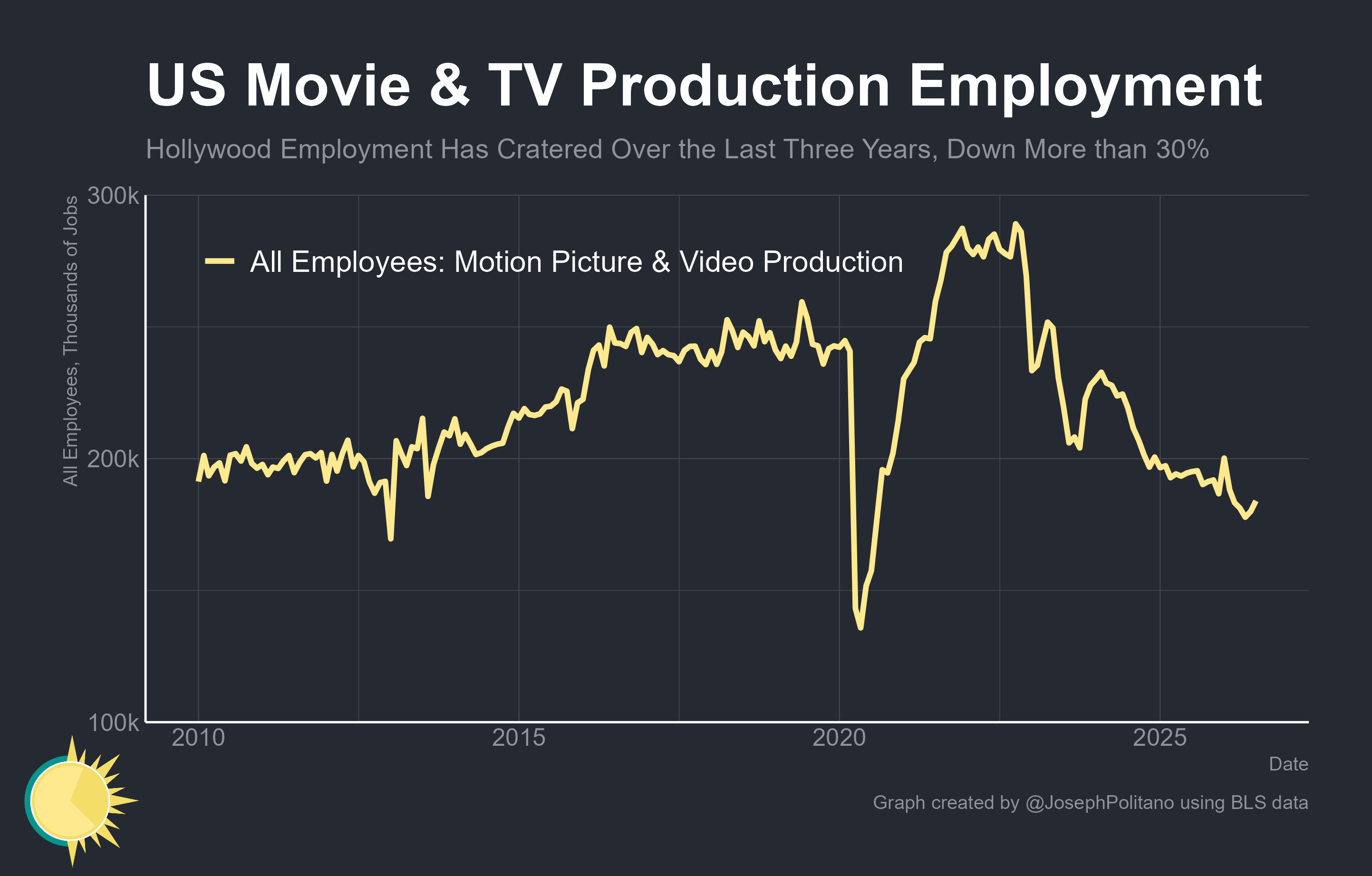
Hollywood has never seen a stretch as bad as the last four years, with the movie & TV industry losing more than 100k jobs, nearly one-third of the sector’s total. At the depths touched this summer, total employment was lower than at any point since the 2008 recession and approaching the lowest point in 30 years. The streaming era has proven an extremely difficult transition, with traditional films and TV shows losing watch time to user-generated and increasingly AI-assisted or AI-generated content flows.
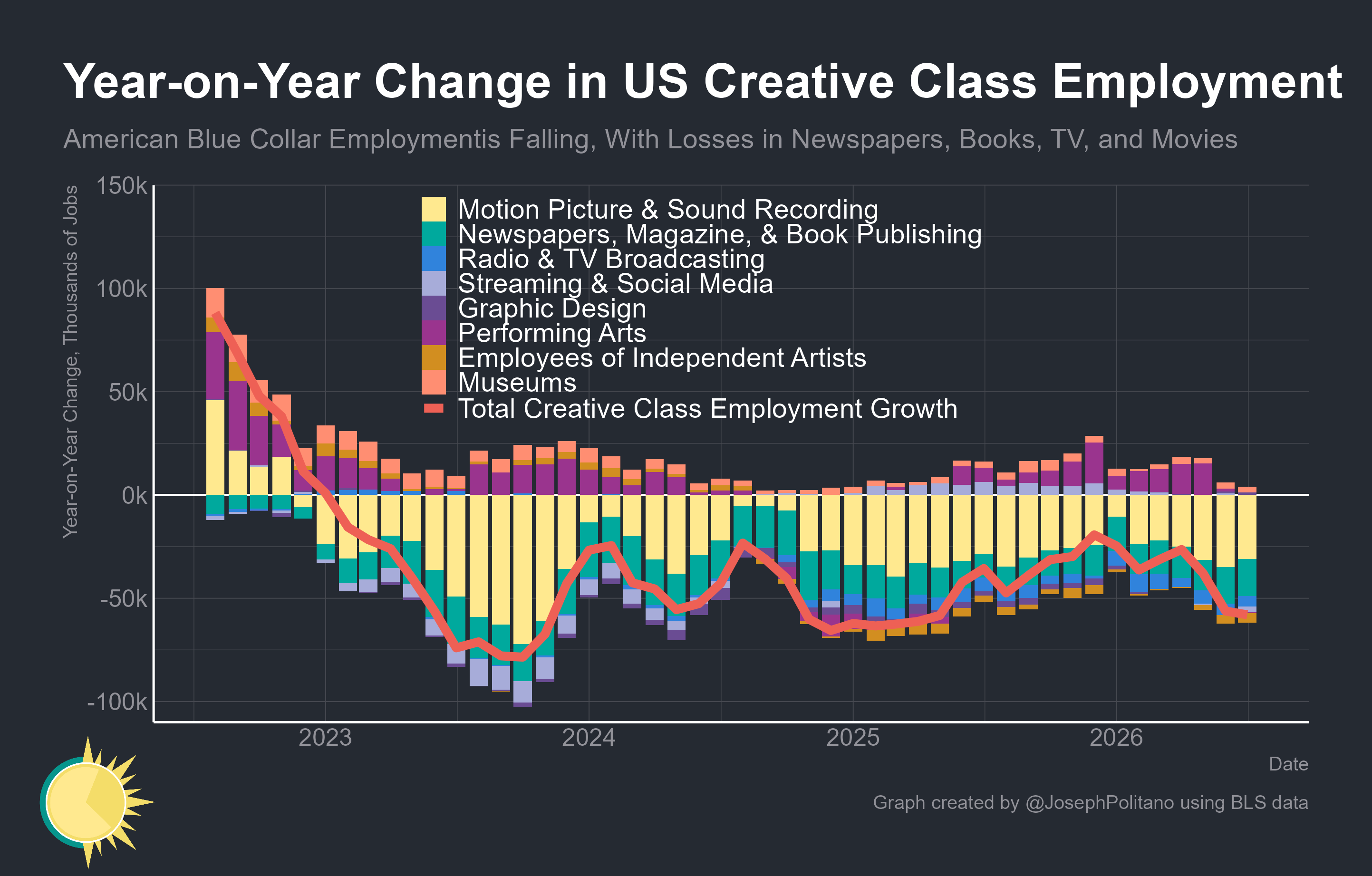
Overall, nearly half the media job losses of the last four years have been concentrated in the movie & sound recording sector that includes Hollywood. Written publishing has been the next-largest source of job loss, with employment down by more than 70k over the same time frame. Yet the job losses have by no means been contained to any particular part of media; instead they’ve hit nearly every subsector at some point. Nor do they show any sign of abating, with losses consistently hovering at around 50k per year and even accelerating in recent months. Will further AI development continue displacing workers in creative industries?
To understand what could happen to the business of art amidst the rise of AI, it’s important to understand what did happen to it during the first digital transition, the rise of the internet.
It was the turn of the millennium, and Metallica had a problem. Demos of their upcoming, unreleased tracks were bouncing around radio and the internet, originally leaked onto a new internet file-sharing website called Napster. There they found thousands of files shared amongst hundreds of thousands of users, many of which were direct rips of albums that sold for $15 being offered for free. The most anticipated albums were often leaked online even before they were on store shelves. Metallica sued Napster for copyright infringement, and they were soon joined by separate suits from other prominent artists and eventually the Recording Industry Association of America (RIAA).
Much of the general public was understandably unsympathetic to Metallica, perceived as a bunch of already-successful millionaires trying to bilk even more money from listeners, and were even less sympathetic towards the RIAA, perceived as scurrilous middlemen who take from artists and fans alike. But the two of them easily won their lawsuit, forcing Napster into bankruptcy. Yet Metallica may have been right on the law but were on the wrong side of technology; the RIAA had won the battle but was losing the war.
The modern internet made file-sharing extremely easy, and no matter how much whac-a-mole companies played, they could not possibly catch every illegal upload. The perennial threat of piracy undermined their copyright and limited their ability to charge for music. Eventually, the value of individual songs fell to the point that companies like Spotify and Apple Music could swoop in to acquire massive catalogues, consolidate them, and charge a comparatively trivial fee for access. For what a single Metallica album would have cost in 2000, you can now get a month’s worth of unlimited access to nearly all human-made music.
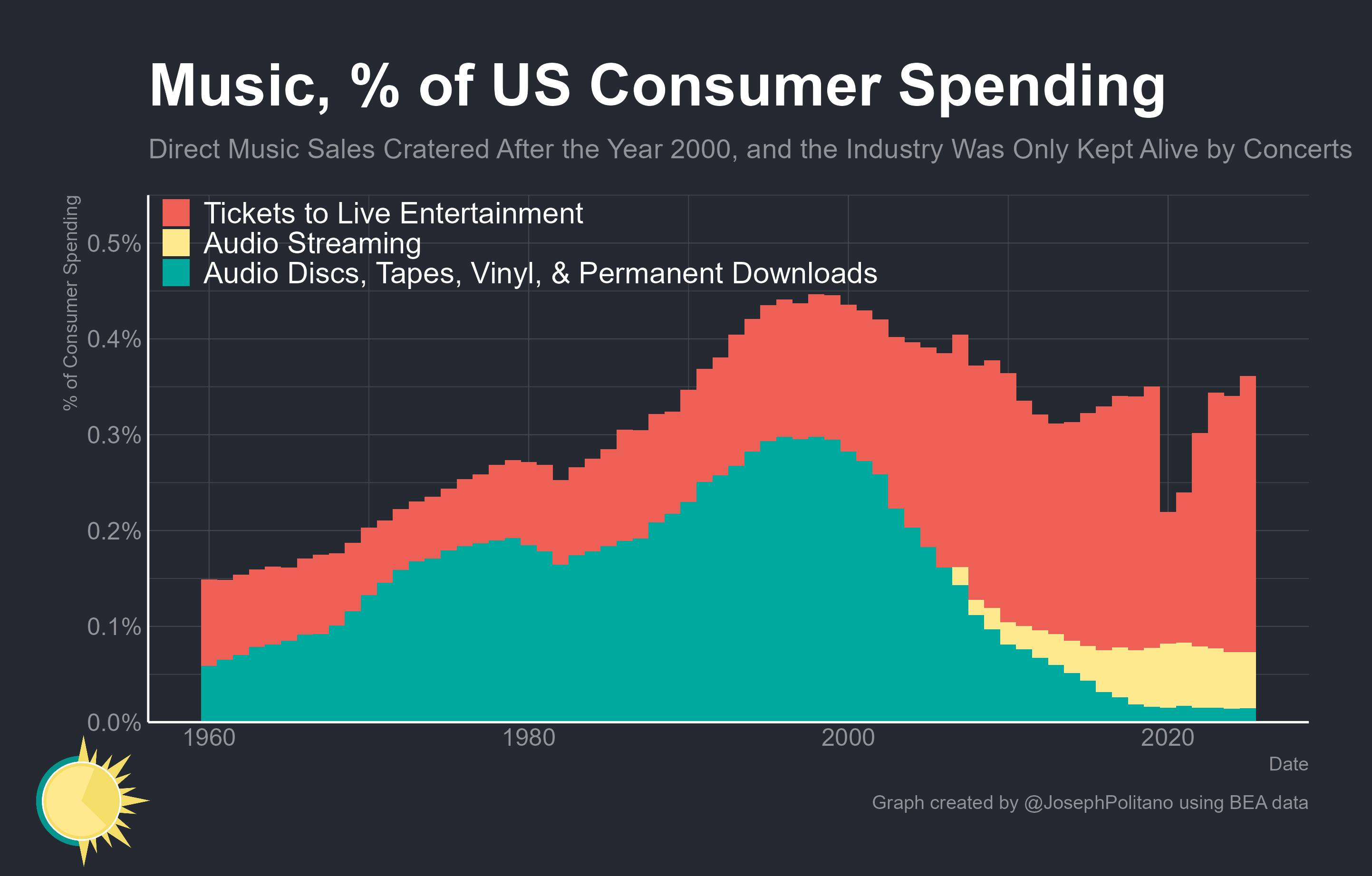
The music industry has never returned to the heyday paydays of the peak CD era—even without adjusting for inflation, streaming revenue pales in comparison to ‘90s physical media sales. This was a massive boon to consumers, but it was also a squeeze on musicians that forced them to fundamentally change their business model over time. Instead of just selling records to earn money directly, music itself increasingly became a loss-leading advertisement for the live concerts (and merch) that provided a growing share of artists’ income. Tours got longer, venues got bigger, ticket prices skyrocketed, and musicians frequently took on roles closer to public influencers than isolated artistes. Were it not for rising concert sales, the business model of music would have completely collapsed, and the income going to musicians would have cratered.
Of course, there were still significant downsides to the transition into the streaming era. Bands (especially smaller ones) complain about the unending pressure to always be on tour. Musicians whose content was suited to home listening lost out to those more suited to giant festivals. Even accounting for concert revenues, musicians made less money than before. Yet musicians fared better than many areas of entertainment subsectors because there was a live component to fall back on—for many media industries, the digital era left no such comfort.
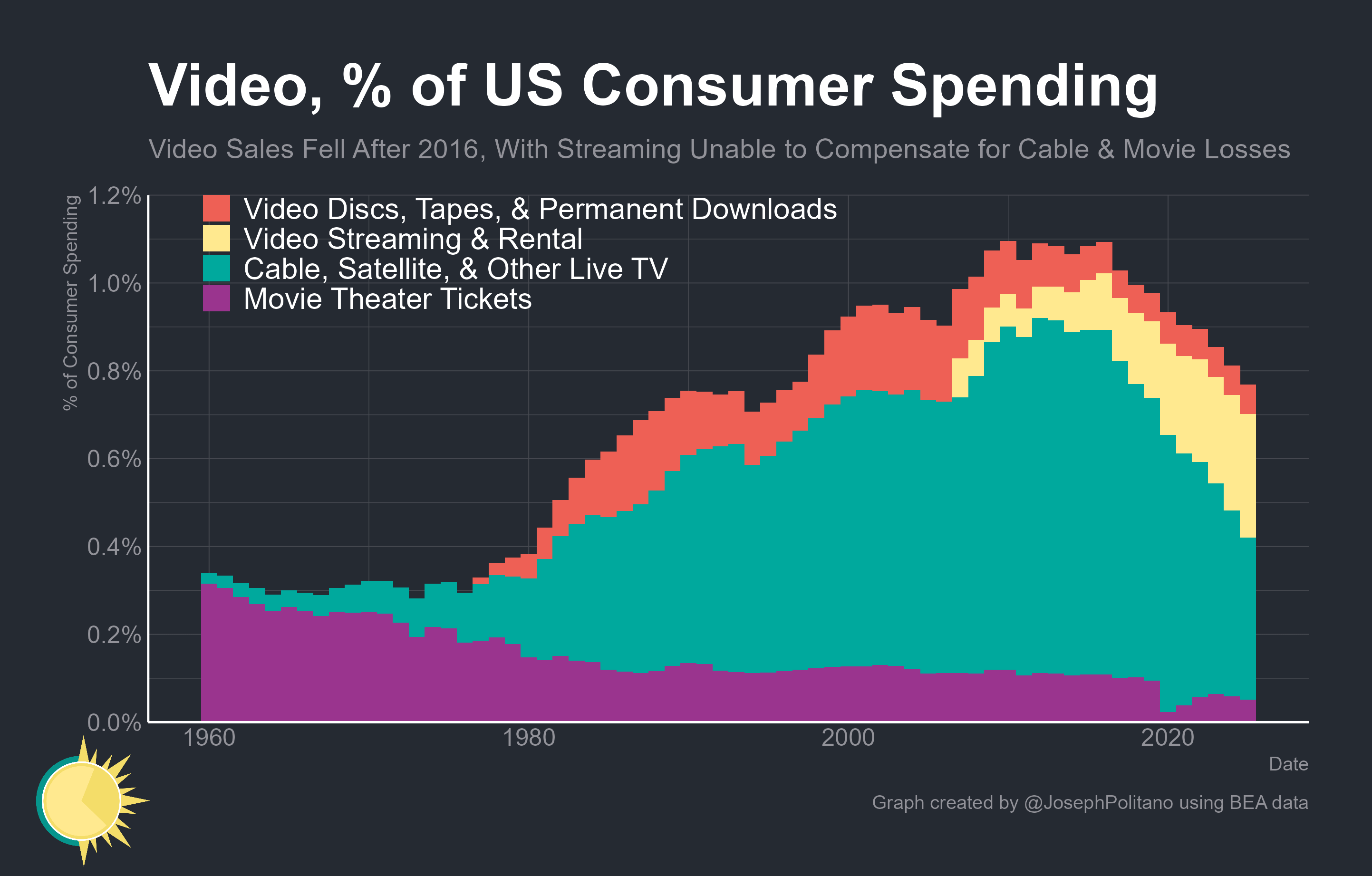
Over time, the business of video has moved in the opposite direction of music—out of the theatre and into the home. Hollywood formerly made most of its money enticing customers to visit sold-out movie theatres, but these were gradually supplanted by broadcast TV, cable, and physical media. Yet because each successful technological leap increased total video watch time, the industry was still able to thrive amidst technological upheaval. That is, until the modern streaming era.
Today, the plethora of video options and the rise of social media have sent video producers into a vicious competition for limited attention. Even before adjusting for inflation, movie ticket sales ended last year down 25% from their 2019 peak, cable revenue is down 18% from its peak, and streaming revenue has not been able to compensate for the drop. The mountain of free user-generated content on YouTube, Twitch, TikTok, or social media was already presenting harsh competition for traditional video companies in the years before ChatGPT’s launch, and now streaming services are also competing with a flood of AI-generated content. The business model of video media is fundamentally getting squeezed, and unlike in the music industry, there’s basically no equivalent to live concerts that Hollywood can be used to ease the pain.
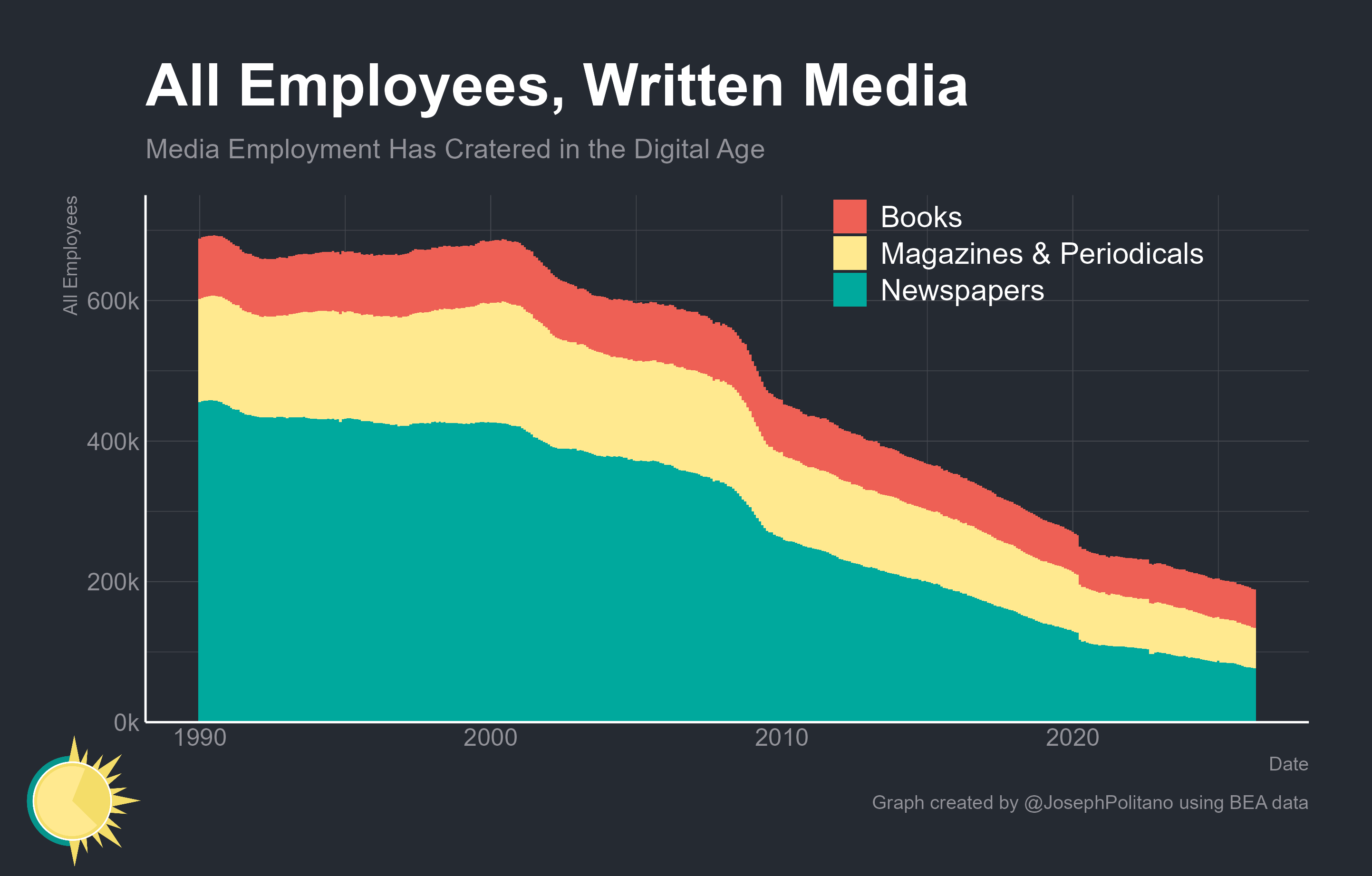
The actual worst-case scenario for creative workers amidst the AI revolution is something similar to what happened to the publishing industry after the advent of the internet—that is, near-total collapse of their fundamental business model. Newspapers used to employ roughly half a million people in the US, more than the entire oil industry, and now their payrolls are down nearly 85% and still dropping. Magazine publishers likewise have let 66% of their staff go since the 90s, while book publishers have lost 40%.
The routine informational updates that previously formed newspapers’ bread-and-butter were all de-bundled—box scores moved to sports websites, stock movements went to financial websites, forecasts went to weather websites—each loss compounding on itself to undermine consumers’ need to buy the paper. Search engines became the first place people looked to for information, and newspapers’ advertising revenue rapidly started flowing to companies like Google instead. The collective of social media users became faster at breaking any news story than a daily paper could ever hope to be. When papers eventually did start aggressively paywalling content, the internet made it trivially easy for people to just copy the articles’ content and share it beyond the paywall. The entire business model had collapsed, to the point that now only a select few major newspapers can even survive.
That scale of copyright dilution and forced unbundling is the worst-case scenario for media businesses in the age of AI. It’s possible arts jobs could survive via consumers’ deep-seated aversion to explicitly AI-generated content, but AI is increasingly being used throughout media in ways invisible to the average end consumer. Roughly 32% of workers in the overall arts, entertainment, and recreation sector use Generative AI to some extent, which is less than the 62% average across all industries, but still enough that virtually every major media project could have some AI within its workflow.
Indeed, AI is likely seeping into media production processes in ways large companies themselves would struggle to prevent even when they desire to—how can a TV studio be sure nobody in their writers’ room is consulting ChatGPT for jokes or any storyboard artist is generating concept art? And even if professional TV and movie studios do effectively hold out against temptation and prevent internal AI use, how long can they compete with the large mass of wannabe independent creators with much fewer scruples? Plenty of media businesses tried to hold out against the algorithmic content waves of the 2010s and were buried as a result.
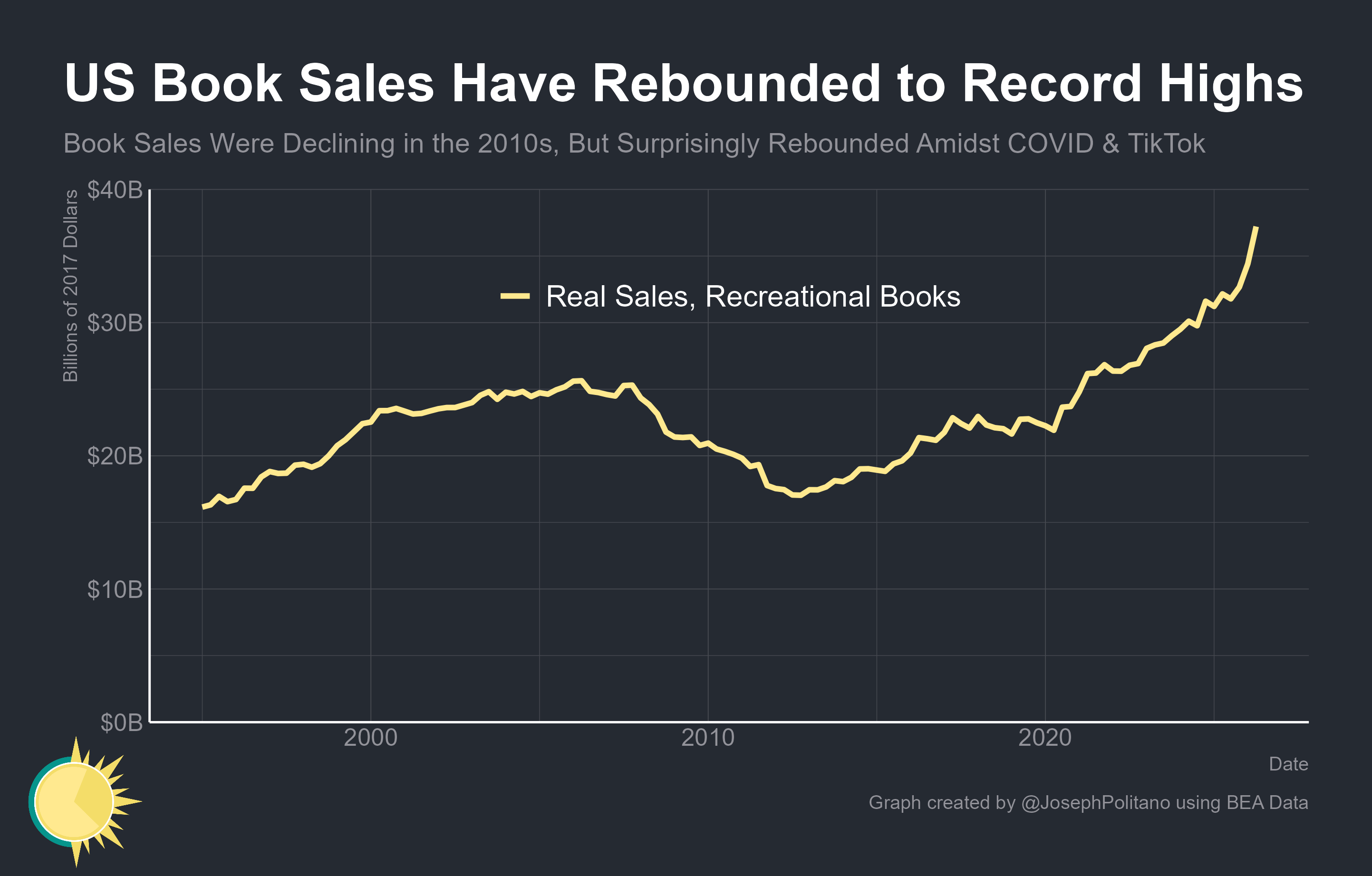
Yet fundamentally, it’s difficult to meaningfully predict how new technologies will interact with existing arts businesses. Take the unexpected resurgence in book sales over the last four years. The novel as a commercial art form had been struggling for decades, with fewer books sold in 2019 than at the beginning of the millennium, but the last six years have seen an unprecedented 70% surge in sales. The unlikely savior of the printed word came from perhaps its polar opposite—TikTok.
Of course, fewer people read now than ever before—for the general public, short-form video apps have accelerated the displacement of reading, just as TV, video games, or social media before them. Yet for a dwindling number of dedicated repeat readers, “BookTok” became a new way to source reviews, analysis, discourse, and community in a way that boosted the reading experience and absolutely turbocharged book sales. It’s possible that AI tools could have those same totally unpredictable spillovers for other museums, concerts, or other forms of art in ways that are unpredictable today, in much the same way short-form video saved books in ways that could never have been anticipated beforehand.
At the end of the day, the arts are only a small sector of the overall macroeconomy. Media made up a small share of the labor market even at its peak, and it has always been difficult to get hired in creative industries to the point that making fun of art students’ job prospects became an easy punchline. The movie industry has an income profile closer to eggs or bicycles than something major like healthcare or finance. Were the goal to create art for art’s sake, for the intangible and nonmonetizable cultural benefits, it would be relatively easy to counterbalance any economic impacts of AI on artists just by reversing recent cuts to the National Endowments for the Arts & Humanities.
It’s telling that Anthropic, the most prominent AI lab, has basically never bothered with image, video, or music generation, because the prospective economic benefits are marginal when compared to using AI to tackle math or scientific problems. OpenAI learned this lesson the hard way when it was forced to abandon its video generation platform Sora, deciding it had better use for its limited compute than making synthetic TikToks. Nowadays, the art generation is done primarily by secondary players running smaller models, though even these are large enough to threaten significant disruption to legacy media businesses.
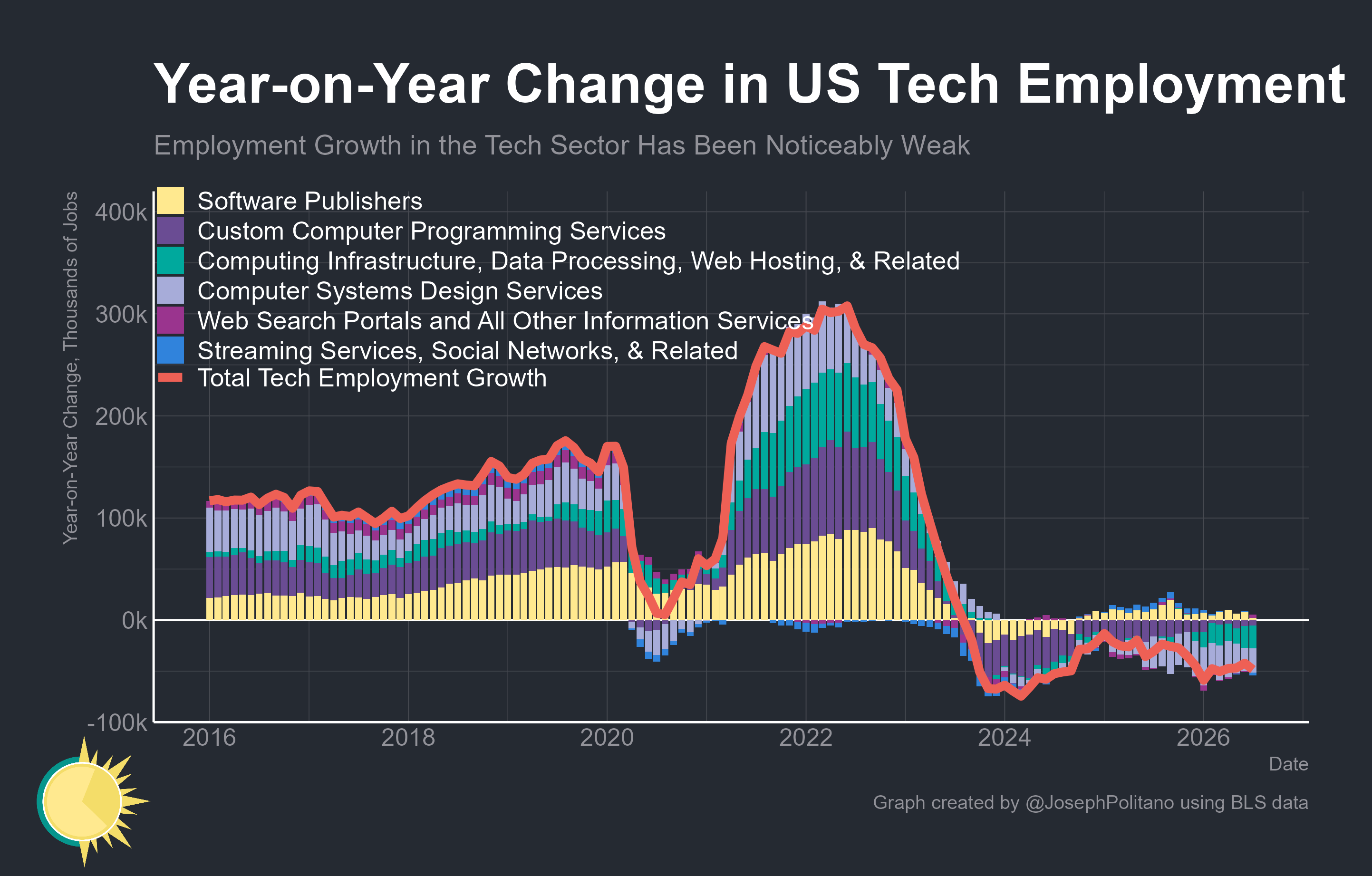
In other words, the primary impacts of AI art will be on culture and society rather than the macroeconomy. Yet arts jobs might be a microcosm for other “creative-adjacent” work that occupies a much larger share of economic activity. Take the tech sector itself, which is the clearest place where AI-driven job loss has shown up outside the media business, as powerful coding agents replace human programmers. Annual tech job gains stood at nearly 300k in 2022, but the sector has been bleeding jobs every year since then in what is now its longest labor market downturn.
Right now, AI-driven job displacement has been relatively minor outside of these few narrow sectors. Unemployment is higher than it was four years ago but still below even the 2010s average, and overall job turnover rates remain extremely low. Some white-collar sectors that looked prime for AI automation have even been on a hiring spree over the last few years, including legal and engineering firms. Yet if the economic impact of AI ends up being anywhere near large enough to validate the trillions of dollars investors are currently betting on it, these economic disruptions will only spread from here.