You know who else can’t keep up with the pace of AI? American politicians. In the space of two years, artificial intelligence has gone from a committee-room curiosity to one of the most contested issues of the 2026 midterms. President Donald Trump claims to have directed more than $2.7 trillion into the AI industry. The lobbying dollars have followed: 11 of the largest technology and AI companies and their trade associations spent $41.8 million lobbying the federal government in the first six months of 2026, according to Issue One, roughly 10 percent more than a year earlier. This past spring, more than $27 million from groups linked to OpenAI and Anthropic poured into a single Democratic congressional primary in Manhattan. The sudden emergence of AI as a political issue has turned zoning fights over data centers into attack ads. And it has pushed a question that once belonged to science fiction—will humanity be wiped out by killer robots?—into cable news bookings.
Photo illustration by Newsweek
What artificial intelligence hasn’t done, unlike nearly every other topic in the public discourse in the year 2026, is sort itself cleanly into the two parties. “There’s been a total scrambling of partisan politics on this,” Evan Roth Smith, a pollster and founding partner at Slingshot Strategies, told Newsweek. “We have seen AI have an impact in just about every way that an issue can impact an election.”
That leaves voters heading to the polls on November 3 with an unusual problem. On abortion, guns or immigration, a party label tells you most of what you need to know about a candidate. On AI, it tells you less.
To map where lawmakers actually stand, Newsweek built the AI Policy Scorecard. It positions all 537 sitting members of Congress, including senators, representatives and nonvoting House delegates, on a scale from AI Skeptic (1) to AI Booster (5). That score is based on the stances each member has taken in five areas: Regulation & Governance, Data Centers & Energy, Jobs & Economy, Safety & Privacy, and National Security & China. The scores draw on the official record: roll-call votes and bill sponsorship from the soon concluding 119th Congress, as well as a wide review of public statements made in speeches, interviews, press releases and social media posts.
The Booster end describes the agenda the hyperscalers and the investors financing the buildout have pressed on Washington: minimal regulation for the sake of technical progress, safety risks as engineering problems to be solved later, vast economic gains worth the job displacement, urgent data center construction at scale, and a race with China that is America’s existential national security challenge of its time. A Skeptic answers no on all five counts.
Between them sits nearly everyone, in combinations no party platform describes, which is why the five category scores matter as much as the overall grade. A single number makes hundreds of lawmakers comparable. The categories show which parts of the agenda each one accepts and which they reject.
It’s a system designed to bring some order to a complicated and quickly moving policy debate around AI. “Very few leaders in this debate are ‘skeptics’ of AI’s potential,” Brendan Parets, general counsel for Public First Action, which advocates for stronger safeguards, told Newsweek. “There are, however, many in the ‘race forward’ camp who are publicly skeptical that AI poses serious risks to our national security, families and communities that necessitate robust regulation.”
Lopsided, Not Polarized
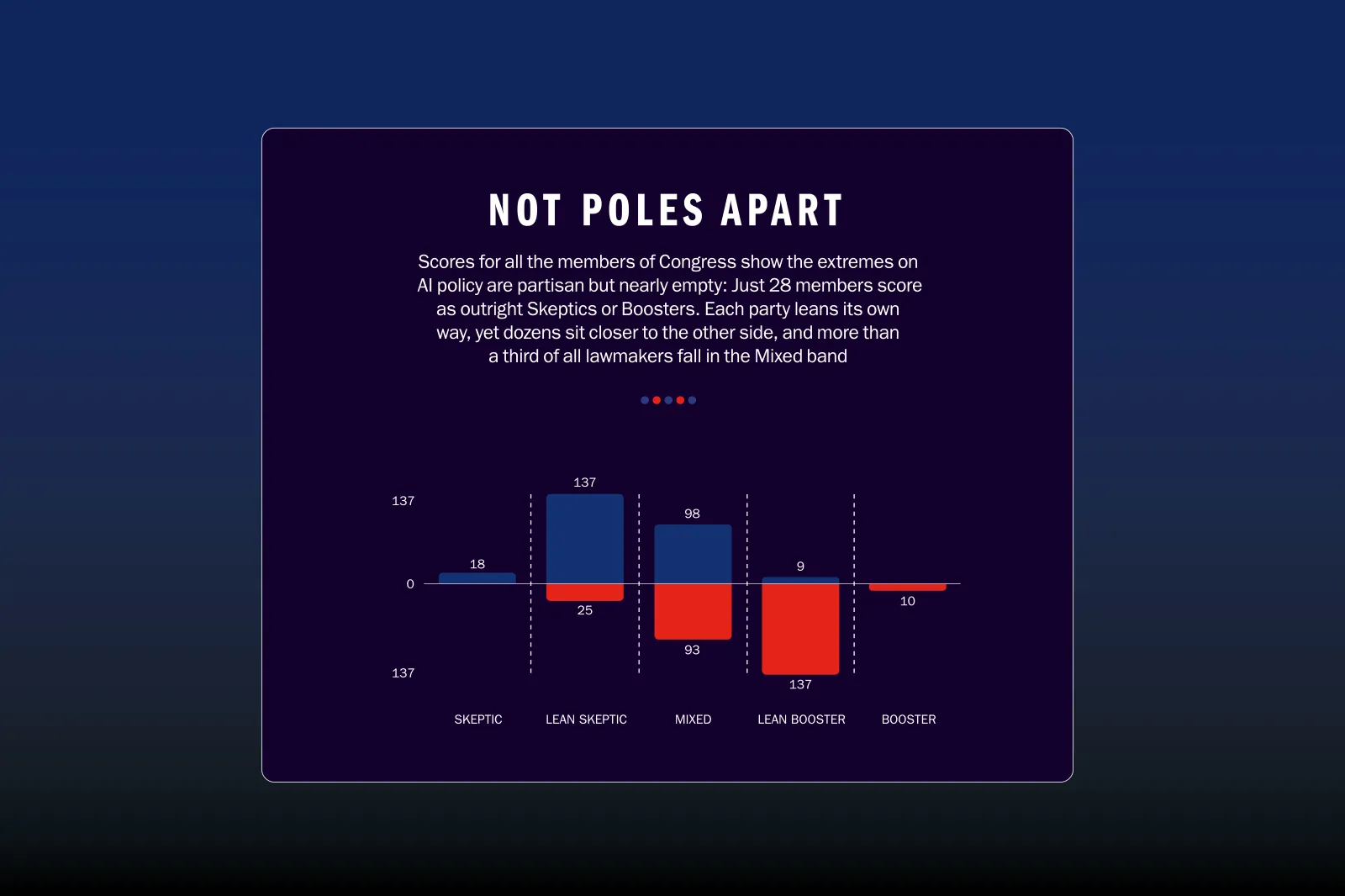
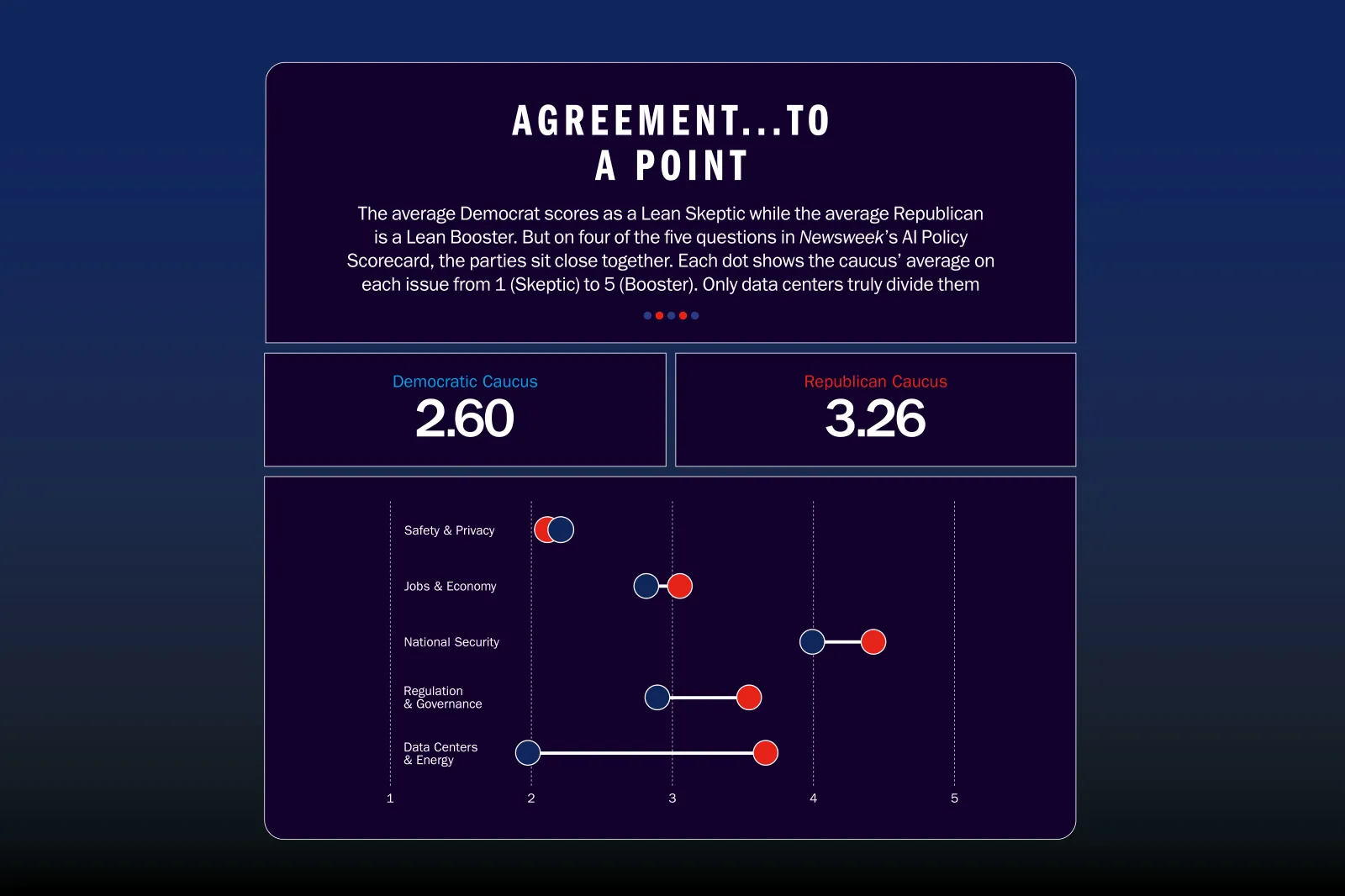
As a whole, each party leans in opposite directions: The average Democrat scores 2.60, Lean Skeptic, while the average Republican scores 3.26, Lean Booster. More than half of Democrats, 137 of 262, fall in the Lean Skeptic band, and more than half of Republicans, 137 of 266, fall in Lean Booster. But the distance between the parties—0.66 points on a scale that runs 1 to 5—is relatively small.
Several findings from the AI Policy Scorecard stand out. The extremes are, as extremes tend to be, highly polarized, but Congress does not sort itself on AI policy along familiar partisan lines. The extremes are also nearly empty. Only 18 members score as AI Skeptics, all of them in the Democratic caucus, and only 10 as AI Boosters, all Republicans. Those 28 members are 5 percent of Congress.
And there is also a lot of overlap. Nine Democrats score Lean Booster and 25 Republicans score Lean Skeptic. Together, these 34 members have AI records closer to the opposing party’s average than to their own. Another 191, more than a third of Democrats and a third of Republicans, land in Mixed, the scorecard’s narrowest band reserved for records that balance right at the center.
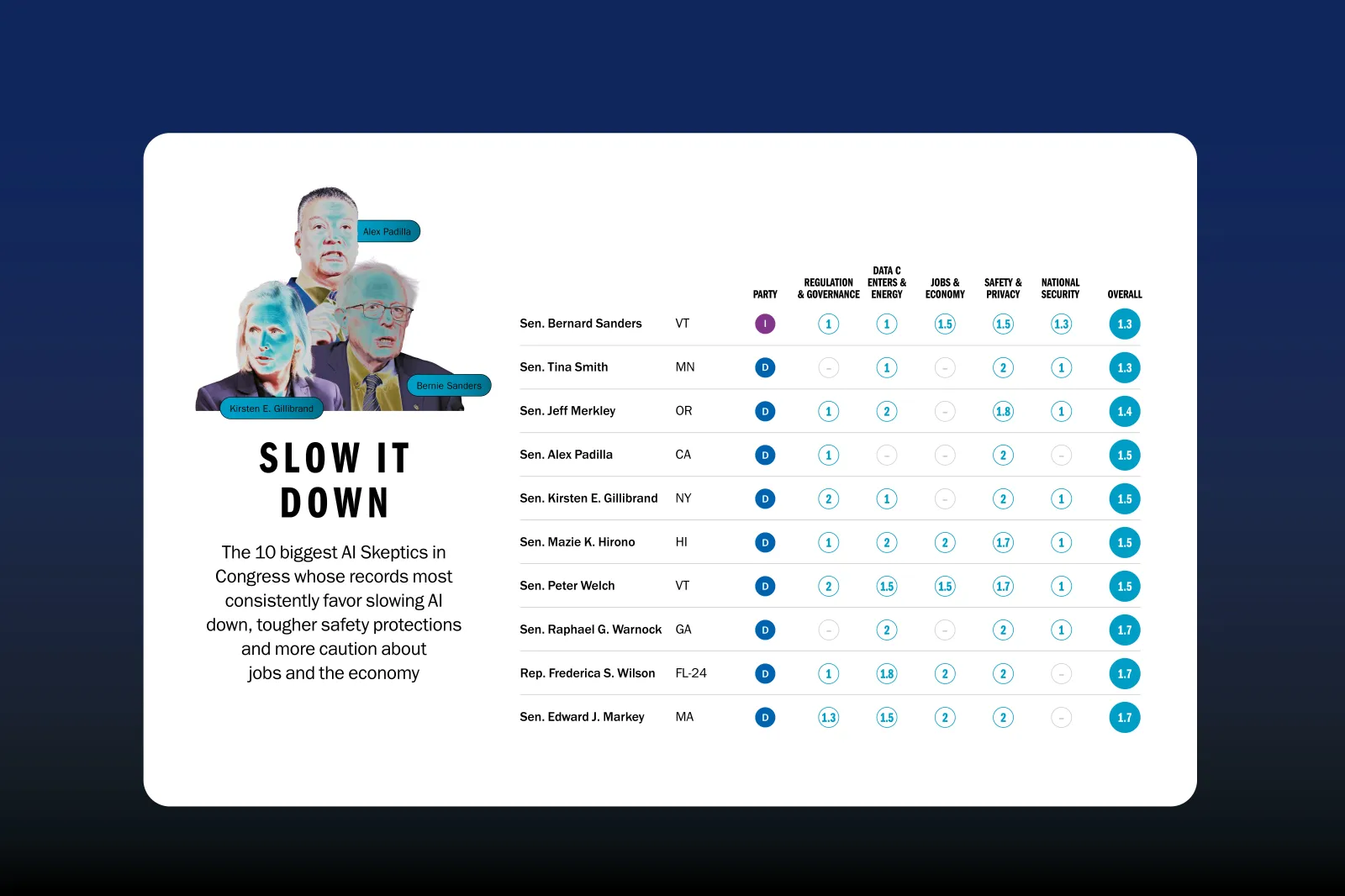
Photo illustration by Newsweek/Getty
Dig deeper into the data and those differences mask a lot of similarities, with the two parties agreeing on many of the questions at the center of the AI debate: how dangerous (or not) the technology is, and how much it matters to beat China in the AI race (a lot). The primary issue where Republicans and Democrats do break decisively is the one, not surprisingly, that has received the most attention in midterm campaigns: data centers. On Safety, the mean score for both Republicans and Democrats is 2.1, a low Lean Skeptic score. On National Security, the mean is 4.4 Booster for Republicans and 3.9 Lean Booster for Democrats. But on Data Centers, the parties show a 1.7-point gap from the 3.5 Lean Booster for Republicans and 1.9 Lean Skeptic for Democrats.
Individual member combinations are where the scores gets especially interesting. Representative Andy Barr, a Kentucky Republican, scores 3.7, in the middle of Lean Booster territory. He’s taken Booster positions, advocating in June that U.S. policy should be to “win the race for artificial intelligence dominance,” and argued that competing would require more data centers, semiconductor production and power generation. Yet he has also sounded Skeptic notes, leaving the question of where that infrastructure gets built to local communities.
“Some communities are going to want those projects, some communities are not,” Barr said. “The people should be in charge of those decisions.”
Representative Ted Lieu, a California Democrat, scores 2.6, Lean Skeptic, and his record displays the complexity behind the labels. In April, Lieu partnered with Republican Representative Jay Obernolte on the bipartisan American Leadership in AI Act, a package aimed at strengthening U.S. leadership through research, standards, federal adoption and workforce development. Three months later, he backed the AI Kill Switch Act, which would require developers of the most powerful systems to retain the ability to slow or shut them down if they pose catastrophic risks.
Agreement on Both Sides
“This is not yet following the typical polarized political dynamics of so many other issues,” Nathaniel Persily of Stanford Law School, who co-leads the American Political Science Association’s task force on AI and politics, told Newsweek.
The coalitions outside Congress are just as unfamiliar. Lauren McFerran, executive director of the AFL-CIO Technology Institute, said labor leaders now sign on to the same letters as conservative religious leaders on some AI issues, drawn together by anxiety over jobs, safety and the direction of the technology.
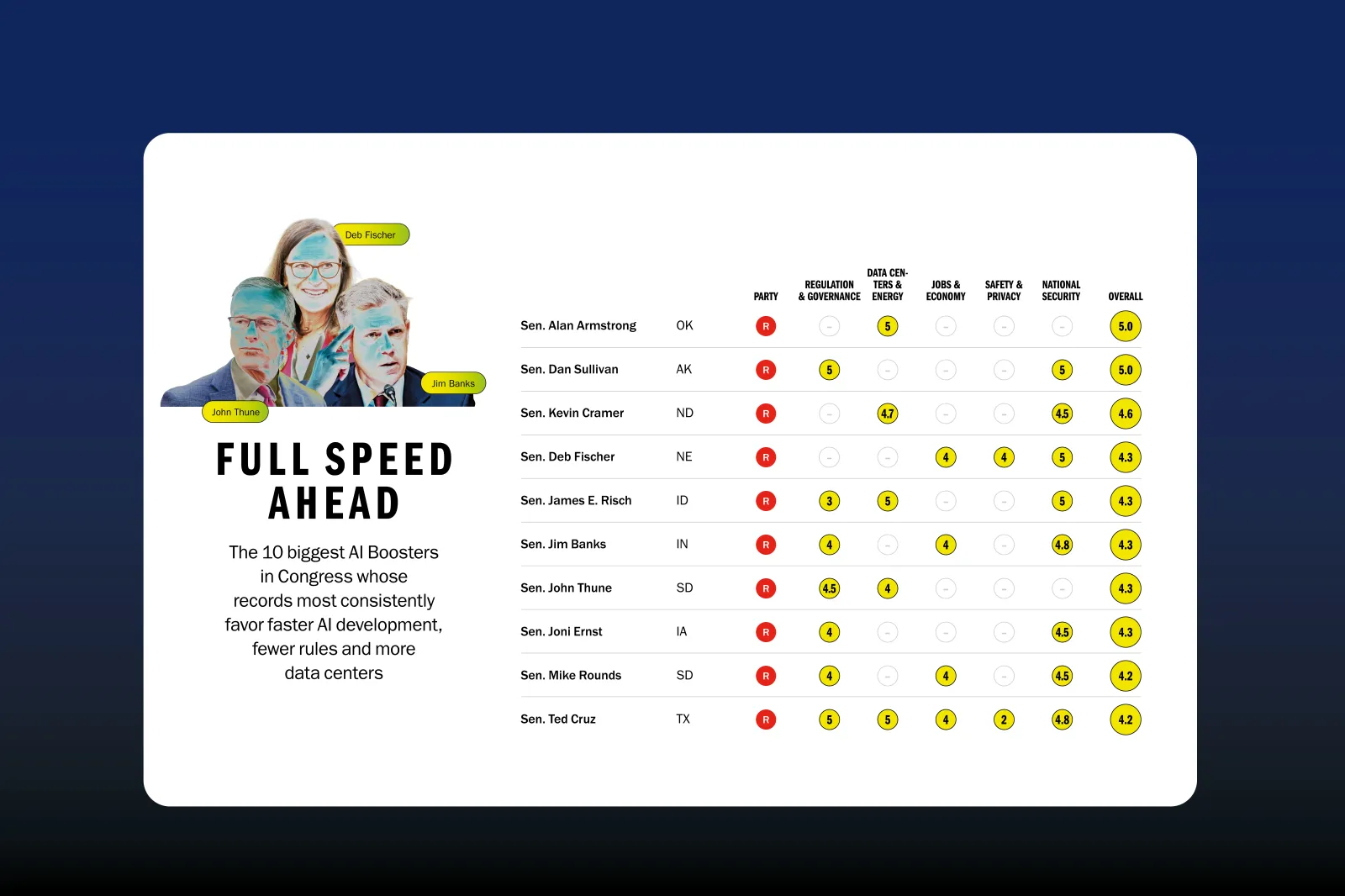
Photo illustration by Newsweek/Getty
“You really see some interesting bedfellows here,” she said.
The anxiety McFerran hears most is about work, which is another place the AI Policy Scorecard shows bipartisan agreement: the means of both parties land in Mixed, with Republicans at 3.0 and Democrats at 2.8. Some 72 percent of Americans said it was a bad time to find a job, per a Gallup poll published in March.
“The rubber is going to hit the road here when it comes to job security,” McFerran said. She pointed to two especially exposed groups: young people trying to enter the workforce and workers in clerical and administrative jobs that have traditionally offered a route into the middle class without a college degree. Protecting workers, she argued, doesn’t have to mean resisting technology. Employees often understand where a new system could fail and what would make it useful. “It’s who’s in the room to make the decision,” she said.
Smith of Slingshot sees the same convergence among voters, but arriving by different routes. A Democrat worried about AI might focus on concentrated wealth and the power of technology executives, he said. A Republican might see an elite class acquiring new authority over ordinary life. Independents often bring a deeper suspicion of centralized power. These different worldviews can end up at the same conclusions.
AI has taken off politically “faster than just about any issue in recent memory,” Smith said, because it reaches people through so many parts of their lives. Slingshot’s polling found that people can be comfortable using AI themselves and still fear the “systemic impacts” of what it could do to the economy and society around them. “People are skeptical and apprehensive,” Smith said.
Existential Angst
It started with a resignation. Jacob Coxon, a researcher leaving Anthropic, posted a note accusing frontier labs of “gambling with our lives” that was viewed more than 173 million times on X. Evan Hubinger, who leads Anthropic’s alignment science team, amplified the alarm. “We really do earnestly believe AI could kill all humans,” he posted.
A September Politico poll found that 63 percent of Americans believe AI poses at least a moderate risk of destroying humanity.
On September 12, Anthropic CEO Dario Amodei published an essay titled “We Must Pace the Frontier.” “We must slow the pace at which we improve the capabilities of AI models,” he wrote. OpenAI’s Sam Altman quickly agreed (“I agree with Dario that we need to pace the frontier”) and so did Elon Musk (“Dario is right”).
Amodei’s case for slowing down rests on the same three premises Congress holds. The technology, he wrote, “could outrun our ability to understand and control these systems.” But slow down too much, “then (unpaced) CCP-associated projects will pull ahead, creating significant national security risk,” he added, warning of giving China’s ruling Communist Party an advantage.
Persily puts the stakes in similar terms. “When [Claude] Mythos first came out, we were living in a world that had never existed before where an American company could basically take down almost any government in the world if it wanted to,” he said. “Things are moving so fast that we kind of forget where we are and where we’ve been.”
Holding both convictions at once has not produced much legislation. On September 16, Senator John Kennedy, a Louisiana Republican, tried to fast-track a bill requiring AI developers to build shutdown mechanisms into advanced systems. “We’ve got this risk out there that we know is real of one of these models becoming the Terminator,” Kennedy said.
Senator Rand Paul, a Kentucky Republican, blocked it. “If Congress acts hastily before the technology is understood,” Paul said, “Congress risks killing innovation and setting this technology back decades.”
Senator Bernie Sanders, the Vermont independent, has backed legislation to ban superintelligence outright. Republican senators including Kennedy, Rick Scott of Florida and Josh Hawley of Missouri have declined to support it; Hawley has pushed instead to hold companies legally liable for what their systems do.
The White House, for its part, has staked out a position to the booster side of the AI industry’s own leaders. “The only control or ‘guardrails’ that AI needs is a STRONG AND SMART (High IQ!) PRESIDENT, and the U.S.A. has that, in spades!” Trump wrote on Truth Social on September 14, accusing Amodei of “now pretending to be a ‘perfect little angel.’”
The Exception
One issue breaks the pattern: data centers. The Newsweek AI Policy Scorecard reflects the past two years of public record, and the events of the last two years go a long way toward explaining the split. In the wake of Trump’s 2024 election victory, marked by a sharp turn toward Trump in the technology industry, backing data centers became a Republican position: the physical infrastructure for the race with China and a source of jobs and investment. Trump continues to make the case himself on Truth Social.
Democrats, for the most part, did not follow. Then public opinion turned. An Annenberg Public Policy Center survey released in August found that 61 percent of Americans opposed construction of a new data center in their area, 12 percentage points higher than earlier in the year. Majorities of Democrats, Republicans and independents were opposed.
Persily calls data centers the “physical manifestation of AI,” a place where anxieties about jobs, geopolitics, energy or the technology itself suddenly acquire a target: land, transmission lines, water use, tax breaks and an electricity bill.
Brent Buchanan, founder and CEO of the Republican polling firm Cygnal, said data centers began surfacing unprompted in his focus groups toward the end of 2025. By the later primaries, candidates were attacking opponents over their records on data centers and the tax incentives that came with them.
“Nobody’s explaining why we need more of them,” Buchanan said. The fight, he argued, has become a stand-in for something larger: “It’s a proxy issue of, ‘Is this person in the pocket of special interest or is this person for people like me?’”
The record is now moving in real time. On September 16, the House passed the Ratepayer Protection Act, introduced by Representative Gabe Evans, a Colorado Republican, by a vote of 417 to 3. The bill requires technology companies to pay for new energy infrastructure serving data centers rather than passing those costs on to other customers. Several Republicans in competitive races signed on as cosponsors in the weeks before the vote. The scorecard rates the measure a 2, Lean Skeptic, and that single vote moved a number of House Republicans’ scores.
Democrats voted for it too—and argued it was not enough. Representative Frank Pallone of New Jersey, the top Democrat on the Energy and Commerce Committee, called the bill “only the beginning.” Senator Martin Heinrich of New Mexico said it “falls short.” As of press time, there have been no signs of advancing to a Senate vote since the House passage.
Much Talk, Little Action
With the coalitions unsettled, the fight over what counts as a reasonable response to AI carries extra weight, and the industry is spending heavily to shape it. The $41.8 million in federal lobbying “captures what’s on paper at the federal level,” said Isabel Sunderland, policy lead for technology reform at Issue One, which co-authored the analysis. It leaves out money flowing through super PACs into campaigns.
Among the biggest lobbying fights is over whether federal rules should preempt state and local AI laws. Craig Albright, senior vice president for U.S. government relations at the Business Software Alliance, told Newsweek that a national framework for risk management and transparency would serve companies and customers better than a patchwork of state rules, but only if it is strong enough to “earn the preemption.” He added, “Regulation isn’t all bad by nature.”
The companies also hold an information advantage. Social media, whatever its flaws, mostly happened in public, noted Joshua Tucker of New York University, who co-leads the American Political Science Association’s AI task force with Persily. “Where we’re going to have an enormous blind spot is actually how people are using these models, because the vast, vast, vast majority of interactions that people have with chatbots are in one-on-one circumstances, which is an essentially private conversation,” he said.
Policymakers can’t see how these systems are used at anything like the scale the companies can.
Amba Kak, co-executive director of the AI Now Institute, sees that imbalance as a form of political power. “This is an incredibly opaque industry—everything we know is pieced together through investigations by journalists, researchers and lawmakers,” she said.
Training data, internal risk evaluations, release decisions and government contracts all remainlargely out of view, though Congress, she noted, has subpoena power and other tools that could force more of it into public view.
“The opacity in this industry is about them holding technical expertise and access close,” she said, “but even more so it’s about the narratives that disempower even political leaders from thinking anyone but the industry can do anything about these problems. That’s what shrinks the policy conversation down to whatever the companies are willing to offer.”
Whether any of this decides elections is still unclear. In New York’s 12th District, the June Democratic primary became a proxy war over the state’s Responsible AI Safety and Education Act, which requires AI providers to publish harm incidents within 72 hours and goes into effect on January 1, 2027. Groups linked to OpenAI, which opposed the measure, and Anthropic, which supported it, ended up spending millions on both sides of the bill’s sponsor Alex Bores, who was running to replace the retiring Representative Jerrold Nadler.
In the end, the race was a high-dollar draw: Bores finished second, 35 percent to 39 percent, to Assemblymember Micah Lasher who had co-sponsored the same law.
A Snapshot of a Moving Target
Ultimately, The AI Policy Scorecards capture Congress at a particular moment: AI has become important enough to move votes, money, campaigns and local politics, but neither party has settled on what supporting or opposing it is supposed to mean.
“It’s not quite clear what it means to be a Republican on AI or a Democrat on AI,” said Tucker. Politicians, he said, are “figuring this out on the fly.”
Illustration by Gregori Saavedra for Newsweek