Governor Newsom signed a law late yesterday that will require California employers to disclose in writing when artificial intelligence is the reason they are cutting jobs. SB 951 will require you to add four pieces of information to the layoff notice you already have to send under the state’s WARN Act whenever AI or other automation causes the layoffs. Here’s what you need to know and five steps to get ready before it takes effect on January 1, 2027.
What Do You Have to Disclose?
California’s WARN Act already requires 60 days’ written notice to affected employees, the Employment Development Department (EDD), the local workforce development board, and the chief elected official of each city and county where certain layoffs happen. That 60-day clock is unchanged, and so are the thresholds that determine who is covered: establishments with 75 or more employees, and layoffs of 50 or more people in a 30-day period.
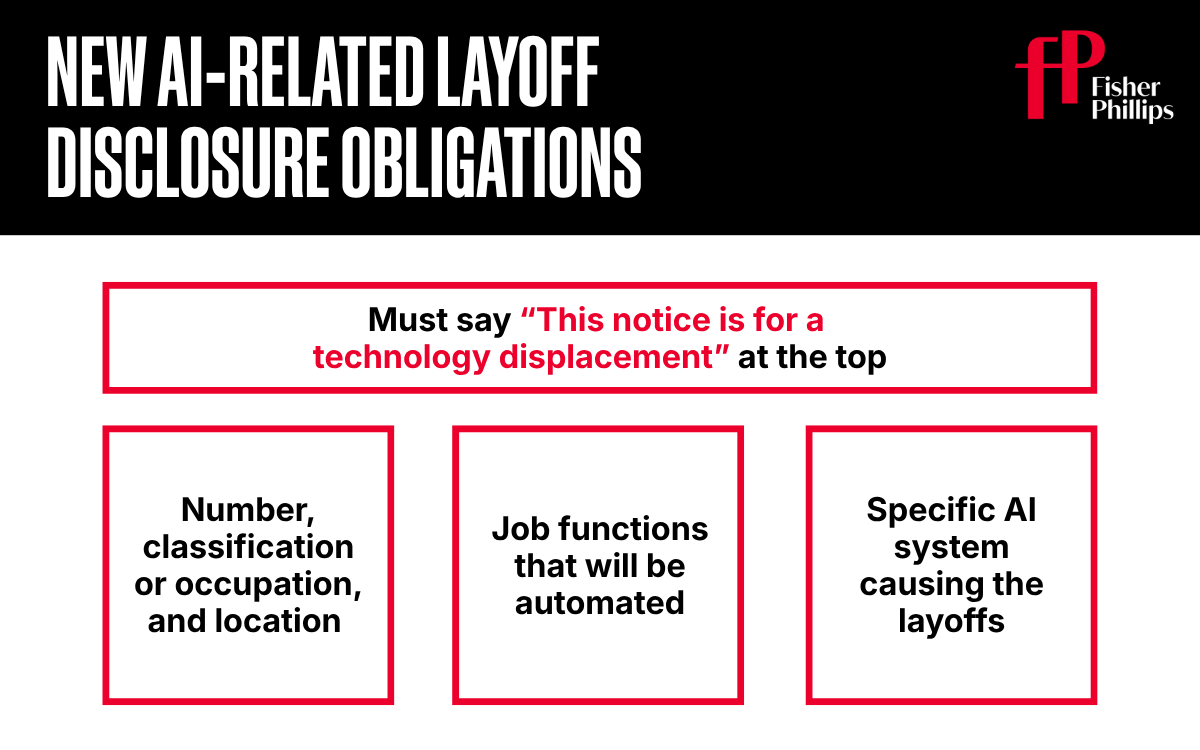
SB 951 adds an AI-related component to your notification obligations. Any mass layoff, relocation, or termination that is caused “in whole or in substantial part” by an AI system or other automated technology replacing or automating employment positions will require these additional four disclosures:
- The statement “This notice is for a technology displacement,” which has to appear at the top of the notice;
- The number, classification or occupation, and work location of the layoffs substantially due to replacement or automation by AI or other automated technology;
- The job functions performed by the replaced workers that will be automated; and
- The specific category or type of AI system or other automating technology that substantially resulted in the displacement.
The law also adds a definition of “artificial intelligence” to the WARN Act, covering any engineered or machine-based system that varies in its level of autonomy and can infer from its inputs how to generate outputs that influence physical or virtual environments. That is broad enough to capture a great deal of ordinary workforce software that you might not immediately think of as “AI.”
⚠️ Open Questions Might Trip Up Employers
The statute gives you no test for when a layoff is caused “in substantial part” by automation, and most real reductions in force have several causes at once. A company that consolidates a support function after deploying a new platform is making a decision driven partly by technology and partly by cost. Whether that crosses the line is a judgment call you will have to make in real time, under a 60-day clock, knowing that your answer becomes a public document.
It is also not entirely clear what the consequences are for getting the disclosure wrong, because the WARN Act’s back pay and civil penalty provisions were left untouched and cross-reference a different subdivision than the one this law creates.
Stay tuned for possible clean-up guidance to address these issues in the coming months. Sign up for the Fisher Phillips’ Insight System to make sure you get updated if and when we receive further clarity.
Your Notices Will Be Published
SB 951 directs the EDD to publish a summary of these notices on its website as part of its regular WARN Act data reporting, and to post a quarterly statewide summary of technology displacements. California already posts WARN notices publicly, but a searchable state-maintained tally of which employers are replacing which jobs with automation could generate heightened scrutiny from the public, unions, and plaintiffs’ attorneys.
5 Steps to Get Ready
You have a few months to prepare for this new law. Here are five steps we suggest:
1. Decide how you will characterize causation, and document it as you go. Capture the business case for any workforce reduction contemporaneously, including the non-technology drivers, rather than reconstructing it after a notice is challenged.
2. Rebuild your WARN notice template now. Add the four new elements and put the technology displacement statement at the top where the statute requires it.
3. Map your AI tools to the roles they touch. You cannot describe the category or type of system that caused a displacement if nobody has inventoried what is deployed and what work it absorbs. This overlaps with the inventory work other California AI laws already require.
4. Loop in legal, communications, and investor relations before the notice goes out. What you file becomes public and quotable. Make sure the description of the technology and the job functions being automated is consistent with what your company says elsewhere.
5. Watch the EDD study. The law separately directs the Employment Development Department to report to the Legislature by January 1, 2028, on how AI is affecting hiring across industries and occupations. That report may recommend a new notice requirement for employers that permanently stop hiring for a position because of automation, even when nobody is laid off. This is the second time in under two years that California has ordered itself to study AI-driven job loss, following the Governor’s executive order directing state agencies to do the same.
Conclusion
We will monitor developments related to SB 951 and provide updates as warranted, so make sure you are subscribed to Fisher Phillips’ Insight System to get the most up-to-date information directly to your inbox. If you have questions, contact your Fisher Phillips attorney, the authors of this Insight, or any attorney in our California offices or our AI, Data, and Analytics Practice Group.