In a flooded and ruthless job market, companies are relying on artificial intelligence to make decisions about who gets interviewed for positions and who gets rejected.
And the big losers in this brave new employment world are workers with decades of dedication and hard-earned wisdom.
These days companies are not only using AI technology to conduct job interviews, but also to vet applications and resumes en masse.
It’s all about making recruitment cheaper and more efficient. But what it means is algorithms are shutting out a generation of workers before they even get a look in.
Stacey Duguid went viral after posting her frustrations on social media.
The 52-year-old former fashion editor, who has worked for the likes of Harrods and Elle magazine, has struggled to get a job for the past 16 months after being made redundant.
“I have been woefully unemployed, having sent out a gazillion CVs,” Duguid told 60 Minutes.
“I have convinced myself that I have become unemployable.”
Duguid did the usual CV updates, perused LinkedIn and applied for a number of jobs she thought would be “a no-brainer”.
“I sent out tens of CVs, April, May, June, nothing, no response, [and] by Christmas, I’m a mess,” she said.
“One of my close girlfriends who works for a law firm in London said, ‘Send me your CV’.
“So I sent over my CV and she said, ‘Stacey, this is an old lady’s CV. You need to Botox it’. And I said, ‘What on earth do you mean I need to Botox my CV?’ And she said, ‘Take off your age. Take off all of your work experience. Only have the last seven years’. And I just said, ‘Shall I change my name to Steve while I’m at it?’”
After sharing her frustrations online, Duguid was astonished by the “thousands and thousands of messages” she received in response.
“Who knew that this pressure cooker, let’s call it, had been bubbling in so many women’s lives, silently in the background, just gently simmering away and suddenly, their lids blew too,” she said.
“I hit a nerve in a way I had never, ever imagined I could or would.”
Duguid boils it down to AI-influenced ageism.
Leah Lambart, a former recruiter-turned-career coach, agrees that age discrimination is rife, but insists AI is only doing the bidding of its masters.
“Ageism is still the elephant in the room,” Lambart told 60 Minutes.

Leah Lambart, a former recruiter-turned-career coach, agrees that age discrimination is rife, but insists AI is only doing the bidding of its masters. 60 Minutes
“Unfortunately, it’s often coming from the top, so whilst the recruiters are the ones writing the job ads and advertising, the brief comes from someone above.”
Lambart said it’s possible for companies to use AI to knock out candidates with too much experience if they’re trying to recruit younger employees.
Barb Hyman, who started her recruitment software company Sapia AI eight years ago, said she’s been trying to stamp out this ageism.
She said many employers have embraced AI to recruit new staff, without really knowing how it truly works, especially the risk of age discrimination.
“I suspect that if you went out and spoke to the market who are using these tools now that are discriminatory, they would be shocked, absolutely shocked,” Hyman told 60 Minutes.
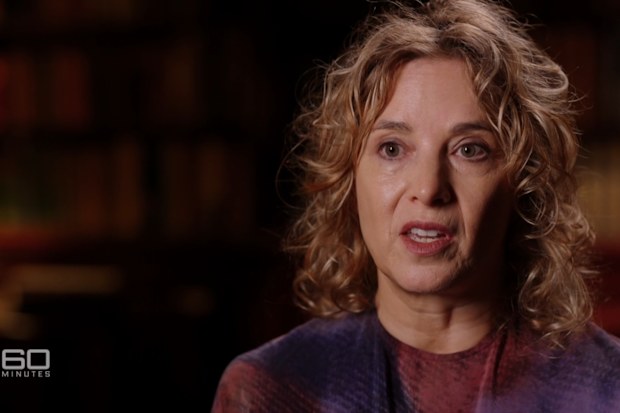
Barb Hyman said many employers have embraced AI to recruit new staff, without really knowing how it truly works. 60 Minutes
“I just don’t think they realise that it’s having this impact. I think that recruiters and companies are naively turning on features that create that bias without realising it.
“I don’t think there’s any malevolence in this. If they knew that that was going to be bias, they would never turn it on. Most of the market is completely naive to this reality.”
Hyman said people using these systems are not being adequately educated on how to best use them and nowhere near fast enough to keep up with the development of the technology.
Fighting back against AI and ageism
After Derek Mobley, 52, realised all of his rejection letters were coming from the same third-party software application, he contacted employment lawyer Rod Cooks.
Cooks is now leading a landmark lawsuit to test whether software companies are liable when AI’s algorithms discriminate against people applying for a job.
“For the age portion, we have 15,000 people that we’re currently representing. That just started with one guy, Mr Mobley,” Cooks told 60 Minutes.
“Where there’s smoke, there’s fire. One or two, you could say, ‘Pfft’, but if you’ve got 15,000 people singing out of the same hymn book, then there’s something there.”
Cooks says they’re hoping that by taking action now, tech firms will take notice.
“We’re trying to ensure going forward that these companies and whoever’s using this technology uses it in a fair and equitable manner and that we don’t run into any more Mr Mobleys two years from now, three years from now, five years from now, that they get the message and they clean up their house,” he said.
Watch the full story in the player above.