How Are Businesses in South Carolina Using AI?
By Lainey Stalnaker, Data Analytics Writer
As artificial intelligence (AI) tools become more advanced and more widely available, they will likely spur changes in the labor market. We can’t predict exactly what those changes will be, but we can identify current business attitudes towards AI. Using the Census Bureau’s Business Trends and Outlook Survey (BTOS), conducted between November 2025 and February 2026, we can answer questions such as:
- How common is AI use?
- Which sectors are most likely to use AI?
- For what purposes are businesses using AI, including generative AI?
- Are businesses using AI to replace workers?
- What barriers are preventing businesses from using AI?
The BTOS does have some limitations. Survey responses reflect firm-reported worker behavior; i.e., AI use that has been authorized by the employer. We cannot know for sure how workers are actually using AI—they may be disregarding directives to use AI tools for particular business functions, or they may be using AI tools that have not been approved by their employer. Despite these qualifications, the BTOS still provides valuable insight into employer perceptions of AI.
Which businesses are using AI?
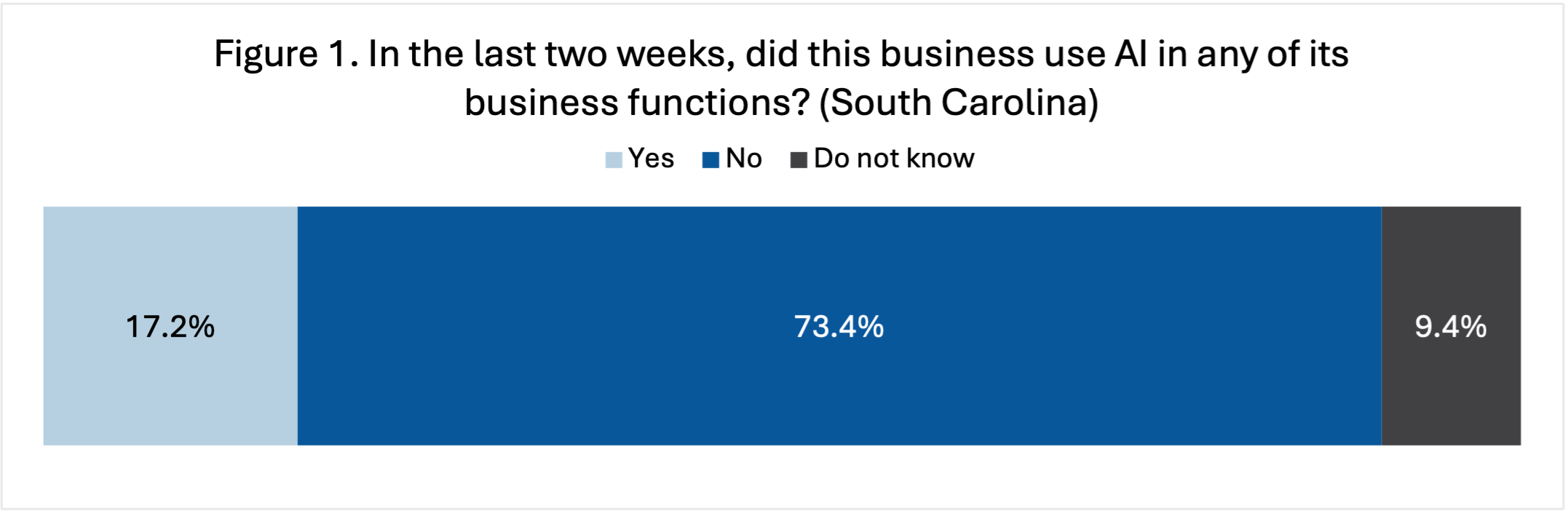
Most businesses—across the country and in South Carolina—are not using AI in any of their business functions. In South Carolina, just 17.2 percent of BTOS respondents said that they had used AI in the last two weeks, which is on par with the U.S. percentage of 17.9. A total of 73.4 percent of SC businesses said they had not used AI, and 9.4 percent responded with, “Do not know.”
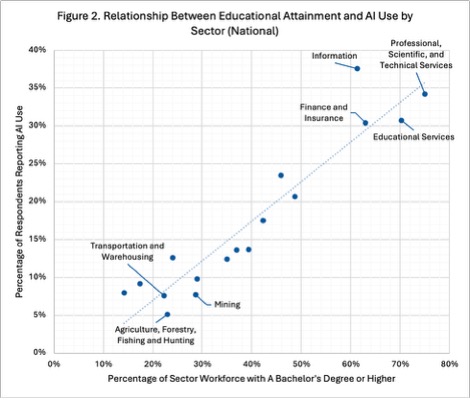
Nationally, the sectors in which businesses were most likely to have used AI in the last two weeks were:
- Information (37.6%)
- Professional, Scientific, and Technical Services (34.2%)
- Educational Services (30.7%)
- Finance and Insurance (30.4%)
- Real Estate and Rental and Leasing (23.5%)
The survey shows major variation in AI use across sectors. The sectors where businesses were most likely to use AI were also most likely to employ workers with at least a bachelor’s degree, while workers in sectors that used AI less frequently typically had lower educational attainment. The relationship between these two variables is shown in Figure 2. High-use sectors encompassed industries such as legal services, accounting, banking, advertising, publishing, and film production, among others. The sectors that were least likely to use AI were Agriculture, Forestry, Fishing, and Hunting (5.1%); Transportation and Warehousing (7.6%); and Mining (7.7%).
What are businesses using AI to do?
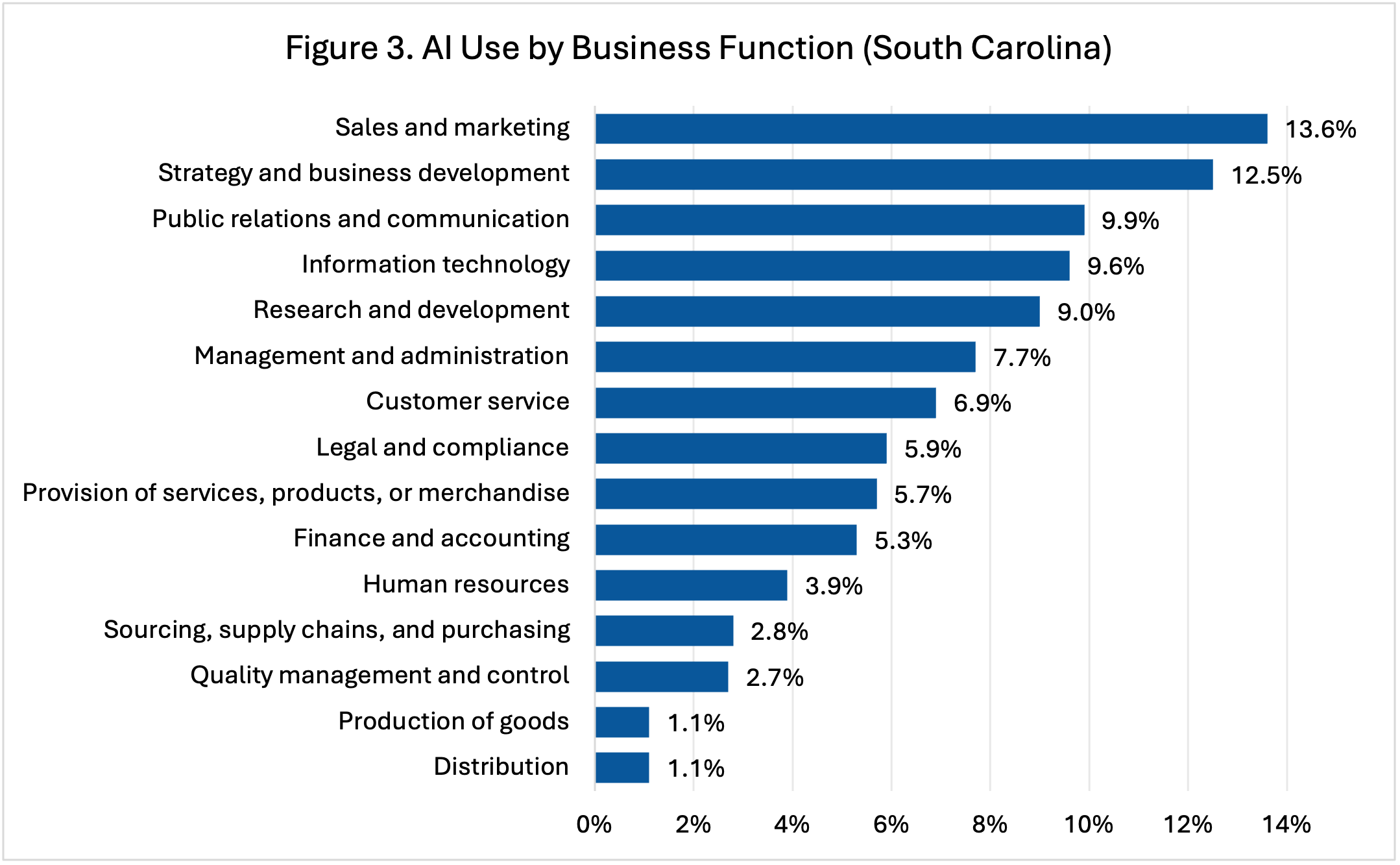
Sales and marketing were the most common functions that businesses used AI for. About 13.6 percent of all South Carolina businesses used some form of AI for sales and marketing. 12.5 percent used it for strategy and business development, and 9.9 percent used it for public relations and communications.
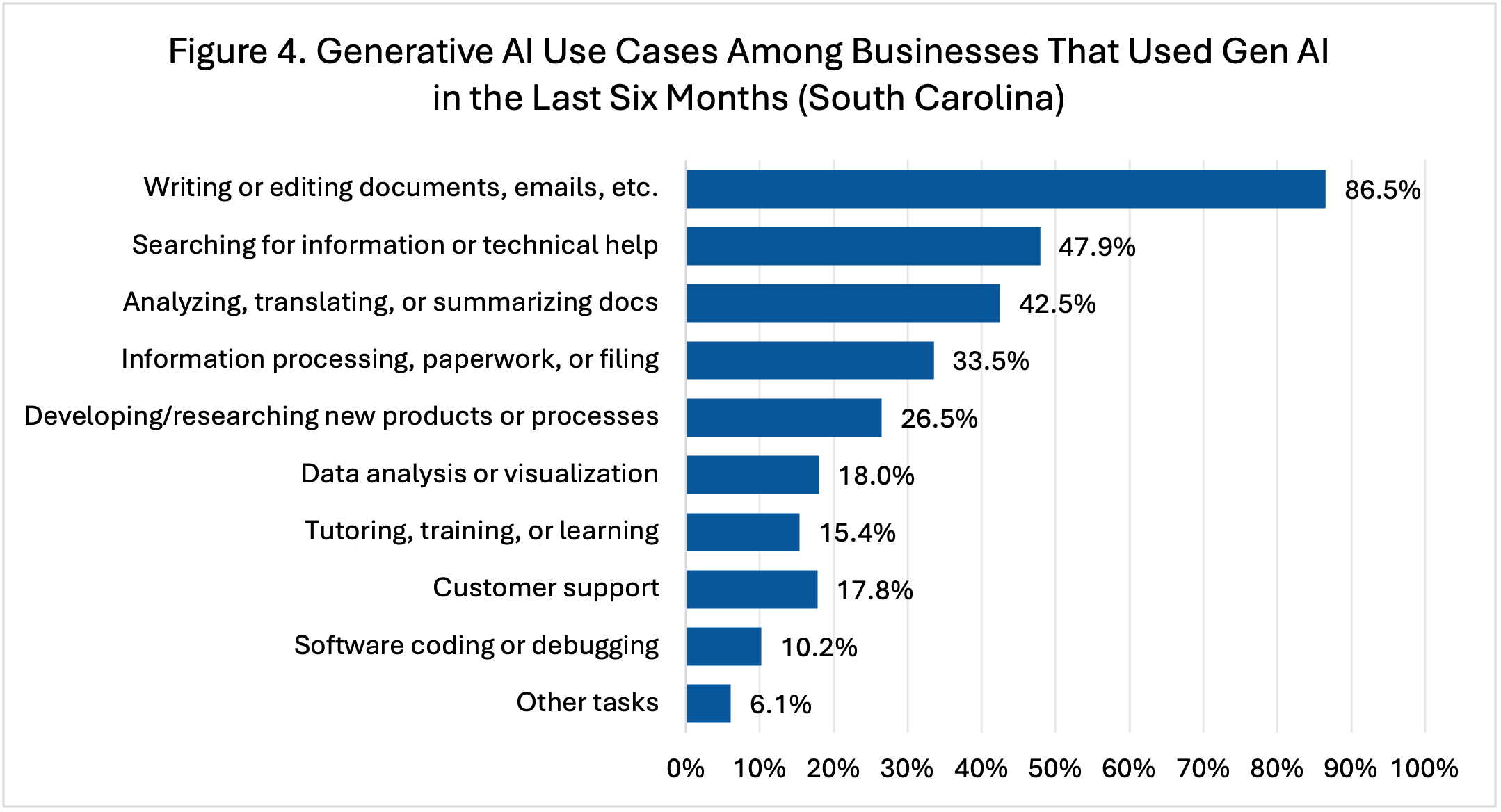
Additionally, 19.7 percent of businesses in South Carolina used one of the most popular types of AI tools—generative AI (e.g., ChatGPT, Gemini, Copilot, Claude, etc.)—in their business functions. Among those businesses, writing and editing were the most common use cases. According to the study, 86.5 percent of businesses who used generative AI used it for this purpose. This includes writing and editing documents, emails, and other communications. About 47.9 percent also used generative AI to search for information or technical help, and 42.5 percent used it to analyze, translate, or summarize documents.
Is AI Replacing Workers?
It doesn’t appear that businesses are currently making major staffing decisions based on access to AI tools. Among businesses that reported using AI, 96.3 percent said that the use of AI had had no effect on their total employment. AI was also more likely to take over tasks done by software than those performed by employees. 14.8 percent of AI-using businesses said that, in the last six months, AI had performed operations previously done by existing software. In comparison, just 8.3 percent said it had performed a task done by an employee. Within this group, 85.3 percent said only “a small number” of tasks previously done by employees were instead performed by AI.
The Future of AI Use
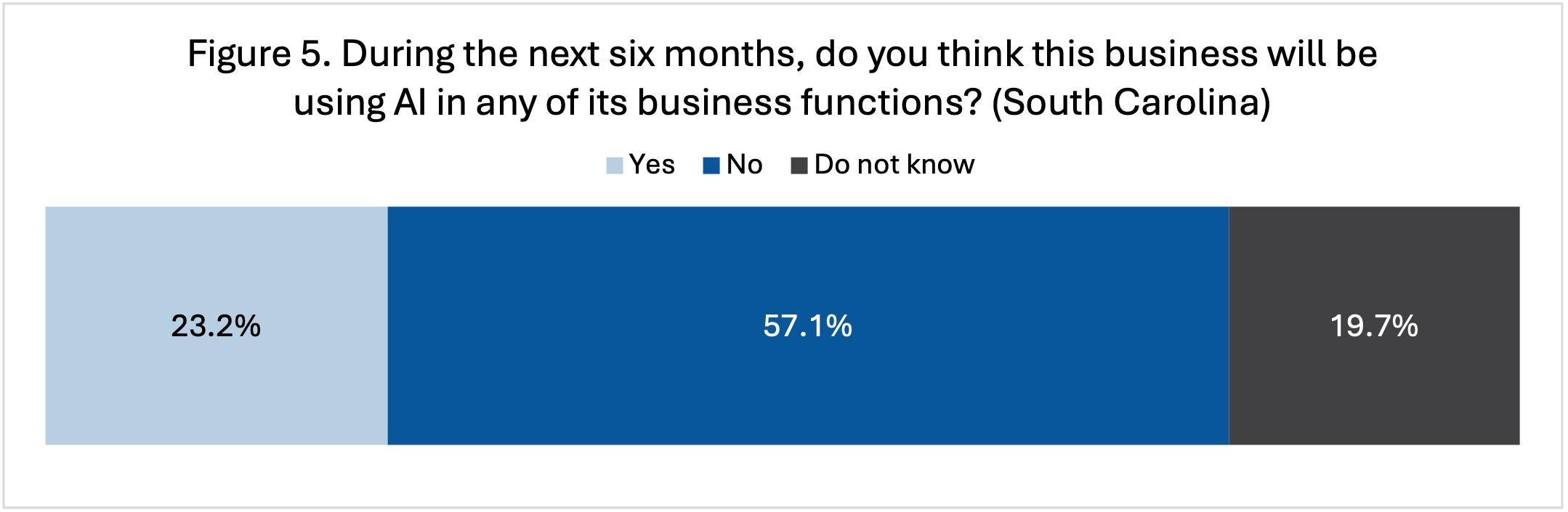
When respondents were asked about later AI adoption, slightly more businesses reported future plans to use AI than current use of AI (23.2% vs. 17.2%); however, most businesses still had no plans to use it.
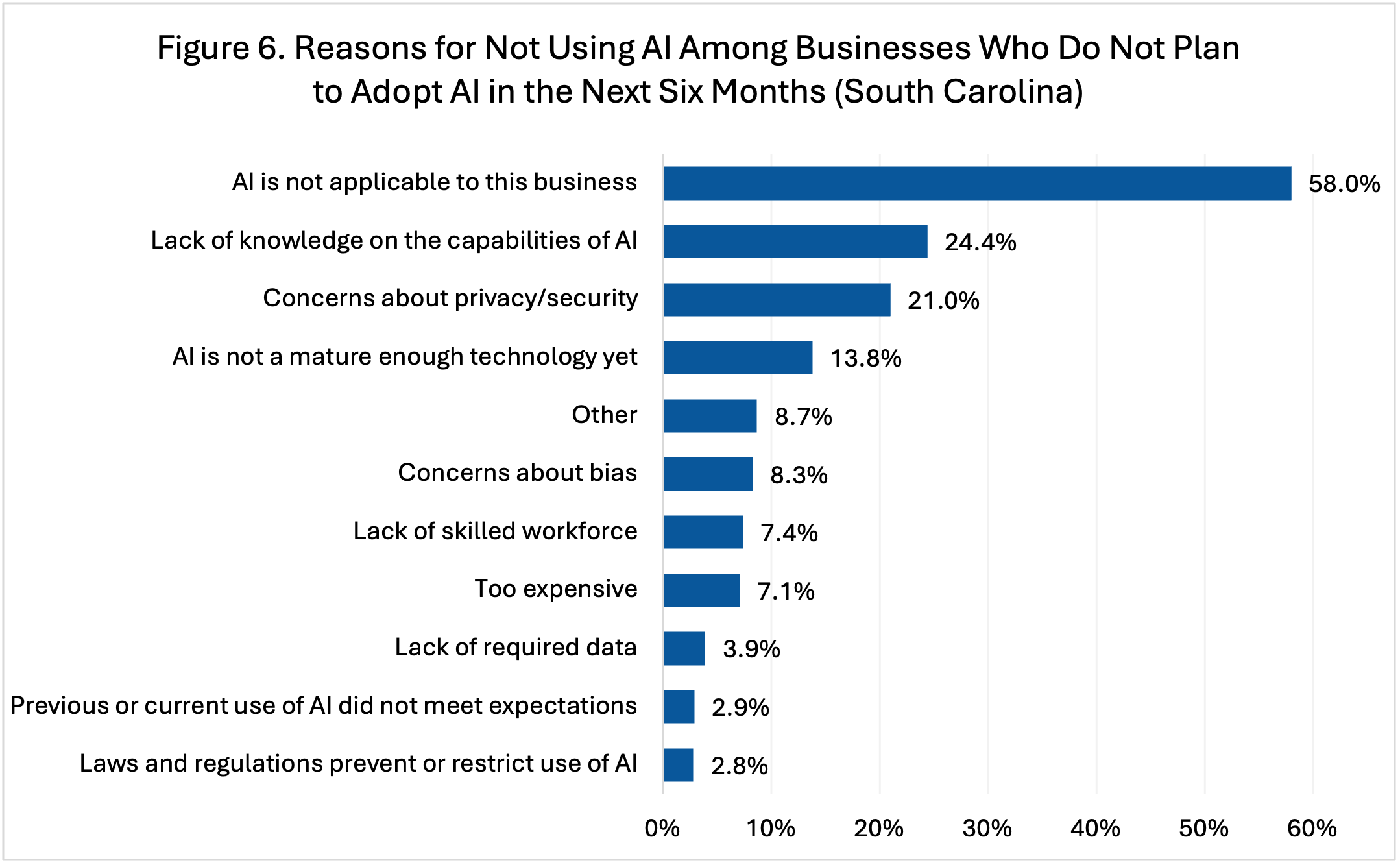
Of the businesses surveyed, 57.1 percent said they did not plan to use AI for any business functions in the next six months. When asked why, more than half said that AI was not applicable to their business. Additionally, 24.4 percent of respondents pointed to a lack of knowledge on the capabilities of AI while 21.0 percent had concerns about privacy. Limitations such as laws and regulations restricting AI use, high costs, lack of required data, and lack of a skilled workforce were less frequently cited as reasons for not adopting AI.
Key Takeaways
Overall, use of AI varies across sectors and by business function. Most businesses in South Carolina aren’t using AI at all. Sales, marketing, and communications are some of the most common functions, but for most businesses, AI tools serve mainly as a supplement to work done by employees rather than a replacement. Business attitudes toward AI may change in the future, but for now, most have no plans to use AI for any of their business activities.
-
https://www.census.gov/data/experimental-data-products/business-trends-and-outlook-survey.html
-
Estimates of educational attainment by sector were calculated using CPS microdata. https://www.census.gov/data/datasets/time-series/demo/cps/cps-basic.2025.html#list-tab-1979780401